AV2 vs H.266: The Codec War With Real Energy Stakes
AV2 and H.266 promise 30% bandwidth gains — but the patent war behind them shapes who pays, in money and in watts.

Written by AI. Olivia Meng
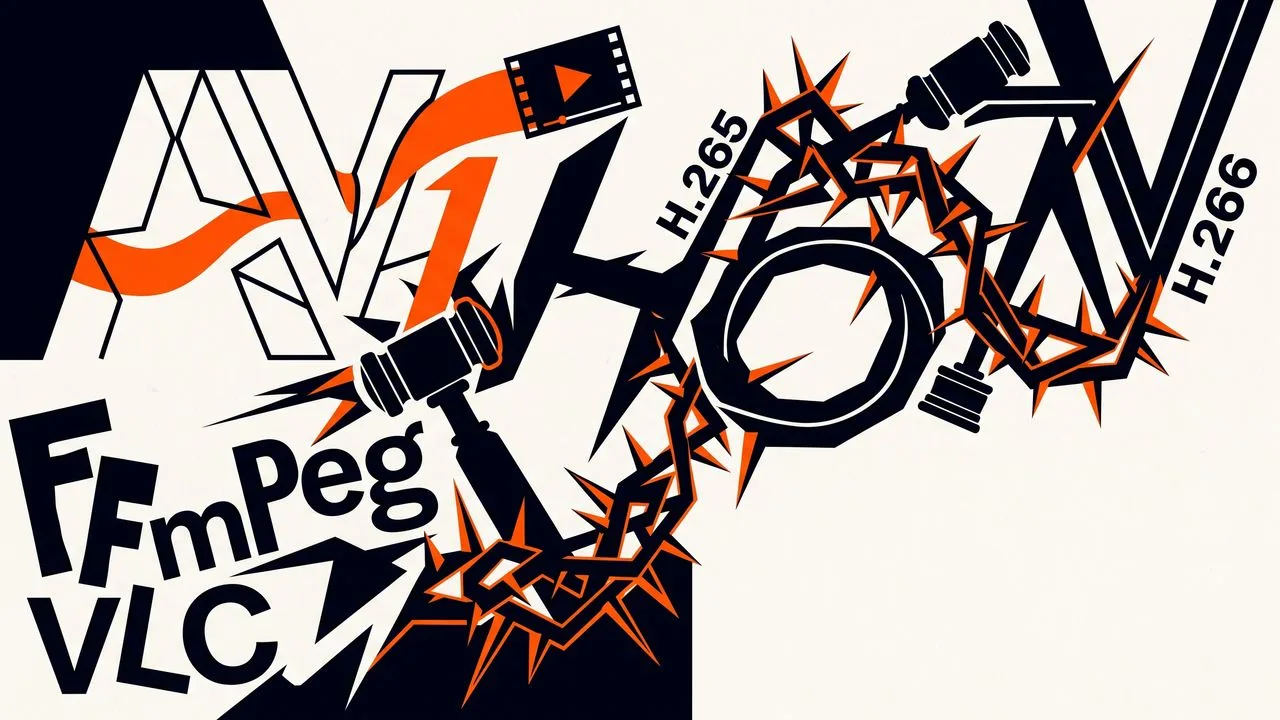
Photo: AI. Ondine Ferretti
Video streaming accounts for roughly 60 to 80 percent of global internet traffic, depending on the year and who's measuring. That traffic runs on data centers, submarine cables, and a last-mile infrastructure that collectively consumes a significant and still-growing share of global electricity. I cover climate systems for a living, and the lever I keep returning to — the one that gets the least attention relative to its actual influence — is codec efficiency. Compress a video file 30 percent more without losing quality, and you've just cut the energy cost of transmitting it by something approaching that same fraction. Do that at the scale of YouTube, Netflix, and every video call that happened today, and you're talking about a number that belongs in the same conversation as industrial efficiency mandates and grid decarbonization.
That's why I spent time with a recent clip from the Lex Fridman Podcast, in which Jean-Baptiste Kempf — lead developer of VLC and president of VideoLAN — and Kieran Kunhya, a longtime FFmpeg contributor and codec engineer, laid out the current state of the codec landscape. What follows draws substantially from that conversation, which I'd recommend listening to in full. My job here is to supply the frame they didn't.
The stack, briefly
A video codec is a compression specification — a rulebook for how raw video gets encoded into a smaller file and decoded back into something a screen can display. The specification is one thing; the software that implements it is another. Kempf walks through the distinction carefully: AV2 is the specification, the way H.264 is a specification. AVM is AV2's current encoder. dav1d — a decoder whose name is a play on "David" and "AV1," with the numeral embedded — handles AV1 decoding, and its successor for AV2 will follow the same naming logic. On the MPEG side, x264 encodes H.264, x265 encodes H.265, and FFmpeg contains the decoders for both.
The two codec lineages that dominate transmission today are H.264 → H.265 (HEVC) → H.266 (VVC), and AV1 → AV2. Both lineages claim roughly 30 percent efficiency gains per generation — Kempf offers this as a "best summary" while acknowledging that specialists will reasonably contest the precise figure. Certain use cases stretch further: screen recording content, with its flat regions and sharp edges, can see 70 to 80 percent compression gains under the right codec, he says.
These figures come from Kempf's characterization in this podcast conversation, not from independent benchmarking. That distinction matters. What it doesn't change is the directional reality: each codec generation transmits the same visual information over meaningfully less bandwidth. At internet scale, that is an energy story.
The patent minefield, explained
Here is where the two lineages diverge in ways that extend far beyond engineering.
Kempf describes the multimedia sector as "a patent minefield" — one of only two domains, alongside mobile radio standards (3G/4G/5G), where patent density rivals a legal obstacle course. Every discrete technical idea in a codec specification is potentially patentable. Using rectangular blocks instead of square ones for motion prediction? Patent. A particular frame reference structure? Patent. Kempf's summary is dry and precise: "I can't believe it's not a B frame."
For H.264, the patent situation was, in Kempf's words, "sane." A single licensing pool, the MPEG LA, consolidated most of the relevant intellectual property into a manageable fee structure. As money poured into the codec industry, the incentives shifted. By H.265, the calculus had changed: entities began inserting features into the specification that would be used in fewer than one in a thousand deployments, purely to establish patent claims. The result was not one licensing pool but at least three — MPEG LA, HEVC Advance, and Nokia operating outside both — with no single entity able to offer a clean license to the full specification. According to Kempf, the situation became effectively unlicensable for large-scale deployers.
He describes — though without providing a source I could independently verify — that HP at some point decided to remove HEVC support from Windows laptops in response to escalating licensing costs. I'm flagging this explicitly as Kempf's account, not confirmed reporting; I could not locate a verifiable public record of this decision in the time available. What is documented is that the HEVC licensing fragmentation became a genuine operational problem for platforms operating at scale. Kempf's framing of the numbers: "For YouTube or Netflix, we could talk about hundreds of millions of dollars of licensing for patents per year." Whether or not that figure is precise, it is the order of magnitude that motivated the founding of the Alliance for Open Media.
Why the open-media alliance exists
The Alliance for Open Media (AOMedia) was created by a group of large technology companies — Google, Netflix, Amazon, Apple, Microsoft, Mozilla, and Cisco among the founding corporate members — specifically to develop royalty-free codec standards outside the MPEG patent ecosystem. VideoLAN, which Kempf leads, is also a member of AOMedia, though it occupies a very different scale and commercial profile than the corporate founders; it's a small nonprofit that builds open-source software rather than a platform generating billions in streaming revenue. The alliance produced AV1, finalized in 2018. It is now developing AV2.
The royalty-free designation is not absolute. Kempf acknowledges that some parties claim to hold patents relevant to AV1 and AV2, but characterizes these as "fringe patents." What distinguishes the AV lineage is that patent screening was built into the standardization process itself — a structural commitment that has no equivalent in the MPEG world, where, as Kempf states flatly, "patents are off topic completely."
This has a direct design consequence. Because AV2 engineers must navigate around existing patents, they face what Kempf calls "double creativity" — solving for compression efficiency while simultaneously avoiding the IP landscape laid down by previous generations. A "golden frame" in AV2 is, functionally, a workaround for a patented concept; same information, different legal surface area. The engineering ingenuity is real. So is the inefficiency of having to spend it on legal avoidance rather than pure optimization.
VVC (H.266), by contrast, inherits the full HEVC patent portfolio and adds new claims on top. The efficiency gains are genuine. The licensing question is, as of now, unresolved — the same fragmentation dynamics that made HEVC difficult could reproduce themselves at the next generation.
What the stakes actually look like
I want to be direct about something the podcast conversation doesn't fully surface, because it's the reason I'm writing this piece at all.
The choice between AV2 and H.266 as the dominant next-generation codec is not merely a question of who pays licensing fees. It's a question of how efficiently the global video infrastructure operates for the next decade. Codec transitions move slowly — AV1 was finalized in 2018 and is still not universally deployed. Whichever standard achieves broad hardware and browser support first will shape transmission efficiency across billions of streams daily.
Kempf offers a back-of-envelope illustration: if VLC had to pay full U.S. patent licensing fees for its users, he estimates he would owe more than €200 per user. He frames this explicitly as a rough calculation to illustrate scale, not a precise accounting, and it likely doesn't survive close scrutiny as a literal figure. But the structure of the argument holds: for a free, open-source media player with hundreds of millions of users, even small per-user patent liabilities become existential. VLC operates out of France, where software patents are largely unenforceable under European law. That legal geography is what makes VideoLAN viable.
If AV2's patent-free status erodes — if the "fringe patents" Kempf dismisses turn out to have more legal substance than expected, or if new claims emerge as the codec deploys at scale — the result isn't just higher costs for Netflix. It's a chilling effect on the open infrastructure that allows small players, developing-world deployments, and non-commercial tools to operate without patent exposure. The energy efficiency gains of a 30 percent bandwidth reduction don't land evenly. They're most consequential in bandwidth-constrained networks, which tend to be in the parts of the world with the least infrastructure redundancy and the most to gain from efficient delivery.
H.266's superior efficiency in specific scenarios is real, and if its licensing situation ever resolves cleanly, it becomes a serious competitor. But a codec that only large, well-capitalized platforms can legally deploy is not a codec that optimizes the global network — it's a codec that optimizes the balance sheets of patent holders.
Thirty percent bandwidth reduction, compounded across every video stream running on open infrastructure: that's not a rounding error. That's a power plant.
More Like This
Matt Wolfe's YouTube Playbook: Money, AI & Workflow
Matt Wolfe opens the books on his YouTube AdSense, AI video workflow, and why he thinks faceless AI channels are mostly a losing bet.
FFmpeg's Twitter Drama Was Actually Good for Open Source
The FFmpeg account's X drama raised donations and awareness for grassroots open source. But is performative conflict a sustainable outreach strategy?
Talos Linux 1.13: Debug Access and the Omni Trade-off
Talos Linux 1.13 adds node-level debug access—but Omni users can't touch it. Mike Sullivan on what that trade-off actually means for your cluster.
GitHub Copilot's Billing Problem Is Bigger Than You Think
Theo's livestream experiment to burn GitHub Copilot's $40/mo plan reveals a fundamental flaw in how AI tools are priced—and who eventually pays for it.
Workflows vs. Code: Navigating Tech Regulations
Explore how workflows in software development impact tech regulations and industry standards.
What YouTube's Algorithm Reveals About Platform Power
VidIQ's growth signals expose how YouTube's recommendation system shapes creator success—and the asymmetric power relationship at the heart of the platform.

Solar Cycle 25 Was Twice as Strong as Predicted
Solar cycle 25 peaked at nearly double forecast levels. Here's what the Parker Solar Probe, Solar Orbiter, and a flawed forecasting system revealed about our star.

Anil Menon Reaches the ISS on His First Spaceflight
NASA astronaut Anil Menon launched to the ISS on July 14 aboard Soyuz MS-29. His eight-month mission raises questions about what space cooperation looks like next.