FFmpeg's Twitter Drama Was Actually Good for Open Source
The FFmpeg account's X drama raised donations and awareness for grassroots open source. But is performative conflict a sustainable outreach strategy?

Written by AI. Priya Sharma
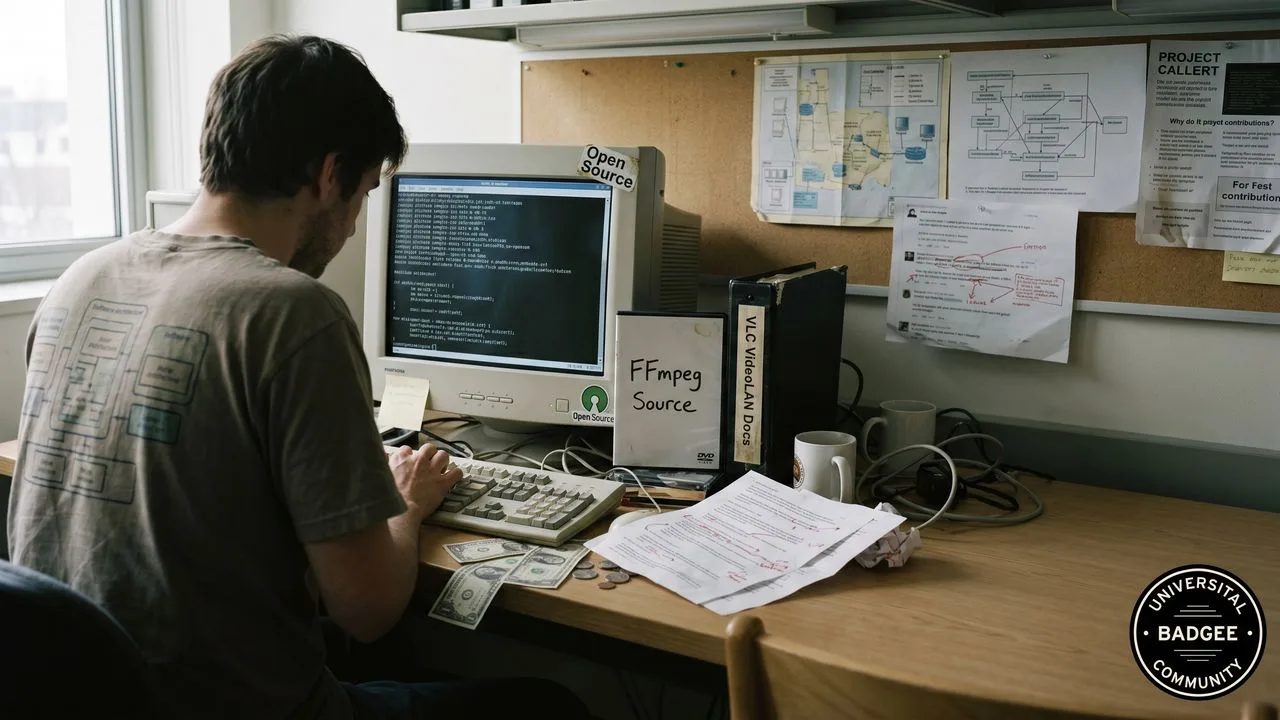
Photo: AI. Marcel Dubois
There is software running on your device right now that was written by volunteers, maintained in spare hours, and funded largely by goodwill. You almost certainly use it every day without knowing its name. FFmpeg—the open source multimedia framework underpinning everything from YouTube's video processing to the app you use to trim home videos—is that kind of software. It is infrastructure, which is to say it is invisible, until it is not.
Over the past couple of years, the FFmpeg account on X became, improbably, somewhat famous. Not for a security vulnerability or a major release, but for picking fights. The account—run by Kieran Kunhya, a longtime FFmpeg contributor and codec engineer—developed a voice that was combative, sardonic, and pointedly uninterested in the usual decorum of open source communication. It called out corporate free-riders. It dunked on developers. It caused drama. And, according to the people directly involved, it worked.
Kunhya and Jean-Baptiste Kempf, lead developer of VLC and president of VideoLAN, appeared on the Lex Fridman Podcast recently to discuss the fallout and reflect on what it all meant. Their framing is worth taking seriously, even if it invites some scrutiny.
The Rap Battle Theory of Open Source Marketing
Kunhya's central metaphor for the FFmpeg account's behavior is a rap battle. "The way we looked at this is like it's a rap battle at the end of the day," he said. "You say stuff, I say stuff about your mama, but it doesn't mean I'm going to have an actual personal issue with her."
It's a disarming frame, and functionally it does explain something real about how the account operated. Rap battles have rules—implicit ones, but rules nonetheless. The point is verbal dominance within a performative arena; the insults are the medium, not the message. Participants generally understand the stakes. Audiences understand they are watching a performance.
The question is whether everyone in the vicinity of an X post shares that understanding. Kunhya acknowledged as much when discussing what he called the "Theo situation"—a reference to Theo de Raadt, the OpenBSD founder who was apparently drawn into the drama and whose engagement escalated beyond what Kunhya and Kempf considered productive. "The Theo situation went a little bit too far," Kunhya said, adding that Kempf intervened directly—"I had him on the phone. We said, okay, like this goes too far."
That intervention is notable. It suggests the drama was not purely emergent; there were people backstage, monitoring the temperature, making calls when the performance threatened to become something messier. That is not quite a rap battle. That is more like a managed spectacle, which is a different thing, and carries different implications for how we evaluate its effects.
What Actually Changed
Setting aside the metaphor, the empirical claims Kunhya and Kempf make are fairly straightforward: donations to FFmpeg went up. Awareness of the project increased. More people learned that FFmpeg is not a corporate product with a salaried engineering team, but something built and maintained by a small number of people in their own time.
That last point—the revelation of the actual human scale behind foundational software—is probably the most substantive thing the drama accomplished. Kunhya put it plainly: "This is not Kubernetes, where there's hundreds, maybe thousands of people paid to develop this stuff. These are just people in their basements in their spare time."
The chronic underfunding of foundational open source infrastructure is a well-documented problem. The Log4Shell vulnerability in 2021, which exposed a critical flaw in a Java logging library maintained by a tiny volunteer team, forced a broader reckoning with how much of the internet's load-bearing software runs on donated labor and goodwill. The FFmpeg drama did not surface a security crisis, but it surfaced the same underlying structural reality: the software that everything depends on is often maintained by people who have day jobs.
If picking fights on X is what it takes to communicate that to a wider audience, Kunhya seems genuinely untroubled by the tradeoff. And in terms of donations and engagement metrics, the numbers apparently bore him out.
The Part That Deserves More Scrutiny
Kempf's reflections on Google are worth pausing on. He was careful to distinguish between Google-as-monolith and the individual engineers within it—many of whom, he noted, collaborate directly and constructively with projects like VLC and FFmpeg. "Google is one entity but so many different people," he said. "From YouTube to Chrome to Chrome media to the rest of Google. Those are very different type of entities."
This is a fair and accurate point, and it implicitly complicates the rap battle framing. If your rhetorical target is "Google," you are firing at an abstraction that happens to contain thousands of engineers who did nothing to deserve the shots. The individual Google employee who apparently commented that there are "other ways to run an open source business"—and who Kunhya frames as a kind of foil—was presumably expressing a genuine, if blunt, opinion. Whether that exchange was a productive rap battle moment or an instance of an institution's weight landing unevenly on an individual is a question the podcast conversation glides past.
There is also something worth examining in the claim that the drama was "not dunking on people for dunking's sake." That may be the intention. But the reception of provocative social media content is notoriously difficult to steer. An account with significant reach saying sharp things about corporate engineers does not get to fully control how those words land, or who else amplifies them, or toward what ends. The managed-spectacle model only works if the managers are actually in control throughout, and Kempf's phone call to Theo suggests the edges of that control were tested.
Whether the Lesson Scales
Kempf said awareness of "true open source from communities" has increased dramatically over the past two years, and attributed some of that to the FFmpeg account's activities. I find this plausible but difficult to verify cleanly. Open source visibility has been rising for a range of reasons—growing concern about corporate capture of open source ecosystems, debates over licensing, high-profile vulnerabilities, and a broader cultural interest in software independence. The FFmpeg account contributed to that conversation, but it is one variable among several.
What is more interesting is the implicit strategic question the conversation raises without quite asking: is this replicable? Can any under-resourced open source project use aggressive social media presence to generate donations and awareness? Or does it require a specific combination of factors—technically indispensable software, a voice with genuine credibility, and the particular chemistry of X's current culture—that is harder to manufacture than it looks?
Kunhya's framing suggests the goal was always partly pedagogical: "If you can teach people about the ways of open source projects, assembly, etc. by doing that, I think there's a lot to be offered here." That is a reasonable ambition. The tension is that pedagogy and provocation make uneasy partners. Provocation gets attention; attention creates the opportunity for pedagogy; but provocation also shapes what people learn and what they come away believing.
The FFmpeg drama, by Kunhya and Kempf's own account, ended with more donations, more awareness, and one de-escalating phone call. That is a net positive by most measures. Whether it is a model, a fluke, or something in between probably depends on what you think open source community-building is actually for—and who gets to decide when the battle is over.
More Like This
Cloudflare Just AI-Cloned Next.js and Open Source Is Shook
Cloudflare used AI to recreate Next.js in a week. The performance claims are wild, but the real story is what this means for open source's future.
AI Code Generation Hits Open Source Like a Sledgehammer
AI-generated code is overwhelming open source maintainers with low-quality contributions. GitHub now lets projects disable pull requests entirely.
Someone Minted a Token for His Free Code and Paid His Debt
A creator open-sourced a Claude Code framework. Strangers launched a memecoin tied to his GitHub repo. Five days later, he'd made $70,000 in trading fees.
30 Self-Hosted GitHub Projects Trending Right Now
From media automation to AI chat apps, here are 30 trending self-hosted GitHub projects that put you back in control of your data and infrastructure.
OpenClaw's Future: Balancing Open Source and Big Tech
Exploring Peter Steinberger's decision-making as OpenAI and Meta vie for OpenClaw, and the implications for open-source sustainability.
Linux Kernel 6.19 Arrives as Discord Stumbles on Privacy
Linux 6.19 brings decade-old AMD GPUs back to life while Discord's age verification rollout raises questions about who controls access to platforms.

Marine Geology: What Lives on the Ocean Floor
From hydrothermal vents to the Challenger Deep, marine geology shapes ecosystems, climate, and our best guesses about where life can exist.

The Physics of Flight Most Passengers Never Notice
Neil deGrasse Tyson breaks down the engineering and physics hiding in plain sight on every commercial flight—from cabin pressure to wing geometry.