How Humidity Makes Extreme Heat Deadly
Wet bulb temperature, not air temperature, determines when heat kills. Joe Hanson's lab experiment reveals what our bodies face in a hotter, more humid world.

Written by AI. Olivia Meng
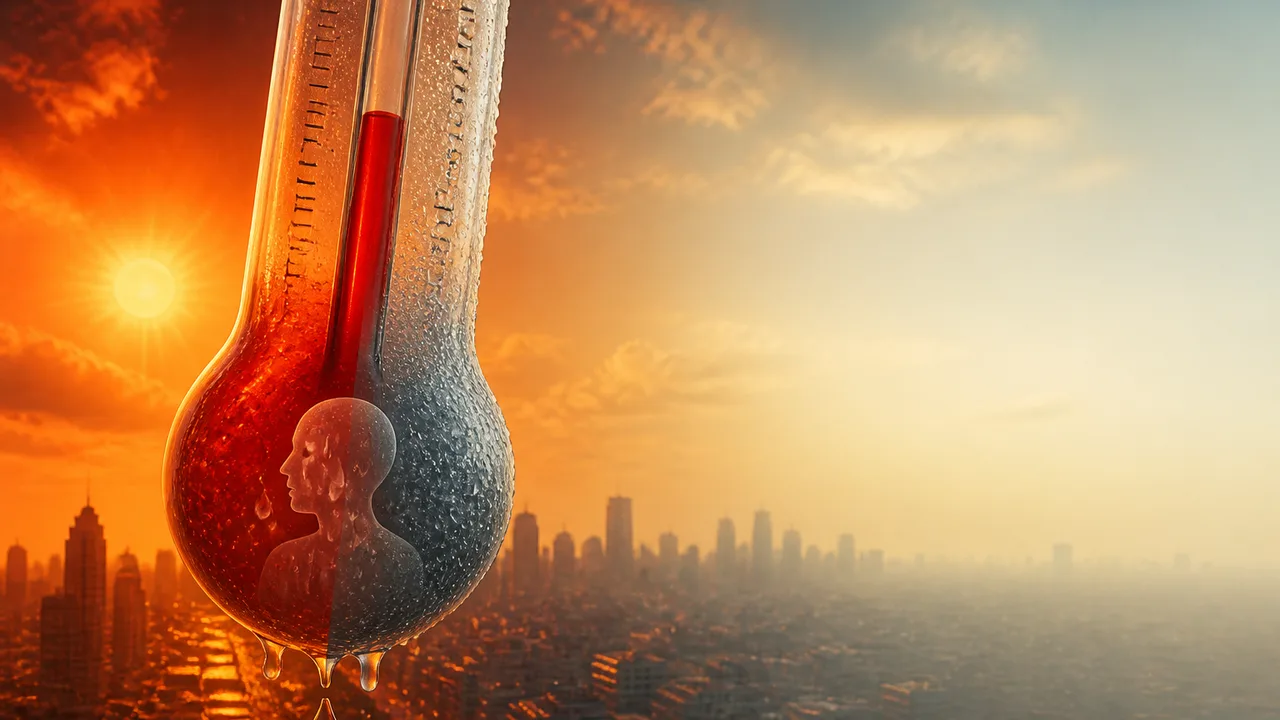
Photo: AI. Castor Belov
The number on a thermometer tells you surprisingly little about whether the heat outside will kill you. That gap between the temperature we report and the danger we actually face sits at the center of a new video from Joe Hanson of Be Smart, who strapped himself to a stationary bike inside a climate and sports research lab to demonstrate — with considerable personal discomfort — what extreme heat and humidity actually do to the human body.
The lab has a specific origin story. NFL offensive lineman Korey Stringer died of heat stroke in 2001 after practicing in full pads in conditions where the heat index hit 110°F. His body temperature had climbed to 108°F before trainers understood what was happening. His survivors founded the institute where Hanson ran his experiment, and that institutional history gives the video's science a grounding that goes beyond the theatrical. This is research born from a preventable death.
The Metric We've Been Ignoring
The concept that anchors Hanson's video — and that deserves wider public literacy — is wet bulb temperature. Unlike standard air temperature, wet bulb temperature accounts for humidity, and that accounting changes everything. When humidity is low, sweat evaporates readily, carrying heat away from the body with it. When humidity climbs, the air is already saturated with water vapor, and evaporation slows or stops entirely. The body keeps producing sweat; the sweat just sits there.
For years, the physiological threshold of danger was set at 35°C wet bulb (95°F at 100% humidity) — beyond which, the thinking went, the human body's cooling system would fail. Then the Penn State HEAT Project revised that estimate significantly downward. Published research from that project found that with sufficient humidity, the body begins to lose its ability to cool at wet bulb temperatures as low as 79 to 88°F. The implications are not subtle: on an 80°F day at 80% humidity, even a young, healthy adult could develop fatal heat stroke within six hours of sustained activity.
Hanson tested this himself. At 100°F with 60% humidity — a wet bulb temperature of about 99.5°F — he was losing sweat at three liters per hour. His heart rate approached its absolute maximum. His core temperature edged toward the threshold at which the research team would have pulled the plug to prevent organ damage. He lost more than a kilogram of net body weight in water during the session alone. And the critical observation he makes: he is well-acclimatized, living and exercising actively in Texas. Someone arriving from a cooler climate would have fared worse.
What the Body Is Actually Doing
Hanson's explanation of the physiology is clean enough to be worth restating. When muscles contract, roughly 80% of the energy output from that contraction is released as heat — not work, heat. The body routes warm blood toward the skin, activates sweat glands, and relies on evaporation to carry that heat away. It is an elegant system, optimized over roughly two million years of human evolution on open savannahs. We carry up to five million sweat glands, more per unit of skin than any other mammal. We can produce up to 12 liters of sweat on a hot day — more than five times the maximum sweating rate of a chimpanzee. The loss of body hair that sometimes puzzles people as an evolutionary choice was, in this framing, a straightforward heat-management upgrade.
The system works — until the air itself is too saturated to accept any more water vapor. At that point, the body keeps sweating in what Hanson accurately calls a "futile effort to cool off." Blood thickens as fluid volume drops. The heart works harder to circulate it. Electrolyte loss disrupts the electrical signals governing muscle contractions, including the one in the chest. The cascade from heat exhaustion to heat stroke — headaches, cramps, confusion, delirium, organ failure — is not a slow process. It can move within hours.
A researcher at the Korey Stringer Institute described heat as among the leading causes of sudden death in sport. That framing sits alongside cardiac events, trauma, and a short list of other acute risks, which together account for the vast majority of athletic fatalities. The point, stated plainly: heat is not a marginal risk for outdoor athletes, soldiers, or laborers. It is a central one.
The Acclimatization Caveat
There is meaningful good news embedded in the physiology. Acclimatization is real, it is measurable, and it happens faster than most people expect. One to two weeks of careful, graduated heat exposure can produce genuine adaptations: blood plasma volume increases by 10 to 25%, giving the body more fluid to lose before reaching critical thresholds. Sweating begins earlier and at higher rates. Electrolyte reabsorption improves, reducing the losses that destabilize cardiac and muscular function. Heart rate for equivalent effort drops.
"When you become acclimatized to a hot environment, your body will adapt and have this ability to better prepare itself for that heat stress," a researcher in Hanson's video explains.
This matters enormously as heat waves increasingly strike regions where populations have no acclimatization whatsoever. In 2015, heat waves across Pakistan and India killed nearly 5,000 people, in places where heat was presumed to be something residents were already adapted to. Acclimatization to the average temperature of a region offers no protection when conditions exceed anything that region has historically experienced.
The City Problem Is Also a History Problem
Hanson pivots from physiology to urban design, and the connection is direct. According to Our World in Data, more than 4 billion people now live in urban areas. Urban environments can run up to 7°F hotter than surrounding areas — a heat island effect produced by the ratio of concrete and asphalt to vegetation. The heat absorbed by those surfaces radiates back through the night, eliminating the relief that cooler overnight temperatures would otherwise provide.
But the distribution of that urban heat is not random. In the 1930s and 40s, a federal mortgage-grading system known as redlining systematically rated neighborhoods with predominantly non-white residents as high-risk investments, denying them access to home loans and channeling disinvestment for decades. The effects did not end when the formal policy did. Satellite imagery shows that formerly redlined neighborhoods carry roughly 20% less tree cover on average than higher-rated areas, and in some cities, the gap is closer to half. The temperature difference between an A-rated neighborhood and a D-rated one in the same city can reach 13°F.
That is a policy-created vulnerability made lethal by climate change. The two histories — discriminatory lending and accelerating heat — did not plan to meet, but here we are.
Research published in The Value of US Urban Tree Cover for Reducing Heat-Related Health Impacts and Electricity Consumption found that urban tree cover meaningfully reduces heat-related mortality and provides substantial natural cooling — a benefit that accrues disproportionately to the neighborhoods that already have it.
What Changes Behavior, and What Changes Outcomes
Hanson surfaces a policy lever that is underused and well-evidenced: structuring outdoor activity around wet bulb temperature rather than air temperature. Georgia's experience with high school athletics offers a documented example — after implementing weather-based activity modifications tied to wet bulb conditions, the state saw a dramatic reduction in heat stroke deaths among student athletes. Georgia had previously led the country in that grim category.
"Georgia has been a leader when it comes to creating these policies," a researcher in the video notes. "They've shown that the data before and after that 79% reduction when you use weather-based modifications is from Georgia."
That kind of behavioral modification is tractable right now, without waiting for infrastructure investment or policy cycles to complete. Wearable technology that monitors core body temperature — rather than skin temperature or heart rate as proxies — is another near-term tool being developed in labs like the one Hanson visited.
The longer horizon is harder. Even under an optimistic 1.5°C warming scenario, roughly 20% of the global population faces exposure to potentially lethal heat and humidity. On the current trajectory, more than 70% of people worldwide could experience severe heat waves by 2050. By the end of the century, cities in the Persian Gulf could routinely reach conditions that have no precedent in human existence.
Two million years of evolution gave us an extraordinary cooling system. The question Hanson's experiment leaves sitting in the room — quietly, after all the sweat has dried — is whether 200 years of industrial choices have outrun it faster than policy, urban design, and behavioral change can compensate.
More Like This

Intelligence Beyond the Brain: Michael Levin's Radical Rethink
Biologist Michael Levin argues intelligence exists on a continuum reaching down to cells and molecules. Here's what the evidence actually supports—and where it gets murky.
How the Asteroid Impact Ended the Dinosaur Era
Explore the catastrophic asteroid impact that ended the dinosaurs, its immediate aftermath, and the long-term environmental changes.

Subcritical Reactors: Nuclear Power's Safety Fix?
A new generation of subcritical reactors promises to make nuclear meltdowns physically impossible. But can they deliver on cost, scale, and timeline?
California's Heat Waves Are Getting Deadlier at Night
Scripps scientist Sasha Gershunov explains why California's heat waves are shifting—more humid, more nocturnal, and more deadly than ever before.

Understanding the Real Risk of Brain-Eating Amoebas
Explore the facts and myths surrounding brain-eating amoebas. How real is the threat, and can climate change affect its spread?
Mass Extinction Risk: How Overdue Are We?
Joe Scott surveys Earth's extinction history—supervolcanoes, asteroid strikes, a 2023 Greenland megatsunami—and asks which catastrophe is statistically nearest.
Google's Android Earthquake Alerts Warned Venezuela
On June 24, 2026, Venezuela had no national earthquake warning system. Google's Android alert network reached 11.4 million phones anyway. Here's what that means.

Magnetic Shielding for Space Radiation: What's Possible
A new study assesses neodymium permanent magnets as radiation shields for spacecraft. Here's what the physics allows, what it doesn't, and why this problem won't go away.