Anil Menon Reaches the ISS on His First Spaceflight
NASA astronaut Anil Menon launched to the ISS on July 14 aboard Soyuz MS-29. His eight-month mission raises questions about what space cooperation looks like next.

Written by AI. Olivia Meng
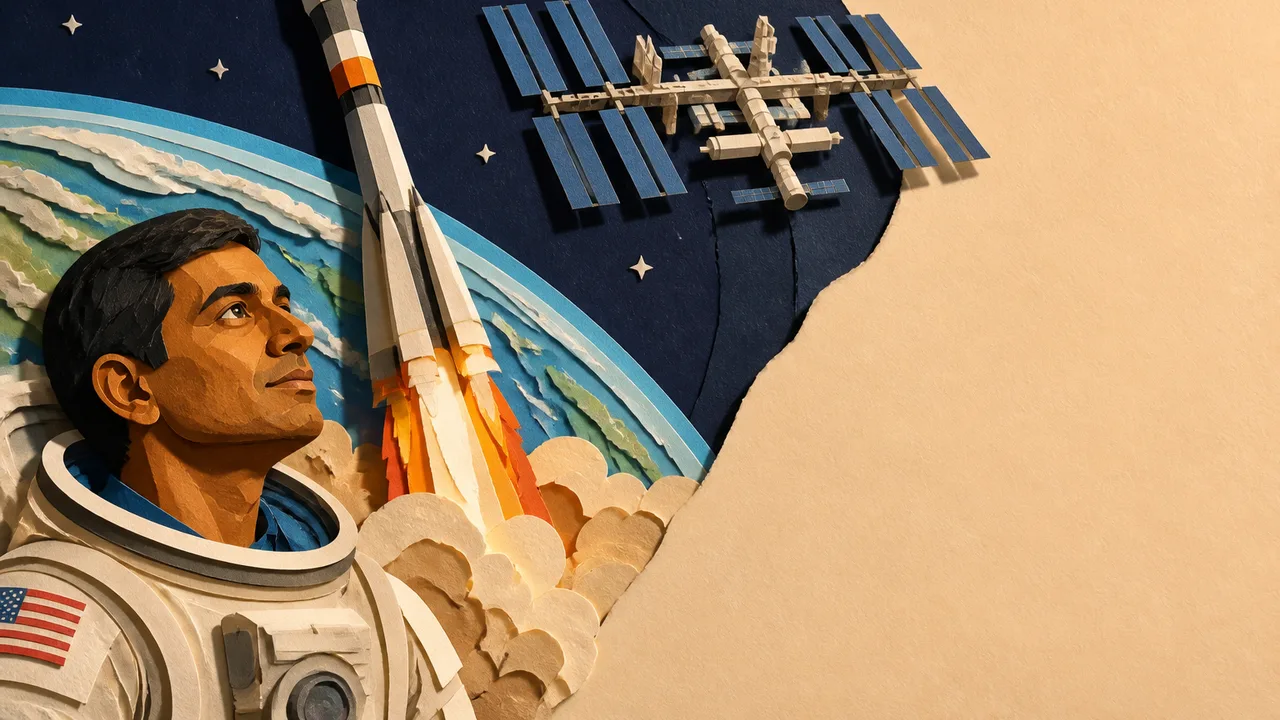
On July 14, 2026, a Soyuz rocket lifted off from the Baikonur Cosmodrome in Kazakhstan carrying NASA astronaut Anil Menon and two Roscosmos cosmonauts toward the International Space Station. It was Menon's first spaceflight, according to India West, and it will run approximately eight months — long enough to matter scientifically, long enough to ask some harder questions about what the architecture supporting it is actually built to sustain.
NASA confirmed that Menon and his crewmates docked successfully and joined the Expedition 74 crew already aboard the station. The launch photographs — including one captured by NASA showing Menon's wife, fellow NASA astronaut candidate Anna Menon, watching the ascent with their children — carry the ceremonial weight these moments are designed to carry. A first launch is a milestone by definition.
But the more interesting questions are structural, not ceremonial.
The dependency that doesn't get mentioned at launches
A NASA astronaut riding a Russian Soyuz rocket to an American-led space station is, at this point, almost unremarkable. The ISS partnership has sustained exactly this kind of interlocking dependency for decades — NASA flies on Soyuz; Russia relies on American funding and scientific participation; the station itself could not operate without both. That mutual dependency is what made ISS cooperation survive geopolitical turbulence that would have ended a less entangled arrangement.
The logic holds — until it doesn't. The ISS is not a permanent fixture. Its operational life is finite, and the platforms intended to succeed it are not yet built. The commercial successors being developed under NASA's contracts represent a fundamentally different model: private stations, built by American companies, operating under a framework that may or may not include the same mandatory seat-swapping that has characterized Soyuz-era cooperation. When Menon's Soyuz MS-29 docks, it does so under institutional muscle memory — procedures, hardware interfaces, and diplomatic arrangements accumulated over thirty years. What comes after the ISS will not have that muscle memory at the start. It will have to build it.
That's not an argument against commercial successors. It's an observation about what the transition period actually costs, and who absorbs those costs. The answer, historically, is junior partners — the agencies and nations whose inclusion in the next platform is more contingent than the lead actors tend to acknowledge.
The semiconductor angle is not incidental
Among the scientific work Menon will conduct during his eight months aboard, AP7AM reports that semiconductor production in microgravity is on the research agenda. This is worth pausing on, because it sits at an intersection that doesn't get mapped cleanly.
Semiconductor manufacturing is one of the defining industrial and geopolitical contests of this decade. The question of where chips are made, by whom, and under what supply chain dependencies has driven legislation in the United States, the European Union, and across East Asia. The parallel question — whether microgravity conditions enable manufacturing processes that are difficult or impossible on Earth — is genuinely open, and the ISS is one of the few places it can be investigated at scale. If microgravity semiconductor research yields anything actionable, the nation best positioned to commercialize it is the one with the most mature relationship between its space infrastructure and its industrial base.
India is developing both, simultaneously, at a pace that hasn't been fully absorbed into Western analyses of who the relevant actors in space actually are. India's space program has included its 2023 Chandrayaan-3 lunar landing, according to NASA Science, among its recent milestones — and it has done so with a cost discipline that makes its program structurally interesting to any nation trying to develop sovereign space capacity without American or Russian price tags.
What the India shift actually pressures
The conventional read on Menon's mission emphasizes his background as a symbol: Indian-American, first-generation space heritage, a lineage that connects to a broader story about how the diaspora has shaped American science. That read is not wrong. But it also flattens what is actually a more complicated structural moment.
India is not waiting to be invited into someone else's architecture. ISRO has demonstrated lunar landing capability. It has a commercial launch sector developing genuine market presence. And it is watching, carefully, how the post-ISS platform decisions get made — specifically, whether the access and data-sharing terms that characterized ISS-era cooperation will carry forward, or whether the commercial successor model quietly concentrates the scientific and industrial upside among the entities that own the hardware.
Here is what that pressure actually implies: if India concludes that the post-ISS commercial platform model replicates the access terms of ISS but transfers the ownership economics to private American entities, the incentive to build an independent Indian platform — rather than buy into a US-led one — increases substantially. The semiconductor research Menon is conducting is not just basic science. It is the kind of research that, if productive, would give any nation with the results a real argument for hosting the next phase of that work on its own terms. Whether India gets meaningful access to those results, or whether the IP structure of commercial station agreements walls it off, is a policy question that no one is publicly resolving right now.
The structural dependency that made ISS cooperation stable was genuine interdependence: each party needed the other enough that defection was costly. The commercial model is designed precisely to reduce that mutual need — to make the platform operator less dependent on any specific government partner. That is probably better for American taxpayers and possibly for innovation timelines. But it changes the calculus for every partner nation deciding where to invest its sovereign space capacity. The evidence doesn't point cleanly to India joining a US-led platform or building parallel to it — but the incentive structure, as it's currently being constructed, tilts toward the latter more than the diplomatic language around these missions tends to acknowledge.
What eight months aboard actually produces
The ISS research agenda Menon joins is not abstract. Nautilus has written about the peculiar cognitive and physical challenges of sustained work in microgravity — the way even basic tasks require adaptation, the way the body and mind recalibrate over weeks and months. Eight months is long enough for that recalibration to complete, long enough for Menon to produce meaningful data on both the human side of long-duration spaceflight and the materials science questions, like semiconductor behavior, that have more immediate industrial relevance.
That dual value — human biology plus industrial materials — is what makes a long-duration mission substantively different from a short one. And it's what makes the question of who owns the data, and who gets to build on it, matter more than the launch photographs suggest.
The ISS has always been, simultaneously, a scientific platform and a geopolitical one. Menon's mission extends both functions. The satellite imagery and handshake photographs will circulate. The research data will go somewhere more specific.
The more consequential question is not whether Menon's mission succeeds — it almost certainly will — but whether the platform that follows the ISS is designed to let the next Anil Menon, flying for a different agency, still have a seat.
More Like This

Rethinking Cosmic Acceleration: A Local Illusion?
Exploring the debate on whether the universe's acceleration is a local phenomenon, challenging the concept of dark energy.
How the Asteroid Impact Ended the Dinosaur Era
Explore the catastrophic asteroid impact that ended the dinosaurs, its immediate aftermath, and the long-term environmental changes.
NASA's Artemis Program: What Returning to the Moon Actually Takes
After Artemis 2's successful circumlunar mission, NASA faces extraordinary technical and biological challenges before astronauts can land on the lunar South Pole.
NASA Names Artemis III Crew for 2027 Moon Mission
NASA has named the four-person crew for Artemis III, a complex multi-launch test mission targeting 2027 that will rehearse docking with both Blue Origin and SpaceX landers in low Earth orbit.
Subcritical Reactors: Nuclear Power's Safety Fix?
A new generation of subcritical reactors promises to make nuclear meltdowns physically impossible. But can they deliver on cost, scale, and timeline?
NASA's Nuclear Mars Spacecraft: What SR-1 Freedom Means
NASA approved SR-1 Freedom, a nuclear electric spacecraft targeting a 2028 launch. Here's what the mission actually tests—and what it doesn't solve.

Ontario Wildfire Smoke Chokes Cities Across North America
Roughly 100 uncontrolled Ontario wildfires are sending smoke 1,000 miles into the U.S. Midwest and Northeast, ranking Toronto worst air quality globally.
Cosmic Rays: What Particles From Deep Space Reveal
Cosmic rays bombard Earth constantly, yet their origins remain partly unknown. Here's what a century of detective work has—and hasn't—resolved.