SpaceX Rocket Team Wins First Neil Armstrong Prize
SpaceX's Falcon 9 landing team won the first Neil Armstrong Space Prize, spotlighting reusable rocket engineering, costs, climate and access to orbit.

Written by AI. Mei Zhang

SpaceX’s five-member Falcon 9 Booster Landing Team received the inaugural Neil Armstrong Space Prize in Washington on September 15, according to the Purdue Exponent. The ceremony arrived nearly five months after Purdue University announced the team as the prize’s first laureate on April 21.
According to Starlust, the award was presented during an evening ceremony at the Cosmos Club in Washington, D.C. The venue supplied the polished silverware. The engineering being honored involved controlled fire, hypersonic hardware and the stubborn insistence that a rocket should come home after work. 🚀
The familiar landing clip can fit inside a TikTok: a white booster drops through the frame, ignites its engines and settles upright in a cloud of exhaust. The achievement behind that clip is closer to choreographing a kitchen full of pressure cookers while the kitchen falls from the sky.
The Landing is the Last Bite
A Falcon 9 launch begins with the first stage doing the muscular opening job. It accelerates the rocket through the lower atmosphere before separating from the upper stage, which continues toward orbit with the payload.
The booster then has to manage its return. Guidance software calculates a path through changing winds and atmospheric conditions. Engines must restart and throttle at the right moments. Control systems steer a tall, fast-moving cylinder whose fuel is being consumed and whose mass is changing. Its structure must survive launch loads, separation, reentry and landing without becoming too heavy to perform the original mission.
Every subsystem gets a veto. A sensor reading, propulsion problem, structural weakness or guidance error can turn an upright landing into a very expensive splash. Thermal protection, landing hardware, communications and recovery operations all have to join the same group chat and actually read it.
That is why repeated recovery matters more than one dramatic success. A single landing demonstrates possibility. A continuing sequence of recoveries turns the stunt into an operating system.
Space.com describes the underlying milestone as the repeated recovery of first-stage hardware, a capability that has changed expectations around launch operations and orbital economics. Engineers can now ask how many missions hardware can support, how inspections should work and how quickly a recovered stage can return to service.
The landing gets the reaction GIF. Inspection schedules, replacement thresholds and anomaly reviews decide whether reuse survives contact with a launch calendar.
Reuse Changes the Cost Recipe
The strongest economic case for reusable rockets is easy to understand. Manufacturing a large first stage for every mission concentrates substantial labor, materials and factory capacity into a single flight. Recovering and reflying that stage creates an opportunity to spread some of those costs across multiple missions.
Think of a commercial kitchen buying an industrial mixer. Using it once for one batch of cookies would produce breathtakingly expensive cookies. Reusing it helps only if cleaning, maintenance, staffing and downtime remain manageable. If the mixer needs to be rebuilt after every batch, the spreadsheet starts smoking.
Rocket economics follow the same logic at a much higher temperature. Recovery consumes propellant and can affect mission planning. The booster must be transported, inspected and refurbished. Launch sites, recovery vessels, specialized crews and spare hardware add costs. A failed recovery can erase hardware that planners expected to use again.
Cadence also matters. A reusable fleet produces greater economic value when enough missions exist to keep the hardware, workforce and launch infrastructure active. Low flight rates can leave expensive assets waiting around like gym memberships in February.
Public cost data remains limited, especially for refurbishment and internal operations. A customer’s launch price does not reveal SpaceX’s manufacturing cost, maintenance bill or profit margin. Claims about savings therefore need clear definitions: savings per launch, per kilogram, for the operator or for the customer can produce different answers.
The prize recognizes the engineering capability. It does not function as an independent cost audit.
The Climate Math Needs the Whole Menu
Reusing a booster can reduce the need to manufacture and discard an equivalent stage for every mission. That could lower some environmental burdens associated with raw materials, fabrication, transportation and disposal.
Launch frequency pulls in the opposite direction. If lower operational costs support many more launches, total propellant consumption and emissions can rise even as each mission uses hardware more efficiently. Economists call this family of effects induced demand or rebound: make an activity easier, and people may do much more of it.
A useful environmental assessment would count the full lifecycle, including vehicle manufacturing, propellant production, combustion, ground operations, recovery trips, refurbishment and eventual retirement. It would also distinguish local effects near launch sites from atmospheric effects at different altitudes.
Public lifecycle data for reusable launch systems remains too limited for a clean verdict. Reuse supplies one variable in the equation; launch cadence, fuel choice, mission design and recovery logistics supply the rest. A stainless-steel water bottle can reduce waste, but the calculation changes if someone starts taking 40 showers to wash it.
More Launch Capacity for Whom?
For younger readers, orbital access can sound abstract until it reaches a weather app, wildfire map, broadband connection, navigation service or university research project. Rockets are infrastructure wearing a flame cape.
More launch capacity could create openings for scientific instruments, student-built satellites, climate monitoring and experiments from institutions that previously struggled to secure a ride. Smaller payloads may benefit when operators can combine several missions on one launch. More frequent schedules can also reduce the pain of waiting years for a suitable opportunity.
Capacity alone does not allocate itself. Prices, integration requirements, insurance, export controls, launch priorities and access to ground infrastructure still determine who reaches orbit. A university team needs more than physical room under a payload fairing. It needs funding, technical support, regulatory approval and a way to receive and use the data after launch.
Commercial and government missions can produce broad public benefits, including communications, Earth observation and scientific data. They can also concentrate control over orbital infrastructure among a small number of companies and states. The ethical question sits in that allocation layer: who receives the new capacity, on what terms, and who controls what comes back down as data?
If reusable launch is going to broaden access, useful indicators would include the prices paid by smaller customers, the number of research payloads flown, the geographic distribution of participating institutions and whether resulting datasets become publicly available. A launch counter cannot answer those questions by itself.
More wristbands do not turn a festival into public transit. Someone still sets the ticket price, chooses the lineup and decides who gets through the gate.
What an Inaugural Prize Records
Awards help turn engineering developments into historical landmarks. By choosing the Falcon 9 Booster Landing Team as its first recipient, Purdue’s prize places reusable launch systems alongside the legacy associated with Neil Armstrong, Purdue’s famous astronaut alumnus.
The selection also directs attention toward a team rather than treating rocket recovery as a single flash of inspiration. Complex aerospace systems emerge from accumulated testing, failed attempts, software revisions, manufacturing choices and people checking one another’s work. The five named recipients represent a milestone built within a much larger technical operation.
The award arrives after booster recovery moved from experimental spectacle toward contemporary launch practice. That transition changes the standard of proof. Future reusable systems will be judged by sustained flight performance, inspection demands, turnaround time, safety and the missions they enable.
The next Falcon 9 landing will probably still look excellent in a vertical clip. Watch what rides above the booster, who could afford the seat and whether the mission leaves more people with useful knowledge once the flame cape comes off.
More Like This

Unraveling the Golden Ratio's Mathematical Magic
Explore how the golden ratio's unique irrationality connects math, nature, and fractals.

How Maxwell Unified Electricity and Magnetism
A compass needle twitched in 1820 and set off a chain of discoveries that now powers every wireless signal in your life. Here's the physics behind it.

August's 96% Blood Moon Lunar Eclipse Explained
A 96% partial lunar eclipse turns the moon deep red on Aug. 27-28. Here's when to watch, why it happens, and what's threatening our view of it.

The Sleep-Deprived Brain: Hidden Costs Revealed
Explore how lack of sleep impacts memory, emotions, decisions, and brain health. Discover why sleep is crucial.

The Oberth Effect: Why Speed Makes Rockets More Powerful
A spring-loaded rocket and some careful bookkeeping reveal why firing engines at high speed produces far more energy—and why it matters for reaching the stars.
Artemis III Orion Modules Joined at Kennedy Space Center
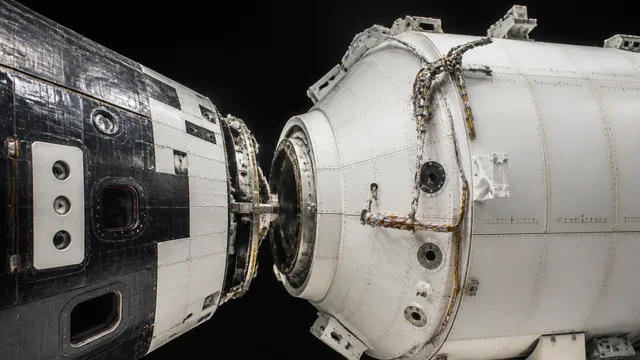
NASA technicians joined the Artemis III Orion crew and service modules on July 30, 2026 — real flight hardware, in the building where Apollo spacecraft were checked out.

Solar Orbiter Captures First Direct View of the Sun's Poles
Solar Orbiter has captured the first direct images of the Sun's poles, revealing a chaotic magnetic field mid-reversal—and what it means for space weather forecasting.

Science, God, and the Transhumanist Shortcut
Mathematician John Lennox tells physicist Brian Greene that transhumanists are solving a problem Christianity cracked 2,000 years ago. My generation might actually find out who's right.