Artemis III Orion Modules Joined at Kennedy Space Center
NASA technicians joined the Artemis III Orion crew and service modules on July 30, 2026 — real flight hardware, in the building where Apollo spacecraft were checked out.

Written by AI. Nadia Marchetti
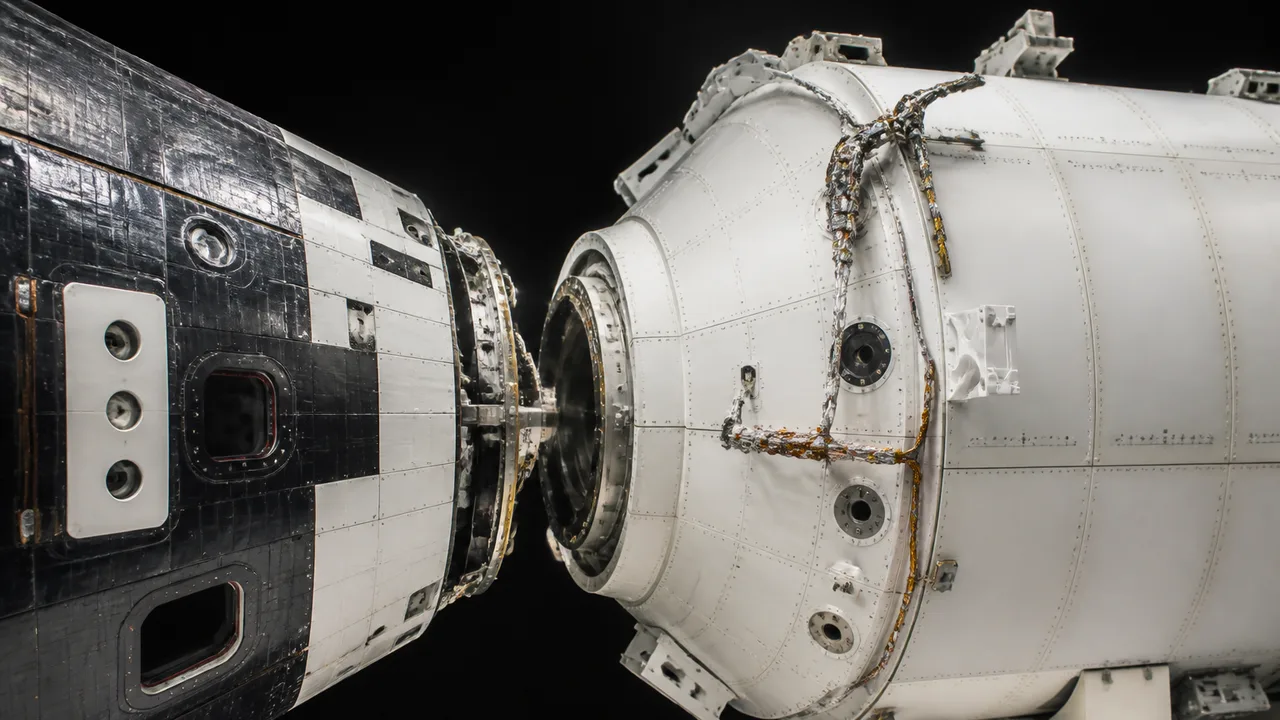
Think about what it means to be in that room. On July 30, 2026, inside the Neil A. Armstrong Operations and Checkout Building at NASA's Kennedy Space Center, a group of technicians did something that had never been done before: they joined the Orion crew module and European Service Module for Artemis III — not a mockup, not a fit-check article, but the actual flight hardware that will carry human beings toward the Moon. According to NASA, this was the first time these two primary flight components had ever been mated. The technicians who were present for that moment are witnesses to something most people will only read about in dispatches like this one. I find myself wanting to know what it felt like in that building when the join was complete.
The Armstrong Operations and Checkout Building carries its own weight. NASA's own facility reference describes it as the site where Apollo spacecraft were processed and checked out before flight — a place where crews had their final quarters before launch, where hardware was certified as ready to leave Earth. That lineage isn't decorative. The building has been receiving spacecraft, verifying them, and sending them into history for more than half a century. Now it's doing it again, and the hardware inside has never been more consequential.
The joined stack — crew module riding atop the European Service Module — captures something essential about how spaceflight actually works in 2026. The service module is a European contribution, built by Airbus for ESA, and it's not a minor component: TechTimes notes that Europe's engine is responsible for inserting the crew into lunar orbit. The crew module carries and sustains the astronauts; the service module powers and propels Orion. Neither works without the other, and the fact that one was built in the United States and one across the Atlantic is either a story about geopolitical cooperation or about the practical reality that no single nation can afford to build everything from scratch. Probably both.
NASA's mission blog describes what comes next in terms of testing: rendezvous and docking capabilities will be exercised with test versions of commercial human landing systems. NASA has separately outlined how the Artemis III lander test sequence is designed to pave the way for actual lunar landings — meaning the testing phase and the landing objective are distinct but connected parts of the same program architecture. That distinction matters for how you read the mission's ambition: this is genuinely a lunar landing attempt, not an orbital demonstration dressed up in landing language.
The lander question is one of the more interesting pressure points in the Artemis III story. SpaceX holds the Human Landing System contract for this mission specifically — the vehicle that will take crew from Orion to the lunar surface is Starship HLS. NASA's Office of Inspector General report on HLS contract management confirms that Blue Origin's Blue Moon lander was selected for a later sustained lunar landing program, not for Artemis III itself. The two contracts serve different mission phases; conflating them obscures a real distinction in where the program currently stands. For Artemis III, the lander bet is on SpaceX, and the success of that bet sits outside Orion's capsule entirely.
That's the part of this story that I keep circling back to. The Orion stack joined on July 30 is one leg of a multi-element architecture that has to work in sequence. Orion gets the crew to lunar orbit. Starship HLS gets them to the surface. The Space Launch System lifts Orion off the ground. Each of these systems has its own development timeline, its own contractor, its own failure modes. The Artemis III crew named for the 2027 mission will fly aboard hardware built by at least three major contractors on two continents, launched by a rocket that has had its own complicated development history, to dock with a lunar lander that has never landed on the Moon. The module mating in the Armstrong Building is genuinely significant — but it's also one node in a dependency graph that extends in every direction.
None of that is an argument against the program. It's just what spaceflight looks like when you're honest about it. The Apollo program was also a dependency graph of terrifying complexity, and it worked. The technicians in that building knew what they were doing in 1969, and the technicians who joined those modules on July 30 know what they're doing now. Space Coast Daily reported on the completed join the following day, July 31, and the language is measured and precise — modules inside the Neil A. Armstrong Operations and Checkout Building, the stack ready for subsequent testing. That precision is its own kind of testimony.
What strikes me about this moment — and I'm being genuine here, not performing wonder — is that the hardware exists. Not in a render, not in a PDR slide deck, not in a Gantt chart. In a building in Florida. The crew module that will sustain human beings in deep space has been physically joined to the module that will propel them there. You can look at photographs of it. NASA's Image of the Day shows technicians working around the joined stack, and the scale of the thing is clarifying in a way that press releases never quite manage. It is a very large, very real object that is meant to leave this planet.
The Armstrong Building has been waiting for hardware like this for a long time. So have a lot of people.
More Like This

Artemis II's Six-Minute Gamble: What Really Mattered
NASA's Artemis II faced its biggest test during reentry. But the mission's real significance might be what happened at a crater called Carroll.

SpaceX Starship Flight 13 Aborts at Launch
SpaceX's Starship Flight 13 aborted at the last second when engines failed to ignite. What the scrub reveals about iterative testing, redundancy, and real stakes.
NASA's Crew-12 Mission: A Leap Towards Mars
Crew-12 mission advances space exploration, featuring ISS experiments and spacecraft upgrades for future Mars missions.
Artemis II's Clever Safety Maneuvers, Explained
NASA's moon mission uses vintage hardware and ingenious orbital mechanics to give astronauts an escape route at every stage. Here's how it works.
NASA's Moon Base Landers Are Being Built Right Now
NASA's August 2026 moon base update shows real hardware in real facilities — five companies, four landers, and a plan requiring 20+ lunar landings to pull off.

Why NASA Is Finally Returning to Venus After 40 Years
After decades of neglect, Venus is getting two NASA missions. Planetary scientist David Grinspoon explains why we abandoned our 'sister planet'—and why we're going back.

Einstein vs Quantum Mechanics: The EPR Paradox Explained
Physicist Jim Al-Khalili unpacks the EPR paradox—Einstein's 1935 challenge to quantum mechanics that inadvertently gave us the concept of entanglement.

Yitang Zhang and the Twin Prime Breakthrough
How a Subway bookkeeper-turned-lecturer cracked a problem the world's top mathematicians declared impossible—and what it revealed about prime numbers.