Michael Shermer on Truth, Bias, and the Post-Truth Era
Neil deGrasse Tyson and Michael Shermer unpack objective truth, motivated reasoning, and why your brain argues like a lawyer, not a scientist.

Written by AI. Nadia Marchetti
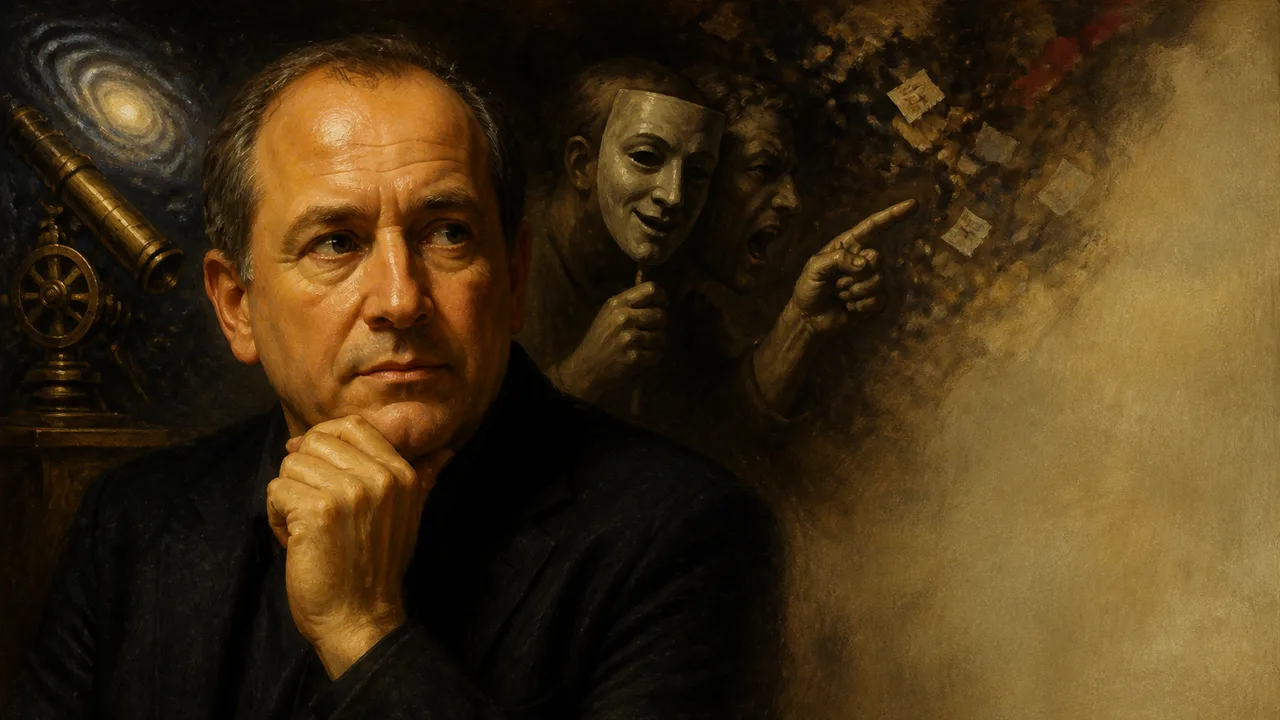
Photo: AI. Henrik Solberg
There's a self-defeating quality to the phrase "post-truth era" that Michael Shermer finds irresistible. The moment anyone opens their mouth to declare that truth doesn't exist, they're making an argument — which means they're implicitly appealing to a standard of truth. You can't coherently announce the death of objectivity without objectivity showing up to witness the funeral.
That logical trap is the opening move in Shermer's new book, simply titled Truth, and it's the thread running through his recent appearance on StarTalk with Neil deGrasse Tyson and co-hosts Chuck Nice and Gary O'Reilly. The conversation covers roughly fifty minutes of territory — from Carl Sagan's garage dragon to the iPod Shuffle to the measles resurgence — and what emerges is less a lecture on epistemology and more a guided tour of how spectacularly, reliably, and sometimes dangerously, human minds fail to track reality.
The Dragon You Can't Disprove
Sagan's thought experiment gets dusted off early, and it's still the cleanest illustration of why feeling certain doesn't constitute evidence. The setup: someone tells you there's an invisible dragon in their garage. You propose tests. Sprinkle flour to catch footprints — it's a levitating dragon. Use an infrared camera — cold-blooded. Listen for fire — the fire is cold.
"What's the difference between an invisible levitating cold-blooded cold fire-breathing dragon and no dragon at all?" Shermer asks. Every attempted measurement gets retrofitted with an ad hoc exception. The hypothesis becomes unfalsifiable — which, technically, doesn't make it wrong. It just makes it permanently beyond the reach of anyone else's verification.
That's the distinction Shermer keeps returning to: internal conviction versus external validation. Your personal experience is real. What you feel is real. But for a claim to graduate from your truth to the truth, it needs contact with something outside your own nervous system. This is where Tyson adds a wrinkle that the dragon analogy sometimes elides: charisma. What if the dragon-owner is so compelling that everyone who enters the garage also feels the presence of the dragon? Shermer's answer is pointed — that's precisely how cults form. The cult leader creates a closed system of internal validation, which is why, he notes, they work so hard to cut followers off from outside reference points. External contact is the threat.
Chuck Nice's ayahuasca detour lands here with unexpected precision. Nice describes experiencing vivid entities during a medically supervised session — beings that felt completely external, completely real — while simultaneously narrating to himself that they were artifacts of his own mind. He got both experiences at once. What's philosophically interesting about his account isn't the vision; it's that the metacognition never switched off. He knew and he felt simultaneously, and those two channels didn't resolve into one. Shermer's response is generous rather than dismissive: there's a domain of personal truths that are real for you and change your life, full stop. That domain just has different rules than the domain where we figure out what viruses do.
The conversation is at its best in moments like these, where the categories turn out to be messier than the clean theoretical frame suggests. Shermer isn't claiming personal experience is worthless — he's claiming it's insufficient, alone, as intersubjective evidence. The distinction matters.
Lawyers, Not Scientists
The most clarifying idea in the conversation might be this: "Our brains are more like lawyers than scientists. We want to win the case for our side, not find out what's actually true."
Shermer calls this motivated reasoning, and he's careful to note it's not a character flaw. It's possibly a feature. One evolutionary hypothesis holds that human reason didn't develop primarily to track truth — it developed to win arguments within a group. Finding food, avoiding predators, and maintaining social standing all required persuading other people, not just modeling reality accurately. We're optimized for rhetorical victory, not epistemic accuracy, and the two often diverge.
This reframe is uncomfortable in a useful way. It means the person furiously accumulating vaccine misinformation and the person furiously accumulating pro-vaccine data might be running the same cognitive software — just pointed at different targets. Both are doing what motivated reasoners do: building a case, not conducting an inquiry. Science, as an institution, exists precisely to create friction against this tendency. Peer review is, at its core, a formalized system for deploying your haters. The goal isn't to find people who agree; it's to find the people most motivated to show you're wrong and let them try.
Shermer extends this to Bayesian reasoning — the practice of holding beliefs as probabilistic and updating them when evidence shifts. It's a more fluid way of tracking truth than binary conviction, and it allows the crucial move of changing your mind without experiencing it as defeat. "My priors are this, and I've upgraded my credence" shouldn't feel like capitulation. It should feel like calibration. The fact that it often doesn't tells you something about what beliefs are actually for.
The Conspiracy You're Not Allowed to Take Seriously
One exchange late in the conversation exposes a bias that operates even among people who consider themselves skeptical. Co-host Nice observes that a small group of fossil fuel companies, with documented knowledge of climate consequences, coordinated for decades to suppress that information and protect their business model. The memos exist. The meetings happened. By any structural definition, that's a conspiracy — and it's arguably caused more harm than the Illuminati has in all its alleged centuries of world domination.
Shermer agrees immediately. Big tobacco is the template: companies that knew, that met, that strategized, that caused millions of deaths, and that gave us the phrase "the science isn't settled" as a deliberate rhetorical weapon. "These conspiracies," Shermer says, "they're not sexy. They don't have aliens. And so nobody cares."
The asymmetry is telling. Conspiracies that are baroque, cosmic, and unfalsifiable tend to attract passionate followings. Conspiracies with subpoena-able paper trails and identifiable defendants tend to get shrugged at. Part of this is Shermer's patternicity at work — the evolved tendency to find meaningful patterns in noise, which fires equally on real threats and imagined ones. The lion in the grass that turns out to be wind costs you nothing. The wind that turns out to be a lion ends your genetic line. So we err toward the pattern, toward the story with a hidden agent, toward the explanation where someone is doing this to us. A corporation optimizing for quarterly earnings is a less satisfying villain than a shadowy cabal.
There's also the outlier paper problem, which Shermer addresses directly: scientific consensus gets dismissed by invoking the two papers that dissent from the hundred. This sounds like skepticism. It's actually the opposite — it's cherry-picking, often funded by the parties most invested in the dissent. Real skepticism doesn't mean finding the one paper you like. It means understanding how to weight a literature.
What Skepticism Is Actually For
Shermer pushes back against the idea that skepticism means perpetual doubt. That's contrarianism dressed in an epistemological costume. Real skepticism has a direction: you start with "probably not true" and you update based on evidence until, at some threshold, it becomes reasonable to provisionally assent. The word he keeps reaching for is provisional — not because truth is infinitely negotiable, but because new evidence should always be able to revise a conclusion. The strength of a scientific consensus isn't that it's permanent; it's that it's the product of people trying very hard to break it, and failing.
"Being a skeptic means you know at which point you no longer need to doubt it," Tyson says. That's a more demanding standard than "I doubt everything," which requires nothing — no engagement with the evidence, no threshold that could ever be met, no pathway to revision. Infinite skepticism isn't rigorous. It's just a posture that can never be wrong because it never commits to anything.
The episode ends with Shermer in an unexpectedly optimistic register. Humans, he argues, are the only species that has developed systematic tools for correcting its own errors — peer review, controlled trials, Bayesian updating, falsifiability criteria. We're bad at finding truth by instinct. We're gradually, slowly, better at building systems that compensate for that.
Moral progress, he adds, happens on a decadal scale — slow enough that you can't see it in real time, visible only when you look back far enough to be startled by the distance traveled.
Whether we're traveling fast enough, given the current headwinds, is the question he leaves open.
— Nadia Marchetti, Unexplained Phenomena Correspondent, BuzzRag
More Like This
How Common Knowledge Influences Society
Explore how common knowledge shapes human interactions and societal norms with insights from Steven Pinker on StarTalk.
Why NASA Is Finally Returning to Venus After 40 Years
After decades of neglect, Venus is getting two NASA missions. Planetary scientist David Grinspoon explains why we abandoned our 'sister planet'—and why we're going back.
Public Trust in Science Is Fragile and Complicated
Trust in science is eroding—but the data is more complicated than the panic suggests. Here's what's actually happening, and why it matters.

Can You Really Grow Your Own Food Anywhere?
Kevin Espiritu of Epic Gardening joins StarTalk to explore urban farming, hydroponics, gray water systems, and whether humans could grow food on the moon.

Colonel John Alexander's Life at the Edge of Official Reality
Colonel John Alexander commanded Green Berets, ran Pentagon psychic programs, and investigated UFOs. His 3-hour Why Files interview maps a career lived at the edge of official reality.
Exploring the Brain as Nature's Own Time Machine
Dive into how our brains perceive time, from past to future, with insights from StarTalk's latest episode.

Einstein vs Quantum Mechanics: The EPR Paradox Explained
Physicist Jim Al-Khalili unpacks the EPR paradox—Einstein's 1935 challenge to quantum mechanics that inadvertently gave us the concept of entanglement.

Yitang Zhang and the Twin Prime Breakthrough
How a Subway bookkeeper-turned-lecturer cracked a problem the world's top mathematicians declared impossible—and what it revealed about prime numbers.