Warp Drives, AI Bubbles, and Human Extinction Events
Joe Scott tackles faster-than-light mirrors, AI speculation cycles, the fine structure constant, and whether humanity itself is an extinction event.

Written by AI. Nadia Marchetti
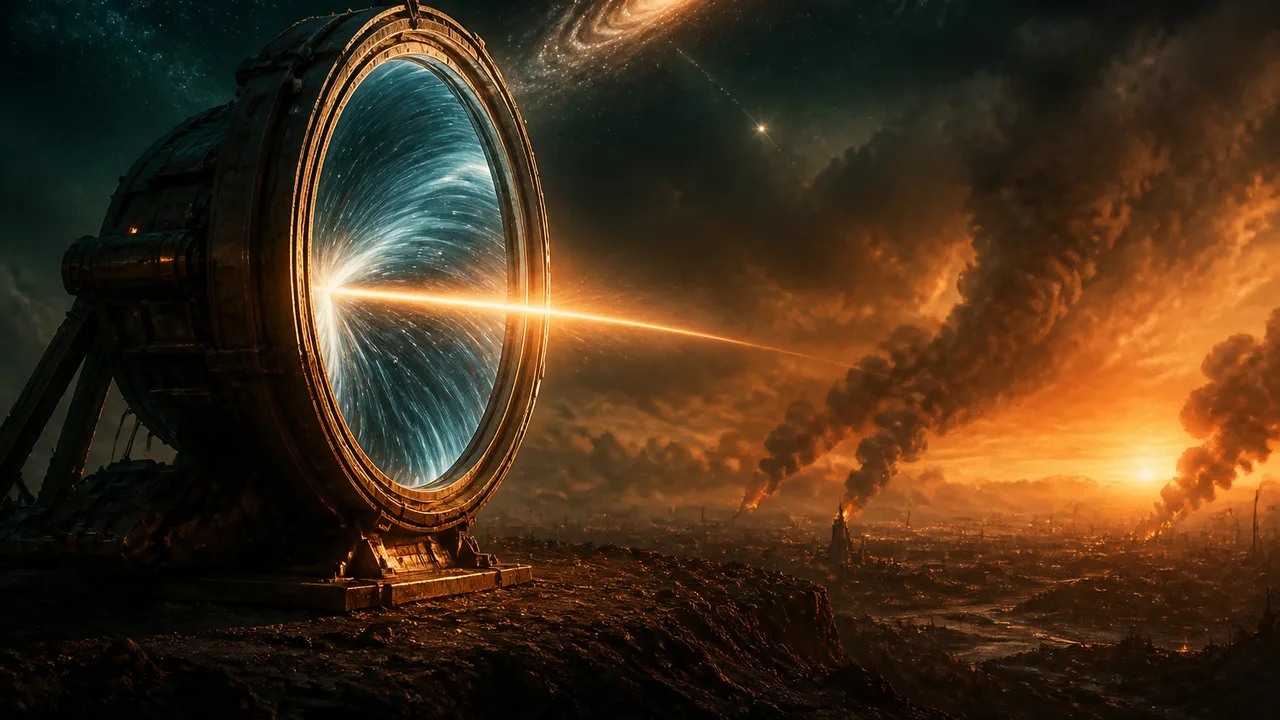
Photo: AI. Astrid Lehmann
There's a version of looking at the night sky that nobody talks about: the fact that it's a giant archive. Every photon arriving at your retina is old news. The star you're squinting at isn't where it appears to be. It might not even exist anymore. The light just hasn't gotten the memo yet.
Joe Scott's latest lightning round video opens with that familiar fact and then promptly weaponizes it. If hypothetical observers on the exoplanet GJ 3378b are 25 light years away, they're watching September 11th unfold right now. Aliens on V391 Pegasi B, 4,500 light years out, could theoretically tell us exactly how the pyramids were built. The universe, it turns out, keeps receipts.
Which raises the obvious follow-up: could we intercept our own receipts?
The Mirror Problem
The thought experiment Scott works through—posed by a viewer named Evan Seagull—starts with a reasonable premise: if we had an Alcubierre warp drive and could outrun our own light cone, could we position a giant mirror in deep space and watch our own history play back?
Technically, Scott says, yes. Practically, it collapses almost immediately under its own requirements.
To observe Earth from a million years ago, you'd need to be a million light years away—roughly the distance to the edge of the Local Group. At that range, our sun is barely a smudge. Earth is invisible. The mirror itself would need to be approximately Earth-sized. And the telescope back home would need to resolve objects at two million light years (once out to the mirror, once back), which would require optics capable of identifying individual organisms on a planet in the Andromeda galaxy.
Then there's the waiting. Even if you warped the mirror into position tomorrow, you'd still have to wait a million years for the reflected light to return.
"None of us would be here to see it," Scott notes. "But the AI paperclip machine that takes over the world in 500 years might have a chance."
What the thought experiment actually demonstrates is something more fundamental: the speed of light isn't just a speed limit, it's an information architecture. The past is technically retrievable in principle and cosmically inaccessible in practice. The universe stores everything and lets you access almost none of it. That tension between theoretical possibility and practical reality runs through everything else Scott covers in this video.
History Rhyming, Then Rapping
The viewer question about whether AI might give socialism a better chance of success sounds like it should be a political trap. Scott navigates it by doing something underrated in public discourse: he treats it as a pattern-recognition problem rather than an ideological one.
His argument is essentially cyclical. Periods of extreme wealth concentration tend to generate political corrections. Marx was reacting to the industrial revolution's labor conditions. The Progressive Era followed the Gilded Age. The New Deal followed the Great Depression. The pattern—inequality expands, instability follows, progressive politics fill the vacuum—has repeated with enough regularity that Scott calls it a decent predictive model.
"History isn't just rhyming," he says. "It's spitting bars right now."
The AI-specific version of the argument isn't that AI will enable socialism, but that the speculation bubble around AI will precipitate the conditions that historically produce socialist political movements. We're spending approximately $700 billion this year on data center infrastructure, according to Scott's read of the landscape, with no clear model for how that money gets made back. Tech oligarchs are consolidating power. Wealth inequality is measurably extreme. Democratic socialists are winning local elections.
Scott is careful to stay descriptive rather than prescriptive here. He acknowledges that some people find that trajectory exciting and others find it frightening, and declines to adjudicate between them. What he does assert is that the pattern is legible—and that AI's primary political effect may be less about what the technology does and more about the economic shockwave the speculation around it is likely to produce.
Standardization: The Invention That Doesn't Get Credit
Sandwiched between the heavier questions is a brief but satisfying detour into the history of the screw. When asked what the most important underrated invention in human history is, Scott points not to the screw itself but to the standardization of it—the moment when interchangeable parts became possible because everyone agreed on the same dimensions.
That agreement, Scott argues, is the real invention. Standardized measurements enabled mass production. Mass production enabled modern life. You can trace the lineage from a single standardized thread pitch to essentially everything in your house. The metric system belongs in the same conversation: not a discovery, but a consensus, and one that rewired what humans could build together.
It's a small point in the video, but it's worth sitting with. The invisible infrastructures—the agreements, the standards, the shared languages—often do more work than the celebrated innovations that run on top of them.
The Cyanobacteria Problem
The video's most philosophically uncomfortable moment comes when Scott is asked what single fact most changed his view of humanity.
He surfaces what he calls his "dark nihilistic side"—a perspective he traces partly to a 1985 claymation film, The Adventures of Mark Twain, and more substantively to time he spent filming a documentary on a 4.02 billion-year-old rock. When you're sitting on something that old, the timeline of human existence compresses into something almost imperceptible. "In the timeline of Earth's history," Scott says, "humans take up just like the last pixel of it."
What unsettles him isn't our brevity but our impact. In roughly 200 years, humans have altered the atmosphere, reshaped landscapes, and driven what many researchers characterize as a sixth mass extinction. That rate of planetary change has precedents—the Deccan Traps volcanic event, the Great Oxygenation Event triggered by cyanobacteria billions of years ago, which killed off the vast majority of anaerobic life on Earth.
The question Scott allows himself to ask, and notably doesn't answer, is: how are we meaningfully different from those cyanobacteria? They changed the world's chemistry, drove mass extinction, and made the planet radically more habitable for a different category of life. From the planet's perspective, they were neither good nor bad. They were a transition.
"To go totally nihilistic," Scott says, "we are basically just an extinction event that happened in Earth's history."
He immediately cops to the fact that not all of him believes this, that the framing is his darkest mode rather than his settled view. But leaving it on the table is its own kind of intellectual honesty.
The Fine Structure Constant, and Survivorship Bias at Universal Scale
The fine structure constant—approximately 1/137—is one of those numbers that shows up in enough places in physics that it starts to feel like a message. It defines the strength of electromagnetic interaction, governs how electrons relate to atomic nuclei, and is, as Scott notes, precisely calibrated for our kind of universe. Tweak it slightly in either direction and either atoms can't form, or carbon—the backbone of biology—becomes impossible.
Scott's explanation for why it appears everywhere is almost anticlimactic in its elegance: it shows up everywhere because it's in everything. Every particle, every atom. Of course it's ubiquitous.
The harder question—why is it 1/137 specifically—he handles via the anthropic multiverse argument. If there are universes with different fine structure constants, and most of those universes can't form stable matter or stars or carbon, then the only universes that will ever ask why their fine structure constant is what it is are the ones where it permits observers to exist. We're not special. We're just the universe that made it to the point of asking.
"It's survivorship bias," Scott says. "You could put it that way."
Apollo 13's Geometry of Luck
The final question has a quietly brilliant framing: not "was Apollo 13 lucky to survive?" but "was it lucky that the disaster happened when it did?" Scott confirms that the timing was, in fact, almost optimally fortuitous. The oxygen tank explosion occurred before the lunar module had been used, which meant its oxygen supply was fully intact—available as an emergency life support system for the crew.
Had the explosion occurred while Lovell and Haise were on the lunar surface, command module pilot Jack Swigert would have been isolated with no viable options, and the astronauts below him would have had no functional vehicle to return to. Had it occurred on the way back, the lunar module would have already been jettisoned.
The window in which the disaster was survivable was narrow. The crew hit it.
Scott is careful to credit the engineers as much as the luck—the mission's survival was as much a function of improvised problem-solving as favorable timing. But the underlying structure of the question is worth holding: catastrophes have not just severity but position, and position matters enormously. A system failure at the right moment in a sequence can be recoverable. The same failure ten minutes later is not.
That's a pattern, too. Much like Scott's read on AI bubbles, or on the fine structure constant, or on human civilization itself—timing isn't incidental. It's often the whole story.
By Nadia Marchetti, Unexplained Phenomena Correspondent, BuzzRAG
More Like This
Why NASA Is Finally Returning to Venus After 40 Years
After decades of neglect, Venus is getting two NASA missions. Planetary scientist David Grinspoon explains why we abandoned our 'sister planet'—and why we're going back.
Ten Engineering Projects That Remade the World
From the Panama Canal to the International Space Station, ten engineering feats that didn't just solve problems — they rewrote what was thought possible.
The Most Sensitive Dark Matter Detector Might Find Nothing
LUX-ZEPLIN sits a kilometer underground, waiting for dark matter. But success might look like silence—and that would tell us something huge.

Heavy Spoilers Builds an Office, Ditches the Algorithm
YouTube creator Paul from Heavy Spoilers explains why he built a garden office, changed his logo, and chose depth over views in content strategy.
Einstein's Happiest Thought, Explained From First Principles
Adam Brown unpacks general relativity's core insight—gravity as curved spacetime—and what black holes reveal about energy, time, and the limits of physics.
Mir 1997: When Heroism Was the Backup Plan
Michael Foale's retrospective on the 1997 Mir collision reveals what really saved the station—and what it means for the future of human spaceflight.
Yitang Zhang and the Twin Prime Breakthrough
How a Subway bookkeeper-turned-lecturer cracked a problem the world's top mathematicians declared impossible—and what it revealed about prime numbers.
Solar Flares, Earth's Magnetosphere, and StormWall
Recent X-class solar flares and CMEs have prompted serious discussion about Earth's space weather vulnerability—and a theoretical plasma shield called StormWall.