NASA's Moon Base Landers Are Being Built Right Now
NASA's August 2026 moon base update shows real hardware in real facilities — five companies, four landers, and a plan requiring 20+ lunar landings to pull off.

Written by AI. Amelia Nwofor
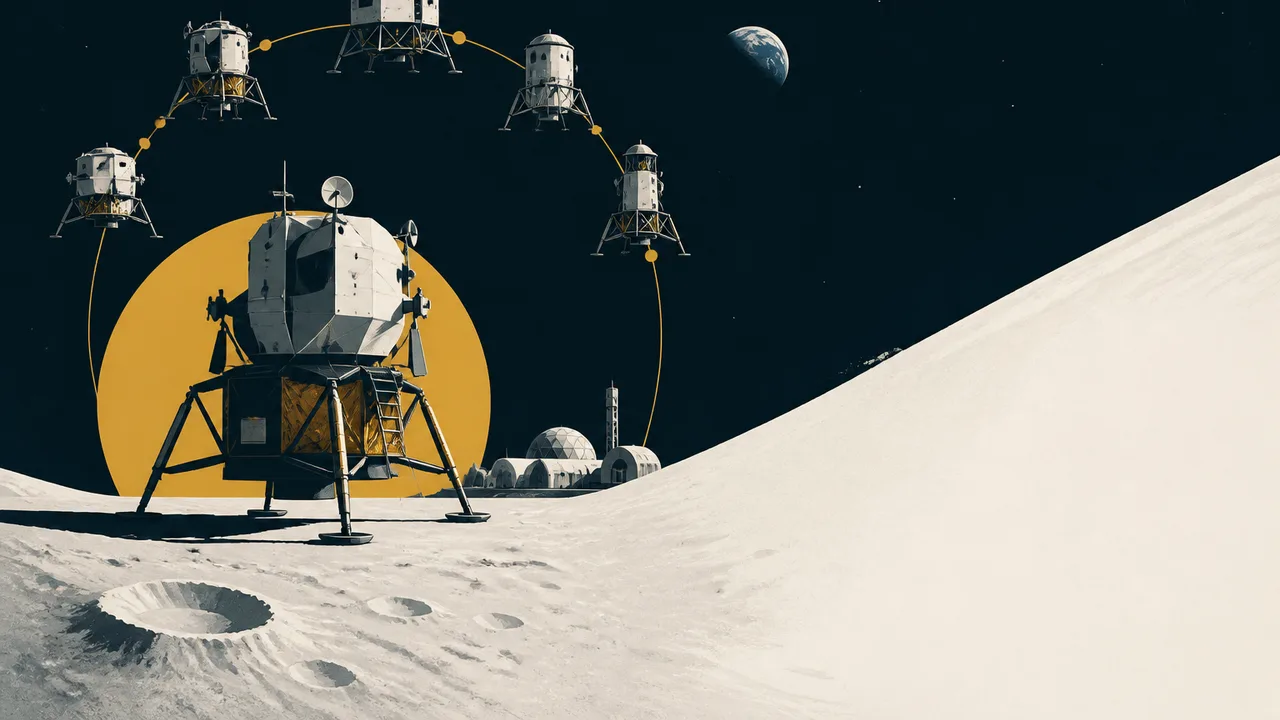
Photo: AI. Mika Sørensen
There's a version of this story that writes itself: sweeping orchestral music, slow pans across gleaming hardware, the word "impossible" used approximately six times. NASA's August 2026 moon base update delivers exactly that, and you could be forgiven for filing it under "agency communications" and moving on.
You'd be missing something.
Underneath the production values, this update is actually doing something less common in spaceflight coverage: showing the work. Not the renders, not the timelines projected on a screen in a congressional hearing — the physical hardware, in facilities, in various states of integration. Engineers with oil on their hands. Mass properties tests. A lander that had to be shipped across the country because the environmental testing chamber back home wasn't big enough.
That's worth paying attention to.
Four Landers, Four States of Readiness
The update visits four active lunar lander programs, each at a different point on the road to launch. The spread is revealing.
Firefly Aerospace is arguably the furthest along in terms of institutional confidence. Blue Ghost Mission 1 flew in 2024. Mission 2 is now stacked and being fitted with electronics and payloads at Firefly's facility north of Austin. The destination this time is the far side of the moon — a choice driven entirely by one of its science payloads, Lunar Ice Cube, a radio astronomy telescope that needs the moon's bulk between it and Earth's electromagnetic noise to observe what researchers call the "cosmic dark ages." The far side is one of the quietest radio environments accessible to humanity. That's not incidental; it's the point.
Firefly is also flying Lunar Pathfinder — an orbital payload — and its first mobility payload: a rover. NASA's Carlos Garcia Galan, touring the facility in the update, asks the question that actually matters: "Can you be successful several times?" The answer from Firefly engineers isn't a confident yes — it's something more honest. "It's also humbling," one of them says. "We did it one time, but now we need it two, three, four. We need to keep doing it and keep upping the bar and getting better each time." That's the logic of iterative development stated plainly. It's also a quiet acknowledgment of how much remains unproven.
Voyager Lunar Systems' Griffin-1 is the infrastructure-class outlier in this group. It's not primarily a science lander — it's a cargo hauler, designed to deliver equipment and infrastructure capability to the surface at scale. At the time of filming, Griffin-1 had traveled to NASA's Jet Propulsion Laboratory in California for environmental testing, specifically because JPL's facilities are among the best in the world for spacecraft of that size. The testing visible in the update includes mass properties measurements — total mass, center of gravity, moment of inertia — the kind of meticulous characterization that flight dynamics teams need before they'll sign off on anything. According to NASA's moon base documentation, the mission targets the lunar south pole, carrying ten payloads including what NASA characterizes as the largest commercial payload ever to be delivered to the lunar south pole: the Asher Lab FLIP rover.
Blue Origin's Blue Moon Mark 1 Endurance has the most complicated near-term path. The lander itself — serial number one — has completed thermal vacuum testing at Johnson Space Center and a battery of subsequent checks: RF compatibility with the TDRS satellite system and deep space network, stage separation testing with New Glenn, acoustic environment testing. The BE-7 main engine fit check, according to Blue Origin's Courtney A. Buglin in the update, "went perfectly." The lander is essentially ready.
The problem is the rocket. New Glenn had a pad incident, and the team is holding serial number one in a quiescent state — essentially in standby — while New Glenn gets sorted. Buglin projects a Q1 2027 launch. That's a real slip in the schedule, and the update doesn't hide it, though it also doesn't dwell on it. What it emphasizes instead is the pipeline: once serial number one launches, Blue Origin continues through serial numbers two, three, and four. The program's logic doesn't depend on any single flight going perfectly. One of the payloads Blue Moon will carry is SCALPSS, a NASA instrument designed to characterize what the BE-7 engine's exhaust actually does to the lunar surface — data that will directly inform the design of heavier landers to come.
Intuitive Machines' Nova-C is the most seasoned platform in this lineup. IM-1 flew in 2024. IM-2 flew in 2025. IM-3 was in active assembly at Intuitive Machines' Houston facility at the time of filming — top deck freshly installed, engine installation and hot fire test imminent. The mission targets Reiner Gamma on the near side of the moon, carrying five NASA payloads focused on the region's unusual magnetic anomaly, six commercial payloads, and a payload from the Italian Space Agency. IM-3, 4, 5, and 6 are described as on schedule. Given that IM-1 and IM-2 both actually launched — a bar that not every commercial lunar program has cleared — Intuitive Machines' cadence claim carries some weight.
The Iteration Argument
The thread running through all four programs is the same: you learn by going, and you build the capacity to go again by institutionalizing what you learned. This is not a novel idea — it's the operational philosophy behind any mature industrial process — but it's genuinely new to commercial lunar spaceflight, a domain where, until very recently, almost every mission was effectively a first attempt.
NASA is framing its entire moon base construction strategy around this logic. Phase one requires more than 20 lunar landings, each one delivering equipment, science, or infrastructure while also generating data that feeds into the next flight. The update describes it as "drawing on the playbook of success from the 1960s." That's a fair characterization: the Apollo program's actual operational momentum came from Gemini's methodical, incremental flights before any human orbited the moon.
The difference now is that the iteration is distributed across multiple commercial partners rather than concentrated inside a single government agency. That has obvious efficiency advantages. It also introduces coordination complexity and varying risk tolerances that a single integrated program doesn't have to manage.
The South Pole Problem
Several of these missions are targeting or supporting operations at the lunar south pole, and that's where the physics get genuinely punishing. According to NASA's moon base reference documentation, the south pole presents extreme thermal swings that place serious demands on power systems, communications hardware, and landing systems alike. NASA's partnership with Northrop Grumman addresses this directly: three technology demonstration missions will deliver power, avionics, and communication systems — hardware originally developed for the Gateway program's HALO module — to the lunar surface in phase one. The goal is to test existing hardware in actual lunar conditions, give it a new operational purpose, and build the infrastructure that both Artemis crews and robotic systems will eventually depend on.
Repurposing HALO module heritage hardware is, analytically, a smart move. It shortens development timelines and leverages testing that's already been done. Whether hardware designed for cislunar space operations performs as needed on the surface is precisely what these demonstrations are meant to establish.
What This Is and What It Isn't
NASA's moon base update is agency communication, not independent reporting. It doesn't interview skeptics. It doesn't quantify the probability that any given mission slips, fails, or gets de-scoped. New Glenn's pad incident gets a single sentence. The question of whether more than 20 successful lunar landings across multiple commercial providers — a feat that has never been accomplished — can actually happen on a planning timeline is not examined.
None of that makes the hardware less real. What's visible in this update — stacked landers, mass properties rigs, engine fit checks, teams that have done this before and are doing it again — is a different kind of evidence than a program roadmap on a slide deck. The machinery of repetition is either building or it isn't.
Right now, it looks like it's building.
More Like This

The Deeper Geometry Behind the Pythagorean Theorem
Explore why the Pythagorean Theorem appears in unexpected places, from geometry to relativity.

SpaceX Starship Flight 13 Aborts at Launch
SpaceX's Starship Flight 13 aborted at the last second when engines failed to ignite. What the scrub reveals about iterative testing, redundancy, and real stakes.

Artemis 2 Carried America's 250th Birthday to the Moon
NASA's Artemis 2 mission carried "America 250" markings to lunar orbit, blending national celebration with the next chapter of deep space exploration.

Why Light Beams Seem to End: Physics Explained
Discover why searchlight beams appear to stop and how physics and atmospheric conditions contribute to this phenomenon.

How the Moon Formed: One Impact or Three?
The giant impact hypothesis has dominated lunar science for 40 years. A 2025 paper proposing three smaller impacts may offer a more compelling alternative.

NASA's Future Under Jared Isaacman: A Balanced View
Exploring NASA's future with Jared Isaacman, focusing on Moon missions, technology, and partnerships under current leadership.

Intelligence Beyond the Brain: Michael Levin's Radical Rethink
Biologist Michael Levin argues intelligence exists on a continuum reaching down to cells and molecules. Here's what the evidence actually supports—and where it gets murky.
The Messy, Brilliant History of Divergence and Curl
How Hamilton's quaternion obsession, Maxwell's electromagnetism, and a self-taught telegraph operator gave us the vector calculus we use today.