How the Moon Formed: One Impact or Three?
The giant impact hypothesis has dominated lunar science for 40 years. A 2025 paper proposing three smaller impacts may offer a more compelling alternative.

Written by AI. Olivia Meng
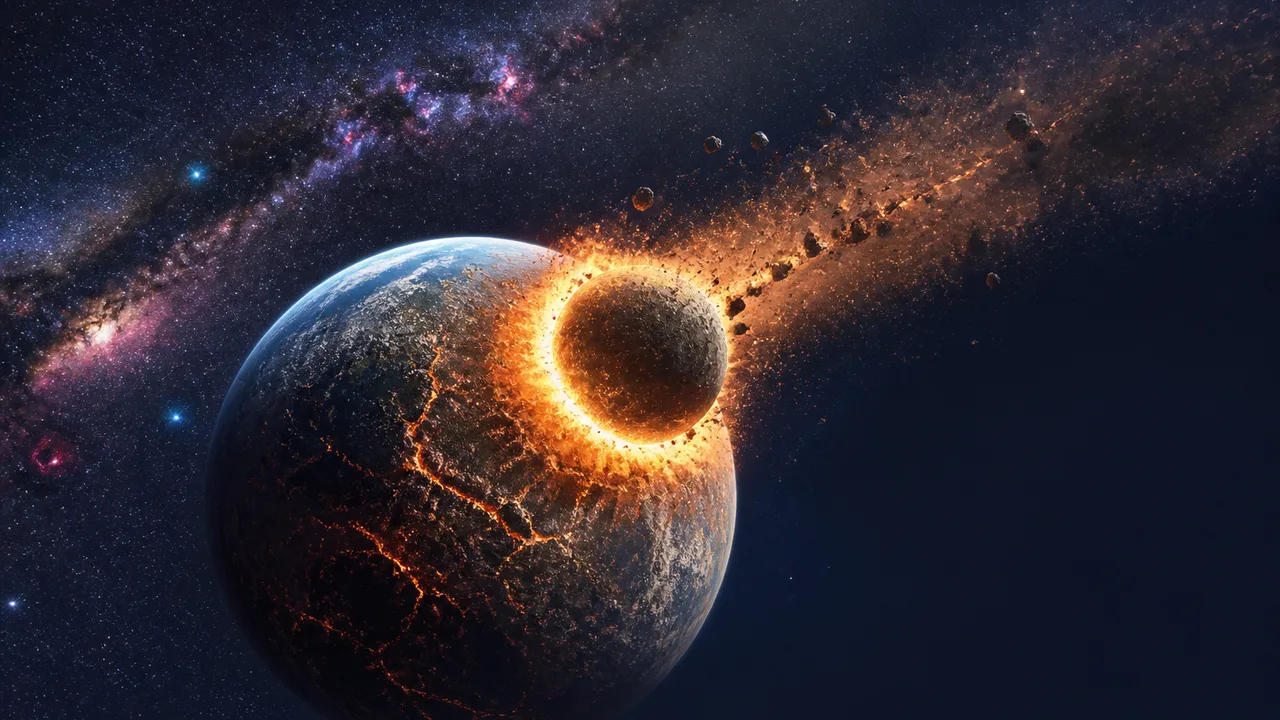
Photo: AI. Castor Belov
The Moon is a deeply strange object, and most people have no idea.
We treat it as background — a reliable fixture, the thing that handles the tides and lights up camping trips. But spend a few minutes with the numbers and the strangeness becomes hard to ignore. Most moons in our solar system are tiny relative to their host planet: we're talking mass ratios of 1-to-1,000 or more. Earth's Moon is only about 81 times less massive than Earth itself. That's not a moon in the conventional sense. That's nearly a companion world. The only analog in our solar system is Pluto and Charon, which don't even behave like a planet-moon pair — they orbit a shared center of mass that sits between them, technically making them a binary system.
So when SciShow host Savannah Gear asks "where did the moon come from?" in a recent episode, the question carries more weight than it might seem. There is no simple answer, and the dominant theory — the one you probably learned in school — is under more pressure than it has been in decades.
The Reigning Theory and Its Cracks
The giant impact hypothesis has held the field for over 40 years. Its central claim is straightforward: roughly 4.5 billion years ago, a Mars-sized body called Theia struck the proto-Earth at an oblique angle, and the debris from that collision eventually coalesced into the Moon. The model has genuine explanatory power. It accounts for the Moon's global magma ocean — lunar samples from both the near and far sides show similar compositions, consistent with a moon-wide molten sea early in its history, the kind of heat signature you'd expect from a colossal impact rather than the slow gravitational snowballing that typically builds planets. It also accounts for the chemical similarities between Earth rocks and Apollo-era lunar samples.
But those same chemical similarities are, paradoxically, also the theory's biggest problem.
The most widely cited computer model of the giant impact, published in 2001, predicts that the debris that formed the Moon came predominantly from Theia, not from Earth. If that's right, then Earth and the Moon should have meaningfully different isotopic compositions — because Theia, having formed elsewhere in the solar system, would have had a distinct chemical signature. Instead, lunar and terrestrial samples are nearly identical. As Gear puts it in the video: "For a lot of researchers, that level of coincidence is just too outrageous."
This is what planetary scientists call the isotope crisis. It's not a minor discrepancy. It's the kind of problem that, after two decades of proposed patches, still hasn't been resolved.
Variations on a Theme
The scientific community has not sat still. Several modifications to the original giant impact model have been proposed, each attempting to bring the Moon's composition into alignment with what we actually find in the samples.
The hit-and-run scenario suggests Theia struck Earth faster and at a steeper angle than the canonical slow graze — an impact geometry that would have excavated more Earth material and produced a Moon composed more of Earth than of Theia.
The merger model goes further, proposing that Theia and proto-Earth were actually similar in size. A more equal collision would have thoroughly blended the two bodies' material, so that both the Earth and Moon we ended up with were built from the same mixed feedstock.
The most dramatic variant invokes a structure called a synestia — a term coined by the researchers who modeled it, combining the Greek prefix syn (together, as in synthesis) with Hestia, the Greek goddess of home and hearth. If the collision was energetic enough, the thinking goes, both bodies could have been largely vaporized. The resulting spinning cloud of vapor would have taken on a donut-like shape, denser at the rim and hollow at the center, and as it cooled it would have resolved into both the Earth and the Moon — each built from the same shared vapor, hence the matching isotopes.
These are creative solutions, and each has defenders. But they are, as Gear accurately characterizes them, "essentially variations of the giant impact model tweaked to patch the original model's leaks." The architecture of the explanation stays the same; only the collision parameters change.
A 2025 Paper Thinks Differently
The more genuinely disruptive idea comes from a paper published in 2025, which SciShow covers in some depth. Rather than a single large collision, this team proposes that the Moon assembled gradually from the aftermath of multiple smaller impacts — each one chipping off a piece of proto-Earth's material, producing what the researchers call "moonlets."
The elegant part of this model is how it handles the isotope crisis almost automatically. If the Moon is built entirely from chunks of proto-Earth, there is no foreign body to introduce a discordant chemical signature. The Moon looks like Earth because it is Earth, fragmented and reassembled by gravity over millions of years.
The mechanical challenge the model has to clear is orbital stability. Smaller moonlets have less gravitational heft, which means they're more vulnerable to being scattered out of Earth's orbit before they can accumulate into something larger. Earlier multiple-impact simulations required 20 or more separate collisions to build the Moon — a scenario that demands an improbably long run of luck to keep all those moonlets gravitationally corralled.
The 2025 model reduces that number to three. As Gear explains: "Fewer impacts implies larger moonlets that are less likely to accidentally escape Earth's orbit and be lost forever in the solar system." Three substantial impacts produce three large-enough moonlets; gravity has a plausible path to drawing them together. It is, as the video describes it, potentially "the sweet spot."
Whether three is actually the number, or whether it's a modeling convenience that happens to work at current simulation resolution, is a question the paper's authors would likely be the first to acknowledge. Computer models are only as good as the physics they encode and the computational power available to run them. The 2001 giant impact model that produced the "mostly Theia" result was the best available at the time; it has since been substantially revised by more detailed simulations. The 2025 paper will face the same scrutiny.
What the Moon Is Still Not Telling Us
One of the less-discussed tensions in all of this is how little we actually know about Theia — the body at the center of the dominant theory. Its mass is uncertain (simulations have been run with Theia ranging from Mars-sized to more than double that). Its origin is uncertain. Some geochemical analyses suggest it formed in the inner solar system, possibly closer to the Sun than Earth; other work points toward the outer solar system. One proposed resolution — that Theia was stabilized at a Lagrange point between Earth and the Sun, slowly accumulating mass until it grew large enough to destabilize — is intriguing but unconfirmed.
The uncomfortable truth is that Theia, if it existed as a discrete body, left no confirmed physical trace. It either merged into the Earth-Moon system so thoroughly that its signature was erased, or its signature was always too similar to Earth's to distinguish. Either way, we are trying to reconstruct a 4.5-billion-year-old collision from the chemical residues of what survived.
More physical samples from the Moon — particularly from geologically diverse or unexplored regions — could narrow the possibilities. So could continued improvements in isotopic analysis, which has become precise enough to detect variations that older instruments would have missed. The James Webb Space Telescope's observations of debris disks around other young stars are also adding context: we have now seen the aftermath of giant impacts in systems a few hundred light-years away, which at minimum confirms that such events happen.
None of that, for the moment, settles the question of whether Earth's Moon arrived in one catastrophic moment or accumulated in stages. The field has a leading theory, a legitimate challenger, and a measurement problem that has resisted two decades of proposed solutions.
That is not a crisis for science. It's science doing what it does.
More Like This

Why Everyone on Earth Commutes for 78 Minutes a Day
New research finds humans worldwide average 78 minutes of daily travel—regardless of wealth, distance, or transport mode. Here's what that means for energy and climate.
Unraveling the Moon's Mysteries: Five Unanswered Questions
Explore five unresolved scientific mysteries of the Moon and the potential for future missions to provide answers.
JWST's Latest Discoveries Are Breaking Cosmology
JWST is finding galaxies too big, too bright, and too early. From dark stars to interstellar comets, here's what the data is actually telling us.
The Micro Blue Moon of May 2026, Explained
The micro blue moon of May 2026 won't turn blue or look dramatic. Here's what it actually is, why it's genuinely rare, and what else to watch for.

Understanding the Real Risk of Brain-Eating Amoebas
Explore the facts and myths surrounding brain-eating amoebas. How real is the threat, and can climate change affect its spread?
Fulgurites: How Petrified Lightning Reveals Earth's Past
Fulgurites form in a lightning flash—but these glassy tubes hold 15,000-year-old clues about the Sahara's lost monsoons and Earth's orbital shifts.
Project Pele: The Pentagon's Portable Nuclear Reactor
The Pentagon's Project Pele aims to power remote military bases with a containerized nuclear reactor. Here's what the technology promises—and what it can't yet answer.
Solar Cycle 25 Was Twice as Strong as Predicted
Solar cycle 25 peaked at nearly double forecast levels. Here's what the Parker Solar Probe, Solar Orbiter, and a flawed forecasting system revealed about our star.