Total Solar Eclipse August 12, 2026: Science and Access
The Aug. 12, 2026 total solar eclipse crosses Spain, Iceland, and Greenland. Here's what scientists are doing with it — and who actually gets to watch.

Written by AI. Mei Zhang
I cover genomics. I write about the parts of biology so small they're invisible, about code written in molecules, about science that most people experience secondhand — through a diagnosis, a drug, a news article they half-read. So when a piece of science literally turns off the sun for a few minutes and anyone with eyes can see it? I feel something I don't usually feel covering this beat.
A little bit jealous, honestly.
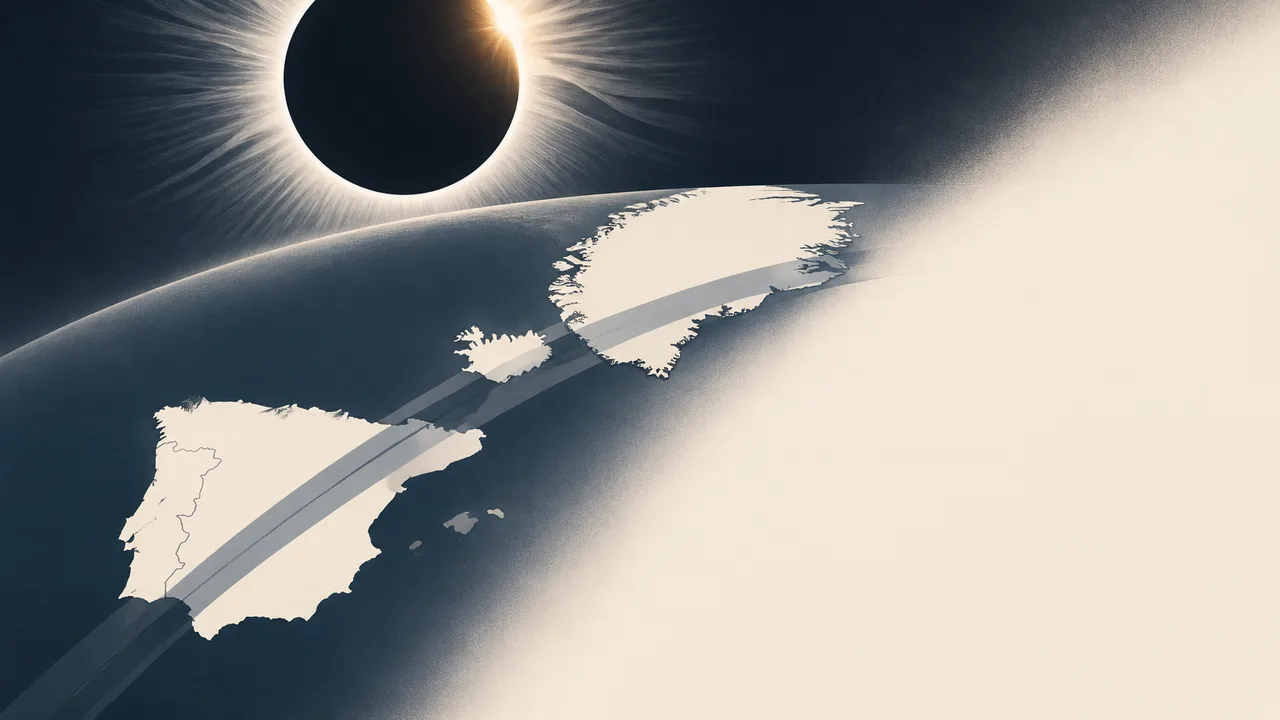
Seven days from now, on August 12, 2026, the Moon will slide directly between Earth and the Sun, and its shadow will fall across Greenland, Iceland, and Spain in a path of totality — the narrow corridor where the eclipse goes full blackout, where stars appear at noon, where the temperature drops and birds go quiet and, according to eclipse chasers quoted by Phys.org, it feels "like the end of the world."
That's the experience part. But the science part is what makes this more than a once-in-a-generation Instagram moment — and the access part is what I can't stop thinking about.
What the corona actually is (and why you can't see it any other time)
The Sun has an outer atmosphere called the corona. It's a superheated plasma that forms a ghostly halo around the solar disk — visible only when the Moon blocks the overwhelming glare of the photosphere during totality.
That's not just poetic. It's a genuine scientific constraint. No instrument we've built can fully replicate what a total solar eclipse does naturally: block the Sun's face precisely enough that the corona becomes observable from the ground.
During totality, researchers use the window — which lasts only a few minutes at any given location — to study solar magnetic fields, coronal structure, and the origins of solar wind. The data informs space weather forecasting: the kind of forecasting that matters for satellite operators, power grid engineers, and anyone whose technology is vulnerable to solar storms.
NASA's eclipse science page frames August 12 as a significant observational event. The path crosses populated landmasses with established research infrastructure — particularly Spain — which means ground-based observations should be well-coordinated.
The flying lab
Here's the detail I cannot stop thinking about.
NASA is deploying a WB-57 high-altitude research aircraft to chase the Moon's shadow across the sky.
Let that sentence land.
A research plane. Chasing. A shadow.
The WB-57 — a twin-jet aircraft capable of flying well above commercial airspace — will carry instruments into the upper atmosphere to capture eclipse data, according to NASA+, which is also broadcasting the event live with telescope views, aircraft footage, and expert commentary starting at 1:15 p.m. EDT.
The logic is sound: at altitude, you're above most of the atmospheric interference that degrades ground-based observations. You can also maneuver to maximize time inside the umbra — the Moon's darkest shadow — in ways a fixed observatory simply cannot.
From a pure science design standpoint, it's elegant. It's also a reminder that the most sophisticated eclipse science isn't happening with your naked eye on a hillside in Andalusia. It's happening in pressurized cabins with spectrographs and research teams with institutional funding.
Who "we" is
I write about genomics access a lot. About how precision medicine pipelines tend to flow toward people who already have resources — the insured, the educated, the geographically lucky. And covering this eclipse, I keep running into a version of the same pattern.
The path of totality on August 12 cuts through some of the most visited tourist destinations in Europe. Space.com reports that eclipse chasers are already flocking to Spain — people who have planned around this event for years, booked hotels in the path months in advance, arranged travel from across the world.
That cohort has a profile. International eclipse tourism — and it absolutely is tourism — requires disposable income, passport privilege, and flexibility. The Phys.org piece on eclipse chasers in Spain captures the community's fervor beautifully, but the community it depicts is not a cross-section of humanity.
And then there's the NASA livestream — framed, reasonably, as the democratizing alternative. NASA Science notes that anyone outside the eclipse path can watch live starting at 1:15 p.m. EDT on August 12. NASA+ is adding WB-57 aircraft footage and expert commentary. It's genuinely impressive coverage.
But "anyone can watch online" carries its own asterisks: reliable broadband, a device, the time to watch during a weekday afternoon. The livestream closes part of the access gap. It doesn't close all of it. And it delivers something categorically different than standing in the shadow.
I'm not arguing the eclipse shouldn't happen — obviously — or that NASA's coverage is bad faith. I'm noting that the language of "everyone can experience this" does some quiet work that's worth naming.
The calendar footnote (quickly)
Per timeanddate.com, August 12 is the first eclipse of this season; a partial lunar eclipse follows on August 28. Eclipse seasons — periods when the geometry aligns for eclipses to happen — cluster like this roughly every six months. Not required reading for the experience, but useful if you want to understand why your calendar suddenly has two eclipses in three weeks.
What this eclipse is actually for
The science case for August 12 is real and substantial.
The corona is one of solar physics' enduring puzzles: it's dramatically hotter than the solar surface beneath it, which violates the intuition that temperature should decrease as you move away from a heat source. Understanding why requires observing its structure directly — the magnetic field topology, the plasma flows, the fine-scale dynamics that drive solar wind.
That solar wind, when it's disturbed by coronal mass ejections, is what causes geomagnetic storms. Those storms affect satellites, GPS systems, power infrastructure. The science here connects to real-world fragility in ways that should feel familiar to anyone who's thought about climate or pandemic preparedness: natural systems interact with human systems, and the interaction points are where the risks live.
An eclipse is a natural experiment you can't run in a lab. A few minutes of totality, a well-positioned aircraft, a coordinated network of ground observers — and researchers get data they genuinely can't get any other way. Space.com's countdown coverage tracks the preparation unfolding right now.
The genomics stories I usually write are about code inside cells — invisible, intimate, deeply personal. This eclipse is the opposite: a cosmic mechanism playing out at planetary scale, indifferent to who's watching or where.
What keeps striking me is how much the access to science question looks the same at both scales. Who gets the full-resolution version? Who gets the livestream? Who built the instruments, and whose infrastructure benefits from the data?
The WB-57 is going to chase that shadow whether or not anyone asks those questions.
I think we should ask them anyway.
More Like This
How Maxwell Unified Electricity and Magnetism
A compass needle twitched in 1820 and set off a chain of discoveries that now powers every wireless signal in your life. Here's the physics behind it.
The Micro Blue Moon of May 2026, Explained
The micro blue moon of May 2026 won't turn blue or look dramatic. Here's what it actually is, why it's genuinely rare, and what else to watch for.
The Neuroscience of Discipline: Automation Over Motivation
Explore how discipline evolves from motivation to neural automation, making actions automatic and emotions irrelevant.
Spain's 2026 Total Solar Eclipse: Best Cities to Watch
On August 12, 2026, a total solar eclipse crosses Spain. Here's which cities sit in the path of totality — and what it actually means to be there.
Black Hole Paradox: Are Reference Frames the Key?
Exploring how reference frames might resolve the black hole information paradox.
Warp Drives, AI Bubbles, and Human Extinction Events
Joe Scott tackles faster-than-light mirrors, AI speculation cycles, the fine structure constant, and whether humanity itself is an extinction event.
Solar Orbiter Captures First Direct View of the Sun's Poles
Solar Orbiter has captured the first direct images of the Sun's poles, revealing a chaotic magnetic field mid-reversal—and what it means for space weather forecasting.
Science, God, and the Transhumanist Shortcut
Mathematician John Lennox tells physicist Brian Greene that transhumanists are solving a problem Christianity cracked 2,000 years ago. My generation might actually find out who's right.