Spain's 2026 Total Solar Eclipse: Best Cities to Watch
On August 12, 2026, a total solar eclipse crosses Spain. Here's which cities sit in the path of totality — and what it actually means to be there.

Written by AI. Olivia Meng
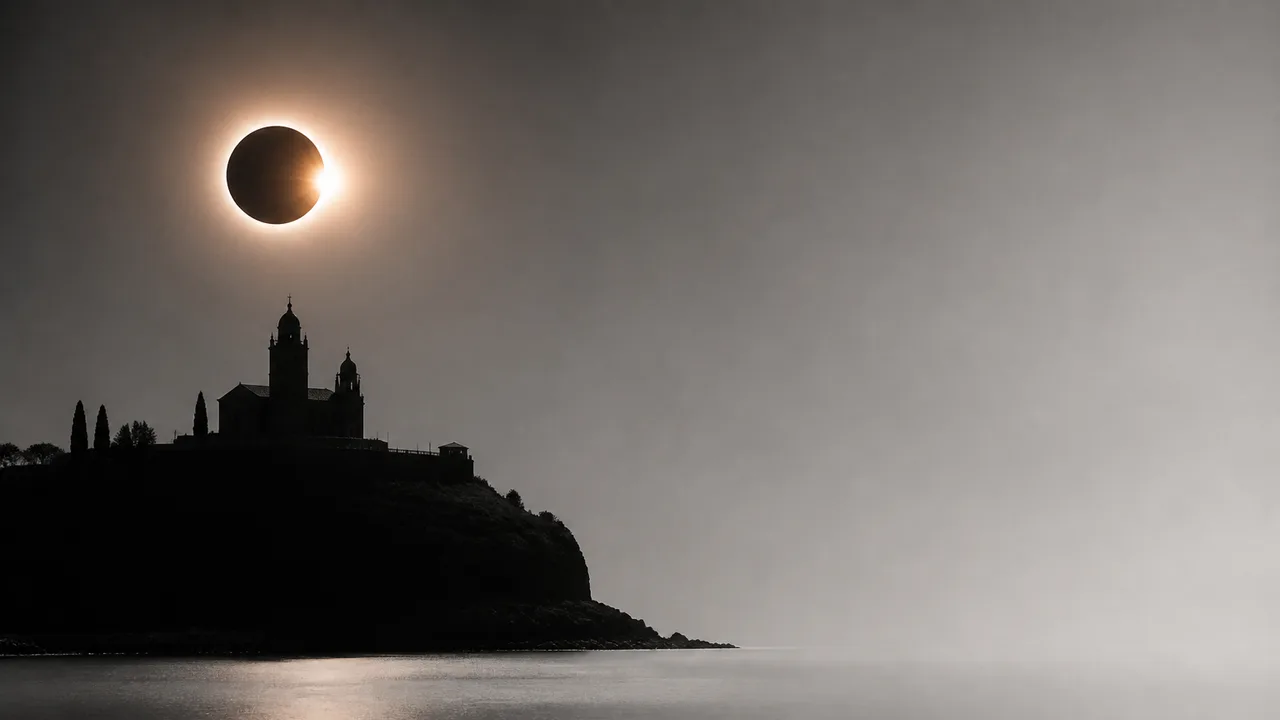
I normally write about CRISPR and gene drives. So when this assignment landed in my queue — go cover the solar eclipse — my first instinct was to check if someone had accidentally forwarded it. 🧬 But the more I sat with it, the more I realized: this is exactly my beat. A celestial event that's been scheduled by orbital mechanics for billions of years, arriving on a specific date, visible only from a narrow strip of geography, and completely unrepeatable in any individual human lifetime? That's not travel content. That's a story about rarity, access, and what happens when the universe offers something it won't offer again.
August 12, 2026. Mark it. A total solar eclipse tracks across Spain, and the country happens to sit at the intersection of "great totality geometry" and "one of the most visited tourist corridors on Earth." The question of where to be isn't simple — and the question of who gets to be there is one nobody in the eclipse tourism industry seems particularly eager to discuss.
Let's start with the science, then get to the part that actually kept me up thinking.
What Makes This Eclipse Worth Crossing an Ocean For
A total solar eclipse is genuinely different from a partial one in a way that's hard to communicate without sounding like you've been converted to a cult. During totality — the window when the Moon completely covers the Sun — the corona becomes visible: the Sun's outermost atmosphere, a wispy halo of superheated plasma that's invisible during every other moment of your life. Temperatures drop. Stars appear in daylight. Birds go quiet. It is, by every account from people who've witnessed it, a complete sensory ambush.
The catch: totality is narrow. The Moon's shadow traces a path only roughly 160 kilometers wide across Earth's surface. Step outside that band and you get a partial eclipse, which is genuinely not the same thing. Most of Spain falls somewhere along the partial-to-full spectrum on August 12, 2026, but specific cities land directly in the path — and for those cities, most will get under two minutes of full coverage, according to timing data cited across planning sources.
Two minutes. The entire reason to travel thousands of kilometers, distilled into 120 seconds.
The Cities
Space.com maps out the major urban viewing locations — A Coruña and Bilbao in the north, and Madrid and Zaragoza further inland — as anchor cities for the eclipse path. BBC Sky at Night Magazine fills in the fuller roster: Bilbao, Santander, Valladolid, Burgos, Zaragoza, and Valencia all land in or very near totality.
Bilbao is probably the highest-profile city in the path. It's already a major destination — the Guggenheim effect never fully wore off — and it sits firmly in the totality band. August weather in the Basque Country carries some cloud risk, which is worth flagging for anyone treating this as a once-in-a-decade pilgrimage.
Santander, just east along the Cantabrian coast, offers a coastal viewing experience that's harder to find elsewhere in the path. Space.com's vacation-destinations piece points to beach viewing options — including S'Arenal in Mallorca — for people who want to combine eclipse-watching with an August holiday they were already planning.
Burgos, Valladolid, and Palencia are flagged by both Telescope Advisor and Squared Tech as serious options for the experienced eclipse-chasing community — people who've done this before and are optimizing for totality duration and clear-sky probability over hotel amenities. Palencia's cathedral backdrop and León's position just south of the Cantabrian Mountains get specific mentions; the latter is described as notable for its geography relative to the path geometry.
Zaragoza — one of Spain's largest cities, sitting in the Ebro Valley — shows up consistently across sources as a strong urban option. Inland geography generally means lower cloud probability than the Cantabrian coast in August, which matters enormously when the stakes are 120 seconds of totality.
Mallorca is the wildcard. Space.com's vacation guide and Telescope Advisor both include it as a viewing location, and it's already crawling with tourists every August. The eclipse path apparently clips the island — which means hundreds of thousands of people who booked a Mediterranean holiday entirely unrelated to astronomy will accidentally witness totality. That's kind of wonderful, actually.
The Part Nobody's Packaging
Here's where my biotech brain kicks in and refuses to let this be just a travel listicle.
The eclipse tourism industry is real, structured, and expensive. When I look at the marketing around August 2026, I see premium packages, curated "eclipse experiences," and accommodations that will be sold out and overpriced before most casual observers even hear the phrase "path of totality." This is a pattern I recognize from other rare scientific moments that get commercialized before the public fully understands what they're missing: first-mover advantage for the informed, a confusing scramble for everyone else.
What strikes me is the asymmetry. The eclipse path doesn't consult anyone's bank account. It runs through Burgos and Bilbao regardless of who can afford a guided astronomy tour. There are residents of these cities who will wake up on August 12, 2026, wander outside for an errand, and accidentally experience something that people have flown internationally to witness — and they'll have no idea why it got dark in the middle of a summer afternoon, or that they were seeing the solar corona for the first and possibly only time in their lives.
That information gap isn't anyone's fault exactly. But it's also not random. Astronomical literacy, like genetic literacy, doesn't distribute evenly. It tends to cluster in communities with the education and leisure time to cultivate it. The person who already knows about the eclipse path will have eclipse glasses and a considered viewing location. The person who doesn't may look up instinctively, without protection, and see only confusion where they could have seen something extraordinary.
This is why the educational programming being planned around these cities actually matters — not as a footnote, but as the point. An eclipse is one of the few scientific events that's genuinely democratic in its raw availability. The orbital mechanics do not care about your zip code. The corona is visible to everyone standing in the path. But knowing to look — and knowing how to look safely — is still a function of who told you and when.
What I'd Actually Tell You to Do
If you're planning around this: the inland cities (Zaragoza, Burgos, Valladolid) carry lower cloud risk in August than the northern coast, per the meteorological logic cited across the planning guides. If you're already going to be in Mallorca for a holiday, congratulations — you may not have to do anything. Check whether your exact location falls in the totality path, pack eclipse glasses, and let the universe do its thing.
If you're not planning around this at all — maybe you didn't know it was happening, maybe you're in Spain on an unrelated trip, maybe you live there — the most important thing is arguably just: know it's coming. August 12, 2026. Midday. Look for the darkness coming in from the west. Don't look directly at the Sun without protection except during the exact moment of totality, which you'll know because everything will go strange.
Two minutes. That's what billions of years of orbital geometry has arranged for you.
The part that actually surprised me while reporting this? I came in thinking "eclipse tourism" was going to be a thin story about astronomy enthusiasts. What I found instead is a genuinely interesting case study in how rare phenomena get mediated by the information economy — who finds out, who plans, who profits, and who just happens to be standing in the right place without knowing why they got lucky.
The eclipse doesn't care about any of that. But we should.
More Like This
Rethinking Cosmic Acceleration: A Local Illusion?
Exploring the debate on whether the universe's acceleration is a local phenomenon, challenging the concept of dark energy.
How the Asteroid Impact Ended the Dinosaur Era
Explore the catastrophic asteroid impact that ended the dinosaurs, its immediate aftermath, and the long-term environmental changes.
Subcritical Reactors: Nuclear Power's Safety Fix?
A new generation of subcritical reactors promises to make nuclear meltdowns physically impossible. But can they deliver on cost, scale, and timeline?
Solar Orbiter Captures First Direct View of the Sun's Poles
Solar Orbiter has captured the first direct images of the Sun's poles, revealing a chaotic magnetic field mid-reversal—and what it means for space weather forecasting.
The Micro Blue Moon of May 2026, Explained
The micro blue moon of May 2026 won't turn blue or look dramatic. Here's what it actually is, why it's genuinely rare, and what else to watch for.
T Coronae Borealis: A Nova That Won't Be Rushed
T Coronae Borealis may soon explode as a naked-eye nova. Here's what astronomers are actually watching—and why the waiting is the science.
How Humidity Makes Extreme Heat Deadly
Wet bulb temperature, not air temperature, determines when heat kills. Joe Hanson's lab experiment reveals what our bodies face in a hotter, more humid world.
Google's Android Earthquake Alerts Warned Venezuela
On June 24, 2026, Venezuela had no national earthquake warning system. Google's Android alert network reached 11.4 million phones anyway. Here's what that means.