Solar Orbiter Captures First Direct View of the Sun's Poles
Solar Orbiter has captured the first direct images of the Sun's poles, revealing a chaotic magnetic field mid-reversal—and what it means for space weather forecasting.

Written by AI. Mei Zhang
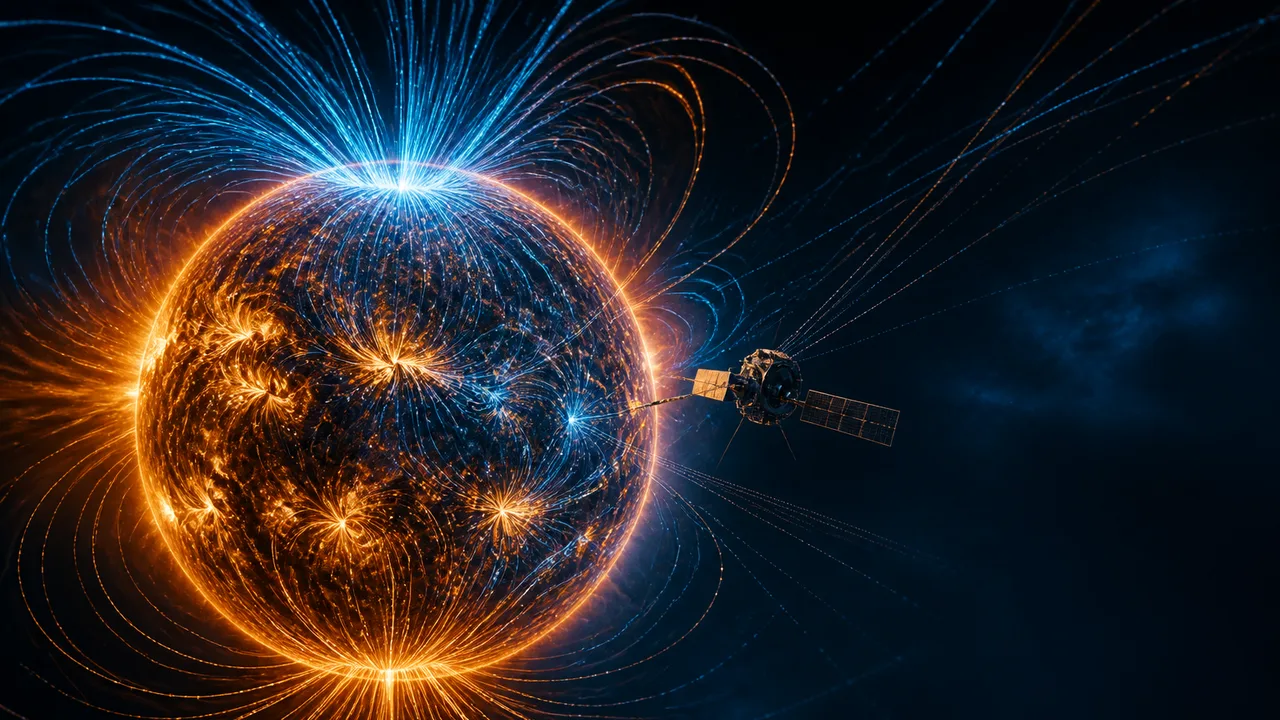
Photo: AI. Dante Nwosu
For decades, we had a surprisingly large blind spot when it came to studying our own star. Not because the Sun is that far away—it's 93 million miles, which is practically next door by cosmic standards—but because of something almost embarrassingly mundane: the angle.
Every spacecraft that ever studied the Sun in detail did so from roughly the same vantage point, the flat orbital plane where Earth and the other planets circle. That's great for watching the Sun's equatorial belt, its sunspot activity, its surface churning. But the poles? Those stayed stubbornly out of frame, like trying to read the top of someone's head when you're only ever standing at eye level.
Solar Orbiter just changed that. And what it found at the Sun's South Pole is not the tidy, calm region scientists might have hoped for. It's a mess—magnetically speaking—and that mess might be telling us something important about how our star works.
The View Nobody Had Before
Solar Orbiter is a joint mission between ESA and NASA, launched in February 2020. What makes it geometrically clever is its orbital design: the spacecraft uses repeated gravitational assists from Venus to gradually tilt its orbit, climbing away from the planetary plane and giving it an increasingly steep look at the Sun's polar regions. According to NASA Space News's breakdown of the mission, "Solar Orbiter changed the situation by slowly tilting its orbit using repeated flybys of Venus. Instead of flying in the usual planetary plane forever, the spacecraft gradually moved into a position where it could look toward the Sun's polar regions from a new angle."
That's not nothing. ESA has confirmed that Solar Orbiter carries a suite of ten science instruments—including imaging tools and magnetic field sensors—that its predecessor Ulysses simply didn't have. Ulysses flew over the Sun's poles in the 1990s and early 2000s and measured particle flows and solar wind, but it couldn't image what it flew over. Solar Orbiter can. That combination of direct imagery, magnetic maps, and in-situ particle measurements is what makes this moment different from anything that came before.
The first major result from this new vantage point: the South Pole is not dominated by a single, clean magnetic polarity the way a stable polar region should be. Instead, scientists are seeing a complicated mixture of north and south magnetic fields coexisting in the same polar area. In the language of the mission's observations: "The data showed a complicated mixture of magnetic polarities. North and South magnetic fields seem to exist close together in the same polar area."
Why a Magnetic Mess Makes Sense Right Now
Here's where timing matters a lot. Solar Orbiter captured these polar views near solar maximum—the peak of the Sun's roughly 11-year activity cycle, the period of maximum sunspots, eruptions, and magnetic turbulence. And solar maximum isn't just the Sun being dramatic. It's also the moment when the Sun's global magnetic field is preparing to flip entirely. North becomes South. South becomes North.
Scientists have known this reversal happens. What they've never had is a direct look at the poles while it's happening. The mixed magnetic pattern Solar Orbiter observed may be showing the Sun caught mid-reset—the old magnetic structure weakening before the new one has fully established itself. As the NASA Space News video frames it: "The mixed magnetic pattern near the south pole may be showing the Sun in the middle of that reset. The old magnetic structure may be weakening, while the new one has not yet taken control."
This interpretation has real precedent. Research published in Solar Physics and related journals has long documented that polar magnetic field strength measured late in a solar cycle can predict the intensity of the next cycle. Weak polar fields at solar maximum have historically preceded weaker subsequent cycles; strong fields have preceded stronger ones. That pattern—sometimes called the polar field precursor method—was identified through indirect measurements. What Solar Orbiter is now potentially offering is a way to watch the mechanism that produces those precursor signals directly, not infer it after the fact.
The Sun's behavior here is worth understanding on its own terms. The Sun isn't a solid object with a clean bar magnet inside. It's plasma all the way down—charged gas in constant motion, where magnetic field lines get tangled, dragged, and reorganized by fluid dynamics across a sphere 1.4 million kilometers wide. NOAA's Space Weather Prediction Center (SWPC), which monitors solar activity and issues space weather forecasts for the U.S., describes the solar magnetic cycle as one of the most consequential but least understood drivers of the near-Earth space environment. Better models of how the poles reorganize after reversal would feed directly into the SWPC's forecasting infrastructure—the same infrastructure that alerts satellite operators, power grid managers, and aviation authorities when a major storm is incoming.
The Unanswered Question Worth Sitting With
There's a genuinely unresolved scientific question at the center of this, and it's the kind that should make anyone intellectually curious lean forward: Is the polar magnetic chaos just a symptom of the solar cycle, or is it actually one of its causes?
In other words, do the poles passively reflect what the rest of the Sun is doing, or do they actively participate in shaping what the next cycle will look like? That distinction matters enormously for forecasting. If the poles are just mirrors, watching them tells you where the Sun has been. If they're drivers, watching them tells you where it's going.
The NASA Space News video is careful not to overclaim here—and that's actually the right call: "But, one part is still unresolved. Whether the pole is only reacting to the solar cycle, or whether it helps shape what the next cycle becomes." Scientists can't answer that from a single observation. What Solar Orbiter has given them is the first real chance to build a time-lapse of the polar magnetic field, watching how the mixed-polarity chaos either resolves cleanly into one dominant field or behaves in messier, more complex ways than current models predict.
If the South Pole gradually settles into a single magnetic polarity as solar maximum passes, that's the models working. If the process is irregular, slower, or stranger than expected, then those models need revision—and that's arguably the more interesting outcome.
What's Actually at Stake
The practical stakes here are not abstract. The Sun's magnetic cycle shapes the heliosphere—the enormous bubble of solar wind that surrounds the entire solar system, extending far beyond Pluto. NOAA tracks space weather events because strong solar storms can knock out GPS signals, disrupt high-frequency radio communications, accelerate radiation dose for airline passengers on polar routes, and—in extreme cases—induce currents in power grids large enough to damage transformers. The 1989 Quebec blackout, which left millions without power for hours, was caused by a geomagnetic storm.
Better forecasting of the solar cycle means earlier warning. Earlier warning means power utilities can take protective measures, satellite operators can adjust orbits or switch to safe mode, and astronauts on the ISS can shelter in more shielded modules. None of that happens without a better model of what drives the cycle—and that model runs through the poles.
Solar Orbiter's orbit will continue tilting, giving researchers increasingly overhead views of the polar regions at different moments in the cycle. What matters now is the comparison: how does the South Pole look at solar maximum versus solar minimum? How does the new magnetic polarity establish itself? Does the polar field strength at the end of this cycle align with what the precursor models would predict for the next one?
"The real discovery may come from watching what happens next, whether the disorder fades, how the new magnetic field forms, and whether that process can help predict the sun's future behavior," the mission analysis notes. That framing—not the first image, but the sequence of images—is where the science actually lives.
The Sun has been doing this magnetic reset every 11 years for as long as it's existed. We just finally have eyes on the part of it where the reset happens. 🌞
— Mei Zhang, Biotech & Genetics Reporter, Buzzrag
More Like This

Webb Detects Methane on Interstellar Comet 3I/ATLAS
Webb's MIRI instrument detected methane on interstellar comet 3I/ATLAS after perihelion—a timing that hints at buried volatile layers from another planetary system.

Betelgeuse's Hidden Star: Solving Celestial Mysteries
Unveiling Betelgeuse's hidden companion star reshapes our understanding of stellar evolution and supernova precursors.
SMILE Spacecraft: X-Raying Earth's Magnetic Shield
ESA and China's SMILE spacecraft launched May 2026 to image Earth's magnetosphere in X-rays—here's why that perspective shift matters for space weather science.
How Io's Shadow Revealed the Speed of Light
How 17th-century astronomers tracking Jupiter's moon Io—for colonial navigation—accidentally measured the speed of light. The discovery that changed physics.
Jupiter's Storms Run Deeper Than Anyone Expected
NASA's Juno probe reveals Jupiter's storms plunge 1,800 miles deep—and the sun isn't powering them. Here's what scientists think is going on inside.

Black Hole Paradox: Are Reference Frames the Key?
Exploring how reference frames might resolve the black hole information paradox.

Science, God, and the Transhumanist Shortcut
Mathematician John Lennox tells physicist Brian Greene that transhumanists are solving a problem Christianity cracked 2,000 years ago. My generation might actually find out who's right.
Solar Flares, Earth's Magnetosphere, and StormWall
Recent X-class solar flares and CMEs have prompted serious discussion about Earth's space weather vulnerability—and a theoretical plasma shield called StormWall.