ISS Antenna Replaced in Two-Spacewalk Operation
NASA's Anil Menon and ESA's Sophie Adenot completed a two-part spacewalk operation to replace a failed Ku-band antenna on the ISS, restoring full communication redundancy.

Written by AI. Amelia Nwofor

There's a phrase that got passed between mission control and the crew of the International Space Station on August 25: "You just saved the video dish." It's the kind of line that only makes full sense when you know what came before it — and what almost didn't happen.
According to Space.com, NASA astronaut Anil Menon and ESA astronaut Sophie Adenot completed a 6.5-hour spacewalk on August 25, 2026, to replace a critical Space-to-Ground antenna on the ISS. The job closed out what had effectively become a two-part operation — and understanding why it took two trips outside the station is the more interesting story here.
A Job That Couldn't Be Finished in One Sitting
The August 25 spacewalk didn't come out of nowhere. Starlust.org reports that Menon and Adenot had already conducted a prior spacewalk on August 18 — a 6 hour and 23 minute excursion that ran longer than expected — during which they removed the failed antenna and secured it to the station's truss structure. The replacement installation, then, was left for the follow-up EVA a week later.
Split EVAs like this aren't unheard of in ISS maintenance history, but they're also not routine. They reflect a situation where the task scope exceeded what could be safely or practically accomplished in a single outing. The first walk ran long. The crew came back in. The job waited. That sequence carries its own operational weight — every day the replacement sat uninstalled was another day the station ran without that communication redundancy in place.
Time.news provides the crucial framing here: the antenna failure that triggered all of this happened back in November, meaning the station operated for roughly nine months with degraded redundancy before the repair was completed. That's not necessarily alarming — redundant systems exist precisely so that a single failure doesn't become a crisis — but it's worth sitting with. Nine months is a long time to rely on your backup.
What the Antenna Actually Does
The component in question is a Ku-band antenna, part of the station's Space-to-Ground communication architecture. Rediff.com describes it as a key link in restoring "redundant communication capabilities," and that word — redundant — is doing serious work.
Ku-band systems on the ISS carry both high-data-rate science downlinks and real-time video communications with ground control. If you've ever watched a live feed of astronauts working inside the station, that signal almost certainly passed through a Ku-band relay. KeepTrack.space refers to it specifically as a "video communications antenna," which explains mission control's shorthand about saving the video dish.
The loss of a single antenna doesn't cut the station off — the ISS has multiple communication pathways, including S-band systems and TDRS satellite relay infrastructure built specifically to prevent single-point failures. But redundancy is the whole point of that architecture. When one layer goes down, you're one more failure away from a serious problem. Restoring the Ku-band unit doesn't just fix a convenience issue; it restores the safety margin the system was designed around.
Who Did the Work
It's worth pausing on the crew composition here, because it represents something the ISS was specifically designed to enable. Anil Menon is a NASA astronaut — a physician and former SpaceX flight surgeon who made his first spaceflight in 2023. Sophie Adenot is a French helicopter test pilot and ESA astronaut who joined the European astronaut corps in 2022, also making her first long-duration mission to the station. Two first-timers — from two different agencies, with very different professional backgrounds — executing a multi-part EVA on a piece of hardware that the station genuinely needed fixed.
The BBC's coverage of the spacewalk captured the moment, and the broader picture it illustrates is one of international operational integration that often gets flattened into press-release language about "collaboration." What actually happened here is that a NASA engineer and an ESA test pilot spent over twelve combined hours outside a structure orbiting 250 miles above Earth, doing careful hardware work in an environment that punishes improvisation. That's the collaboration. It's less photogenic than a handshake, but considerably more useful.
The Maintenance Problem Nobody Talks About
There's a structural tension in how we cover ISS operations that this story surfaces cleanly: the station is consistently celebrated as a scientific achievement, and less consistently acknowledged as an aging machine with an escalating maintenance burden.
The ISS has been continuously inhabited since November 2000. Its core modules were launched in the late 1990s and early 2000s. NASA and its international partners have extended the station's planned operational life multiple times, with the current target around 2030, though that timeline carries real engineering uncertainty. The gap between when hardware was designed and when it's expected to keep working is widening, and EVA time — which is finite, physically demanding, and resource-intensive — gets consumed by maintenance that was never part of the original operational picture.
This antenna replacement is, by the standards of ISS maintenance history, a relatively clean success: failed hardware identified, replacement sourced, two-part EVA executed, redundancy restored. The system worked the way it was supposed to. But the fact that a November antenna failure required two spacewalks across two different weeks in August to fully resolve is itself informative. These jobs are hard. They take time. They take crew capacity that might otherwise go toward science objectives.
None of this is an argument against the ISS or its maintenance. It's an argument for taking seriously what it actually means to keep a 25-year-old orbital laboratory operational while simultaneously planning successor architectures. NASA is already working with commercial partners on future low-Earth-orbit stations; the ISS serves, among other things, as the proving ground for understanding what that transition actually requires.
What a Six-Hour Spacewalk Costs
Six and a half hours in a spacesuit is not a trivial ask. EVA suits are pressurized environments unto themselves — they maintain atmospheric integrity, thermal regulation, oxygen supply, and carbon dioxide scrubbing while the wearer performs fine motor tasks against the resistance of pressurized gloves, in vacuum, with no margin for equipment failure. Astronauts lose grip strength measurably over the course of a long EVA. Cooling systems run at capacity. The suits themselves — NASA's Extravehicular Mobility Units — are old enough to have their own maintenance histories.
The August 18 walk ran longer than planned at 6 hours and 23 minutes, per Starlust.org. The August 25 walk went 6.5 hours. That's nearly thirteen hours of combined EVA time across two spacewalks for what is, in principle, a single antenna swap. The planning behind that — pre-breathing protocols, suit integrity checks, timeline buffers, contingency procedures — represents hundreds of hours of ground support work that never makes it into a headline.
When mission control said "you just saved the video dish," they were acknowledging a genuinely difficult piece of work, not just a technical checkbox. The astronauts hearing that knew exactly what it cost to get there.
The ISS will require more repairs before 2030. Some will be simpler than this one. Some won't. The question hovering over every EVA on an aging station is whether the maintenance infrastructure — suits, crew time, ground support capacity — scales alongside the hardware's increasing need for it. This antenna replacement answers that question for one specific component, on one specific day. The broader question stays open.
More Like This

Exploring the Enigma of Negative Time in Quantum Physics
Dive into the perplexing world of negative time in quantum physics with insights from Prof. Aephraim Steinberg.
Space Stations Beyond the ISS: A Forgotten History
From a Cold War spy base to a Soviet ice rescue to China's chicken-wing oven in orbit — the real history of space stations is wilder than you think.
AstroRad Vest Passes Artemis I Radiation Test
A radiation-shielding vest tested on Artemis I shows real promise for lunar and Mars missions. Here's what the data actually tells us—and what it doesn't.
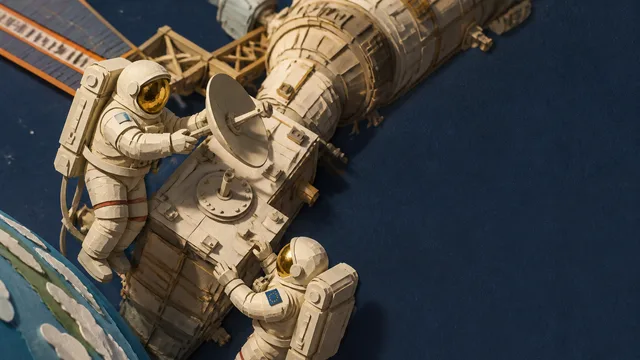
ISS Antenna Spacewalk Reveals a Station Past Its Prime
Menon and Adenot spent 6 hours outside the ISS and still couldn't finish the job. The real story is what that says about a 25-year-old station we can't yet replace.

The Real Hazards of Space Exploration, Explained
From orbital debris to solar flares and the psychology of deep-space confinement, a rigorous look at what actually threatens human spaceflight.
Webb Detects Methane on Interstellar Comet 3I/ATLAS
Webb's MIRI instrument detected methane on interstellar comet 3I/ATLAS after perihelion—a timing that hints at buried volatile layers from another planetary system.
A Black Hole Photon Ring Inspired a New Laser Design
Researchers built a laser using the light-trapping geometry of black hole photon spheres. Here's what the experiment actually shows—and what it doesn't.

Cold Spark Machines Are Hot — Just Not How You Think
Cold spark machines are marketed as safe firework alternatives, but the science tells a more complicated story. Here's what's actually happening inside those sparks.