The Real Hazards of Space Exploration, Explained
From orbital debris to solar flares and the psychology of deep-space confinement, a rigorous look at what actually threatens human spaceflight.

Written by AI. Priya Sharma
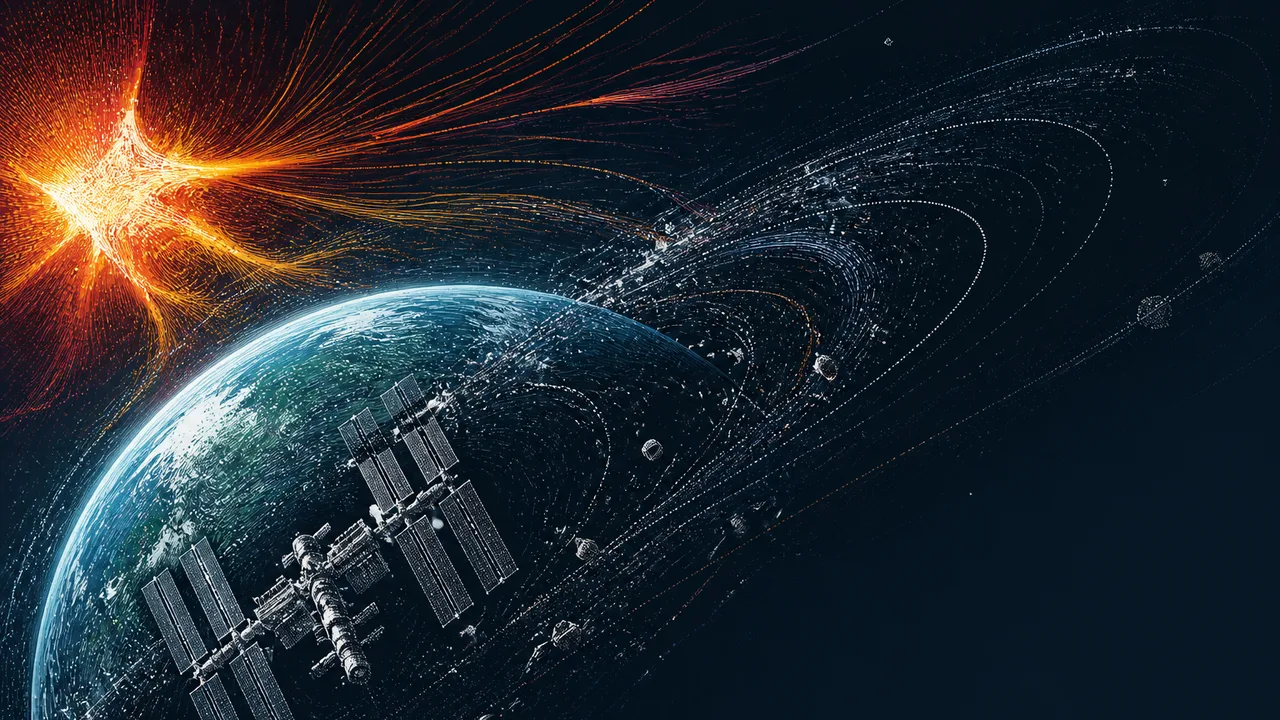
Photo: AI. Dexter Bloomfield
Imagine a speck of paint — not a boulder, not a missile, a fleck of paint — traveling at 17,500 miles per hour. At that velocity, it carries enough kinetic energy to pit the reinforced window of a spacecraft. Shuttle crews came back from missions with small craters in the glass the size of a pencil point, caused by debris so small it couldn't be tracked by any sensor on Earth. This is the texture of the hazard environment in low Earth orbit: much of what can kill you is invisible until it has already done its damage.
The History Channel's The Universe marathon, "Space Disasters That Could End Humanity," works through this catalog of threats in roughly chronological order of mission timeline — from launch to orbit to deep space to the surfaces of other worlds. At over two hours, it's a long sit, and it sometimes trades scientific precision for dramatic framing. But strip away the production scaffolding and you're left with a genuinely useful map of the engineering and biological challenges that human spaceflight has always faced and has not yet solved.
Orbit Is Not Empty
The documentary's most grounded material concerns Earth orbit, and specifically the debris problem. Since Sputnik's launch in 1957, low Earth orbit has been accumulating the residue of every rocket stage, defunct satellite, and collision event that followed. By the time the documentary was produced, that total had grown to roughly 20,000 trackable objects — and the Joint Space Operations Center (JSpOC), the publicly acknowledged command under U.S. Space Command based at Vandenberg Air Force Base, was tracking all of them using a global network of 29 radar and optical sensor stations. The threshold for tracking is about two inches wide. Everything smaller than that — and there is a great deal smaller than that — goes unmonitored.
China's 2007 anti-satellite test, in which the Chinese military deliberately destroyed one of its own weather satellites, added a significant volume of debris to the environment and drew sharp international condemnation. The precise scale of the increase remains a matter of ongoing measurement rather than a settled figure, but the general trajectory is not in dispute: the debris population is growing, and the statistical insurance policy against a catastrophic collision with an inhabited spacecraft will not hold indefinitely. As one speaker in the documentary puts it plainly: "We rely on the fact that you're just statistically unlikely to hit a piece of debris to protect you. And that insurance policy is going to run out someday."
The documentary's answer to this problem — better tracking, better maneuvering, better construction — is correct but incomplete. It doesn't engage with the active debris removal proposals that have circulated in the aerospace community, or with the Kessler Syndrome scenario in which a cascade of collisions could render entire orbital bands unusable. Those are real discussions happening in real institutions. Their absence from a television documentary is understandable; their absence from policy planning would not be.
The Sun Does Not Negotiate
The section on solar radiation is where the documentary's stakes feel most viscerally real. On Earth, we barely notice solar flares. The atmosphere and magnetosphere absorb the charged particle flux and we go about our day. On the moon, which has neither an atmosphere nor a magnetic field, a major flare is a different proposition entirely.
The documentary notes that in August 1972, a significant solar storm occurred in the gap between the Apollo 16 mission in April and the Apollo 17 mission in December. Had either crew been on the lunar surface during that event, the radiation dose would likely have been fatal. The comparison offered — to those who survived the initial blast at Hiroshima and Nagasaki only to die from acute radiation exposure — is stark, and not melodramatic. That is what acute, high-dose radiation sickness looks like.
Future lunar or Martian colonists would need real-time space weather forecasting systems with enough lead time to reach shelter before the particle flux arrives. Sunlight, traveling at the speed of light, takes about eight minutes to reach the moon. The energetic particles in a flare arrive minutes to roughly half an hour later. That window is workable — but only if the monitoring infrastructure exists and the shelter is close enough to reach in time.
Fire in a Sealed Box
The documentary dedicates a substantial segment to fire in spacecraft, and the physics here are counterintuitive enough to be worth dwelling on. In zero gravity, there is no convection. Hot gases don't rise; they accumulate spherically around the flame source. A smoke detector mounted on a ceiling, the standard Earth approach, would be useless — which is why spacecraft detectors are located next to small suction devices that actively draw air past the sensor.
The deeper problem, as researchers at UC Berkeley's Combustion Lab have found through experiments in zero-gravity flight conditions, is that spacecraft fires are not necessarily less dangerous in microgravity — they can be more so. Air conditioning systems create small currents that supply fresh oxygen to a flame while the lack of buoyancy means heat dissipates more slowly. The result is a hotter, more sustained burn than you might see in the same conditions on the ground.
There is also the oxygen concentration problem. EVA spacesuits operate at low pressure with 100% oxygen — necessary for flexibility, but creating a fire environment of extraordinary intensity. A spacesuit arm burned in a 1980 ground test at Johnson Space Center provides a tangible reminder: the suit was valued at $3.1 million, and NASA spent $20 million redesigning around the vulnerability. The fire hadn't even involved a person.
The Human Element
Perhaps the most underappreciated section of the documentary addresses crew psychology on long-duration missions. The engineering problems of a Mars mission are significant. The human problems may be harder to solve.
"If you're cooped up in a tiny space capsule for, let's say, a year at a time going to Mars," one expert observes, "you can go crazy. You can get claustrophobic. The guy next door could really get on your nerves and you want to strangle him after a certain point." This is not merely colorful speculation. There is documented history of crew friction aboard Soviet space stations, including incidents serious enough that they became known within the space community even if they weren't widely publicized at the time. The selection and psychological support of long-duration crews is an active research area, and one where the scientific literature is considerably more textured than a documentary segment can convey.
The supply problem for Mars is equally unforgiving. A resupply mission from Earth, depending on orbital alignment, can take anywhere from months to years to arrive. An accident that destroys half a colony's consumables doesn't just create a crisis — it may create an unsurvivable one. "You think you've got enough to last, you lose half of it through an accident, you're dead." That is the bluntest possible summary of a logistics challenge that every credible Mars mission plan must answer.
Saturn and What Lies Beyond
The documentary's second major arc takes a step back from immediate human survival to explore planetary ring systems, using Saturn as the central case study. This is well-trodden ground — Saturn's rings have been imaged in extraordinary detail by the Cassini spacecraft, which orbited the planet for 13 years before its 2017 deorbit — but the documentary does a reasonable job of conveying why the rings remain scientifically interesting rather than merely photogenic.
The core tension is gravitational. Saturn's rings are not static; they are the product of an ongoing war between the gravity of ring particles pulling toward each other and Saturn's tidal forces pulling them apart. Particles in the innermost rings move faster than those in the outermost ones, which prevents them from clumping together into moons. The result is a structure spanning roughly 180,000 miles in diameter but averaging less than 30 feet thick — a sheet of paper scaled to the size of a continent, made of ice and rock and moving at up to 53,000 miles per hour.
Where the rings came from remains genuinely contested. One hypothesis holds that they are primordial debris from Saturn's formation 4.5 billion years ago. The competing theory, which recent mass measurements from Cassini have tilted toward, is that the rings are far younger — perhaps only 100 million years old — and formed when a moon or a captured object strayed inside Saturn's Roche limit and was pulled apart by tidal forces. If the younger origin is correct, early dinosaurs looking up at Saturn would have seen a different planet. We happen to be living at an extraordinary moment in geological time, when the rings are present and we have the instruments to study them.
Evidence for geologic activity on Saturn's moon Enceladus — water geysers that eject material hundreds of miles into space, continuously replenishing Saturn's E-ring — accumulated across multiple Cassini flybys beginning in 2005. The significance of that activity for astrobiology remains an open question. What the data establishes clearly is that Enceladus is not a dead world. Whether it hosts conditions compatible with life is a question for future missions, not current evidence.
Acceptable Risk, Honestly Reckoned
"If we're going to continue human space flight, we have to accept the risk because it is a very dangerous occupation. But we have to manage the risk and that's going to require good technical people and good leadership."
That quote from the documentary lands differently depending on where you sit. To an engineer, it's a design brief. To a policymaker, it's a budget argument. To an astronaut, it's a daily reality. The documentary doesn't resolve the tension between humanity's evident drive toward exploration and the very real cost that drive has sometimes extracted — in Challenger, Columbia, and in the near-misses that never made the news cycle.
What the documentary does, when it's working well, is translate that tension into specific, concrete engineering problems: how do you track debris you can't see? How do you evacuate an astronaut from a spacecraft that has no ejection mechanism? How do you design a shelter that can be reached in the minutes between a solar flare's light and its particles? These are tractable questions, which means they have answers — and the answers require investment, international cooperation, and the willingness to sit with the fact that some risk will always remain.
The question of whether that residual risk is worth bearing is one the documentary wisely leaves to the viewer.
More Like This

How Opponent Recognition Unlocks Cooperation in Evolution
A Rutgers physicist argues that tailoring cooperation to specific opponents—not blanket strategies—may be evolution's simplest path out of the Prisoner's Dilemma trap.
Magnetic Shielding for Space Radiation: What's Possible
A new study assesses neodymium permanent magnets as radiation shields for spacecraft. Here's what the physics allows, what it doesn't, and why this problem won't go away.
CERN's LHC and the Search for Hidden Dimensions
Inside CERN's Large Hadron Collider: how 600 million proton collisions per second could reveal dark matter, extra dimensions, and the Higgs boson.
Mir 1997: When Heroism Was the Backup Plan
Michael Foale's retrospective on the 1997 Mir collision reveals what really saved the station—and what it means for the future of human spaceflight.
Exploring Black Holes and Asteroids with StarTalk
Neil deGrasse Tyson delves into black holes, asteroids, and more in StarTalk's latest Cosmic Queries episode with Chuck Nice.
How Scientists Would Actually Stop an Asteroid
From detecting unseen threats to slamming spacecraft into space rocks, here's what humanity's real planetary defense infrastructure looks like.
The Solar System May Have Started With Six Giant Planets
A new study suggests the early solar system had six giant planets, not four. Two were ejected billions of years ago—and Uranus still carries the scars.

How the Brain Decides What Is Real and What Is Not
UCL neuroscientist Nadine Dijkstra explains how the brain constructs reality, why imagination isn't hallucination, and what breaks when the system fails.