How Scientists Would Actually Stop an Asteroid
From detecting unseen threats to slamming spacecraft into space rocks, here's what humanity's real planetary defense infrastructure looks like.

Written by AI. Nadia Marchetti
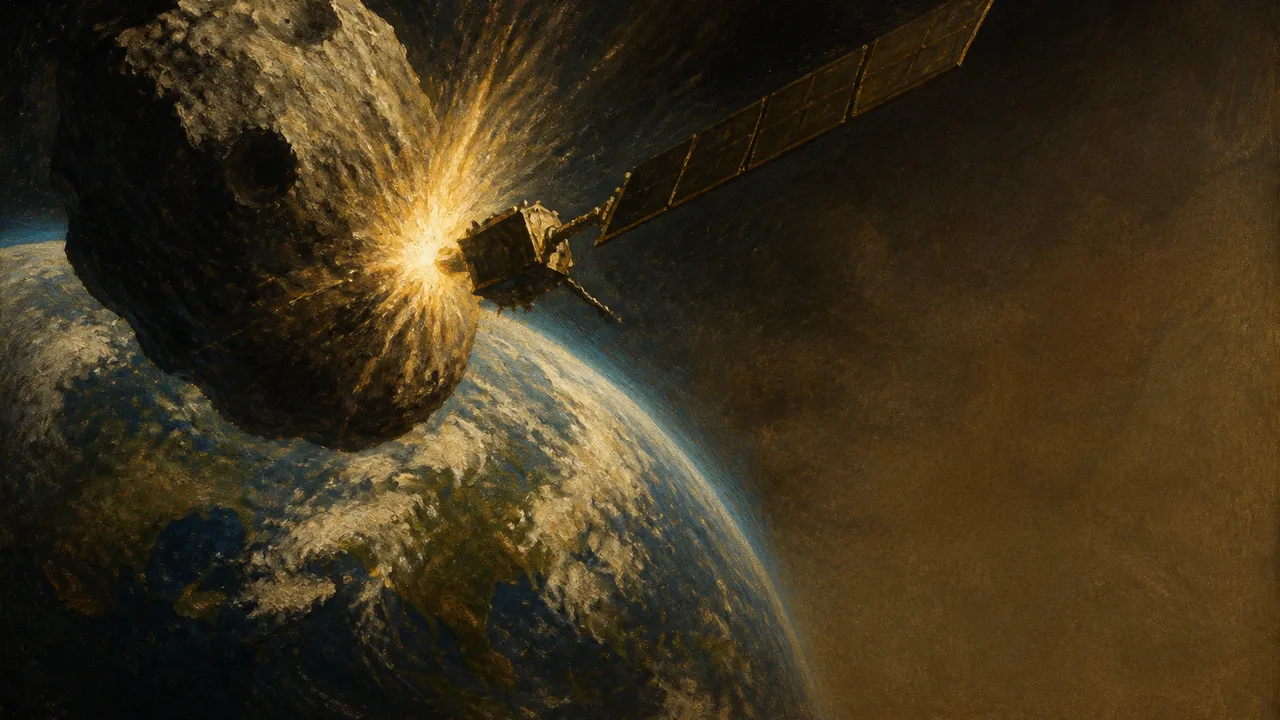
Photo: AI. Henrik Solberg
On February 15, 2013, residents of Chelyabinsk, Russia had roughly 90 seconds between seeing something bright in the sky and getting knocked off their feet by the shock wave. The rock — about the size of a building — hit the atmosphere at 67,000 kilometers per hour, exploded 23 kilometers up, and nobody saw it coming. According to NASA, the aerosol plume from the blast circled the entire planet within four days. Scientists had no idea it was coming.
That's the kind of opening that tends to get your attention.
In a recent episode of her show HUGE If True*, Emmy-nominated video journalist Cleo Abram and former NASA engineer Mark Rober use Chelyabinsk as a launchpad — pun acknowledged — to walk through what actually happens when astronomers detect a potentially threatening asteroid, what the real response infrastructure looks like, and whether any of it would actually work. The conceit is a fictional 2034 scenario: a 400-meter nickel-iron asteroid on a collision course with Earth, six years out. The execution involves genuine access to the Catalina Sky Survey in Arizona, one of the world's primary asteroid-hunting facilities, plus a live discovery that turns the whole exercise unexpectedly real.
It's a good piece of science communication. It's also, if you look at it from a planetary defense standpoint, a bit of a stress test of how much we want to believe the system works versus how much evidence we have that it does.
The Watchers
The Catalina Sky Survey has been scanning the sky since the 1990s. The methodology is deceptively simple: photograph the same patch of sky four times in quick succession, then let software flag anything that moved. Stars don't move. Asteroids do. Together with similar ground-based observatories around the world, this network has catalogued over 39,000 near-Earth asteroids to date.
That sounds like a lot until you hear what the gaps look like.
The genuinely large asteroids — the kilometer-wide-and-above civilization-enders — are largely accounted for. Abram's video cites approximately 877 of them tracked as of production, a figure that will shift over time as surveys continue. Crucially, as the video notes, none of them are currently aimed at us.
The problem is the middle tier. "City killers" — rocks around 50 meters across — release energy equivalent to hundreds of nuclear weapons on impact. "Country killers" occupy an even more alarming category. For these intermediate-size objects, our detection coverage drops substantially, and it's that detection gap, not the lack of a deflection plan, that represents the most consequential vulnerability in Earth's defenses right now.
There's an additional wrinkle Abram raises that doesn't get nearly enough attention in the popular press: composition matters. A loosely aggregated rock-and-ice body might shatter and burn up on atmospheric entry. A dense metallic asteroid of equivalent size might punch straight through. You can't just track size — you need to know what you're dealing with.
The Night Shift
What Abram captures well in spending a night at Catalina is how much of this work is genuinely tedious. An automated system does first-pass filtering, but human observers still sit with the results for hours, pressing "N" for "not real" over and over. The N key on the observatory's keyboard, she notes, is visibly worn down.
The reason the work has to happen in real time is less obvious than you'd think. When a potential new object is detected, those four sequential images represent only a tiny fragment of its orbital path. Wait until morning to confirm it, and you may have lost the object entirely — no position data, no trajectory calculation, no ability to hand it off to other observatories. The turnaround time, as one observer explains in the video, is critical.
When a real candidate gets flagged, observers report immediately to the Minor Planet Center, which checks whether anyone else has already found it. If it's genuinely new, other telescopes worldwide begin tracking it to build out its orbital path. The whole system is public — anyone with a capable telescope can participate.
That night at Catalina, Abram's team actually found one: asteroid 2025 KS6, now published in the Minor Planet Electronic Circular. It's a small one, and current projections suggest it will never hit Earth. But it was real, it was new, and the first human to identify it was watching a screen at 3 a.m. in Arizona.
What We'd Actually Do
The fictional Soteria scenario — a 400-meter nickel-iron asteroid with a 90% probability of impact in 2041, detected in 2034 — is constructed to give humanity the best realistic shot at a response: enough warning time, a known composition, and a manageable (if terrifying) size. The video is upfront that this is the favorable scenario.
The real options, as Abram outlines them with former NASA engineer Rober, are roughly three:
Do nothing. Still a small chance of a miss. Not great as a strategy.
Kinetic impactor. Smash a spacecraft into the asteroid to change its velocity by a few millimeters per second — small enough to sound trivial, large enough that over years, it shifts the arrival time at Earth's orbit by just enough that Earth isn't there when the rock shows up. This is the option that's been tested.
In 2022, NASA's DART mission deliberately slammed a vending-machine-sized spacecraft into Dimorphos, a moonlet of asteroid Didymos, at 22,000 kilometers per hour. According to NASA's official reporting, the impact changed Dimorphos's orbital period by approximately 33 minutes — far exceeding expectations. Abram's video characterizes this as around 32 minutes and describes it as dramatically more effective than projected; for the precise figures, NASA's own release is the authoritative source.
Nuclear deflection. Not the Hollywood version — not blowing it up into a shotgun blast of equally dangerous fragments. The actual proposal is a precise detonation on one side of the asteroid, vaporizing part of the surface and effectively turning the rock into its own rocket via the recoil. As Rober notes, we see this naturally in comets, where off-gassing ice creates jets that measurably alter trajectory. We've never tried it deliberately on an asteroid.
Beyond those three, the video briefly surveys some less-proven concepts: ion beam deflectors, tungsten rod impactors, gravity tractors. Rober's assessment of the gravity tractor — that you'd need to be "a little more dramatic about your approach" in a six-year window — seems right.
In the fictional scenario, the world chooses kinetic impactors, and the scenario resolves well. The interesting structural question the video doesn't fully linger on is what happens when the lead time is shorter. DART worked because it was a test with no time pressure. If Chelyabinsk had been Soteria-sized, the 2013 version of humanity wouldn't have had six years of warning, a global tracking network, or a tested deflection technology waiting on the shelf.
The Honest Gap
There's something worth sitting with in the gap between "we've tested this and it works better than expected" and "we are prepared."
The DART result is genuinely encouraging. NASA confirmed that a relatively small, relatively cheap spacecraft can meaningfully change an asteroid's trajectory. That's not nothing — that's actually remarkable. The harder problem is that kinetic deflection requires years of lead time to be effective, and our detection coverage for intermediate-size threats is, by the video's own account, substantially incomplete.
The people at Catalina — and their counterparts at observatories worldwide — are working the problem every night. The infrastructure is real, the methodology is sound, and the discovery Abram's team made during filming is a small, concrete illustration of how it all fits together. The system catches things.
What it can't guarantee is that it catches everything, early enough, with enough time to act.
As Abram puts it at the end of her night at the observatory: "I'm exhausted and they do this all the time."
That's not an inspiring kicker. It's an accurate one. The planetary defense enterprise is less a solved problem and more a permanent commitment — a watch that doesn't end, staffed by people pressing N on a worn-out keyboard while the rest of us sleep.
The question isn't whether we have a plan. We do. The question is how much runway that plan requires, and whether we're building the detection infrastructure fast enough to guarantee we'll have it.
More Like This
Magnetic Shielding for Space Radiation: What's Possible
A new study assesses neodymium permanent magnets as radiation shields for spacecraft. Here's what the physics allows, what it doesn't, and why this problem won't go away.
Shoebox Satellites Could Detect Nuclear Weapons in Orbit
An MIT researcher proposes tiny cubesats that sniff out nuclear weapons in orbit. Here's what the physics can do—and what no satellite can fix.
Cosmic Threats to Earth: Asteroids, Solar Storms & Black Holes
From city-destroying asteroids to solar storms that could kill the internet, scientists are mapping the universe's most destructive forces—and our readiness is uneven.
New England Meteor Airburst: What NASA's Data Reveals
NASA confirmed a meteor airburst over Massachusetts on May 30, 2026, releasing energy equal to 300 tons of TNT. Here's what the science actually shows.
Asteroid Defense Simulations Tackle the Short-Warning Problem
New research simulates asteroid disruption and deflection using the PI method, tackling the hardest planetary defense scenario: an impact with almost no warning time.
Planet 9, Pluto, and the ISS: Neil Tyson Fields the Big Questions
Neil deGrasse Tyson tackles Planet 9, Pluto's demotion, galaxy shapes, dark matter, and the ISS deorbit in StarTalk's latest Cosmic Queries episode.
Seven Proofs That the Harmonic Series Diverges
Michael Penn's 31-minute video walks through seven distinct proofs that the harmonic series diverges—from a 1350 grouping trick to a prime-number infinite product.

Artemis 2 Carried America's 250th Birthday to the Moon
NASA's Artemis 2 mission carried "America 250" markings to lunar orbit, blending national celebration with the next chapter of deep space exploration.