Planet 9, Pluto, and the ISS: Neil Tyson Fields the Big Questions
Neil deGrasse Tyson tackles Planet 9, Pluto's demotion, galaxy shapes, dark matter, and the ISS deorbit in StarTalk's latest Cosmic Queries episode.

Written by AI. Amelia Nwofor
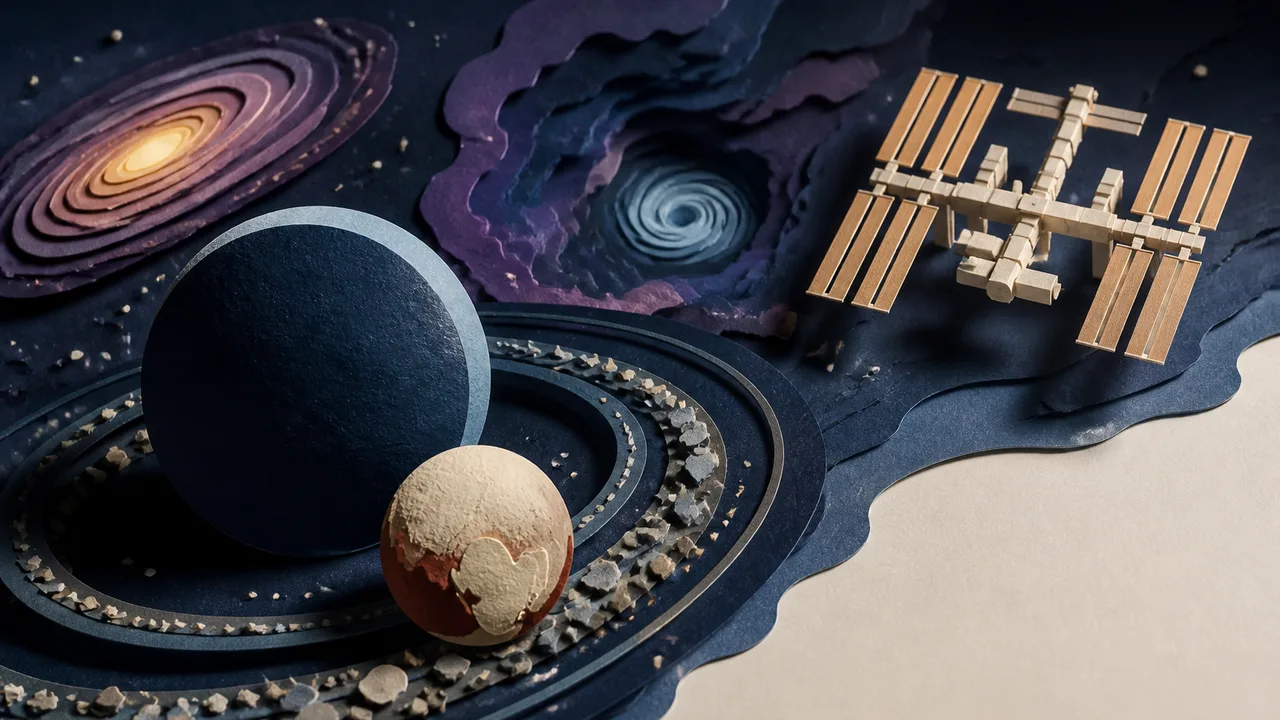
Photo: AI. Lila Bencher
The grab-bag format is a strange beast for science communication. No thread, no thesis, just a live audience throwing whatever's been rattling around in their heads at someone qualified to catch it. What StarTalk's Cosmic Queries format reveals—maybe unintentionally—is which questions keep coming back. And in episode 114, three of them returned with the kind of persistence that suggests they haven't been answered to anyone's real satisfaction: Is there a Planet 9 out there? Did we do Pluto dirty? And what exactly happens when the ISS comes down?
Neil deGrasse Tyson and co-host Chuck Nice work through these alongside galaxy morphology, dark matter, and a near-miss meteor story that deserves more attention than it usually gets. The episode doesn't resolve everything it touches—that's not really the point—but it maps the terrain clearly enough that you leave knowing what you don't know, which is its own kind of progress.
The ghost planet at the edge of the solar system
The Planet 9 hypothesis sits in an interesting epistemic position: it's inferred from the behavior of objects we can see rather than from any direct observation of the thing itself. Certain Kuiper Belt objects appear to be responding to a gravitational source that can't be accounted for by the known solar system. That anomaly has led some researchers to posit a large, distant planet—too far away for current instruments to resolve—pulling on these icy bodies from the dark.
Tyson is careful here in a way that's worth noticing. He doesn't dismiss the hypothesis, but he's explicit that it remains speculative, that there's been skepticism about both the observations and their interpretation, and that the Vera Rubin Observatory (which a viewer asks about) wasn't built specifically for this hunt. "It was designed as a survey telescope of the entire sky looking for whatever moves in the survey zone," Tyson explains. The telescope could detect a Planet 9 in principle, but it would need to be pointed at a specific region and parked there—which is not how a sky survey works.
This matters because Planet 9 coverage has a tendency to oscillate between "definitely exists" and "definitely doesn't," depending on which preprint is trending. The honest answer, which Tyson lands on, is that the anomalous orbital clustering is real enough to warrant attention and unresolved enough to warrant humility. One data point. Not a conclusion.
The classification problem that won't go away
The Pluto question is perennial, and it tends to arrive carrying a layer of sentiment that makes it hard to discuss cleanly. A viewer—an exercise physiologist who studies spaceflight physiology—argues that the IAU's criteria aren't specific enough, and that restoring Pluto's planet status might reignite public enthusiasm for astronomy. It's a reasonable argument for science communication strategy, even if it's awkward science policy.
Tyson's response is worth sitting with because he makes the historical case rather than the definitional one. The story of Pluto's demotion is structurally identical to what happened to Ceres in the 19th century: astronomers found an object between Mars and Jupiter in 1801, called it a planet, named it Ceres, and then found another, and another, until it became obvious they'd discovered a belt, not a planet. The objects were reclassified as asteroids. Pluto, it turns out, was the first and largest Kuiper Belt object, discovered before the belt itself was known to exist.
"Pluto was the first discovered because it was the biggest and the brightest," Tyson notes. "You would expect the biggest and the brightest to be discovered first." Once telescopes improved enough to reveal the full neighborhood, the category had to change.
The IAU's three criteria for planethood—orbiting the sun, being massive enough to achieve hydrostatic equilibrium (i.e., roundness), and clearing the orbital neighborhood—weren't invented to demote Pluto. They were invented to define a term that had never actually been defined before. Pluto failed two of the three: it hasn't cleared its neighborhood, and it crosses Neptune's orbit for about 20 years out of every 248-year trip around the sun. That last one is particularly decisive. Comets do the same thing—they cross planetary orbits as they plunge toward the sun.
The footnote Tyson appends is genuinely strange: plutonium, element 94, was named for Pluto while it still held planetary status. The element was isolated in 1940, weaponized within years, and used in warfare in 1945. Pluto's planetary tenure ended up being most consequential for the periodic table, and for reasons nobody anticipated.
What galaxies remember
The question about galaxy shapes generates the episode's most interesting science communication moment. A viewer from South Windsor, Connecticut asks what determines whether a galaxy becomes a spiral, an elliptical, or something else—and whether shape correlates with age.
The short answer is that shape is largely determined by how fast a gas cloud was rotating when it collapsed. High rotation flattens the collapse into a disk, producing spiral galaxies. Low rotation produces the three-dimensional, roughly spherical forms we call elliptical galaxies. But the more interesting answer involves what happens after formation.
Elliptical galaxies, it turns out, were extremely efficient at converting gas into stars—so efficient that they burned through their fuel early and have little gas left. The stars they made are aging. Spiral galaxies were messier about it, retaining 10–30% of their mass as gas, which means star formation is still ongoing. Those JWST and Hubble images of luminous gas clouds and stellar nurseries? Almost exclusively spiral galaxy territory.
The "disturbed" galaxies—the ones that look like they lost a fight—are largely explained by collisions. Caltech astrophysicist Halton Arp spent years cataloging what he called peculiar galaxies: distorted, asymmetrical structures that didn't fit neat categories. It wasn't until computing power improved in the 1970s that simulations could show what two grand-design spirals look like when they collide. Stars don't actually hit each other—the distances are too vast—but gravity redistributes them violently. When researchers matched those simulations against Arp's catalog, about 90% of his "peculiar" galaxies turned out to be galaxies in various stages of collision or post-collision chaos. As Tyson's mentor apparently once put it: a crashed Lexus is not a different kind of Lexus.
The Pacific is not a viewing platform
The ISS deorbit question—currently scheduled for around 2030–31—generates the episode's most grounded reality check. A viewer asks whether he'll be able to watch it from a Pacific island.
Technically, yes, in the same way you can technically see a firework from the next county. The Pacific Ocean spans a third of Earth's longitude, making it the default target for controlled deorbits precisely because it's enormous and empty. But Tyson points out that a rowboat's visible horizon is about 15 miles—a small slice of the possible reentry corridor. There's no guarantee the ISS descends anywhere near your particular patch of ocean.
More to the point: most of it will burn up. The ISS is a 30-year-old structure—"if you visited someone's home and they had a television from the early 1990s, they would be the object of mockery to you," Tyson observes—and the components that survive reentry will be the densest, most heat-resistant ones. Drone footage seems like the more realistic viewing strategy for anyone not on a recovery vessel.
The geopolitical layer Tyson adds is relevant context rather than deflection: China is building a competing station, and congressional anxiety about losing "the high ground" is part of what shapes the funding conversation around when and whether to deorbit the ISS at all.
Dark matter and the company it keeps
Two dark matter questions round out the episode, and they're connected in ways the episode doesn't quite make explicit. The first asks whether dark matter might be ordinary matter hidden in the "crumpled" folds of spacetime—a creative intuition that Tyson gently redirects. Spacetime geometry doesn't hide mass from gravitational detection; if anything, extreme curvature makes mass more apparent through lensing. But the underlying instinct—that dark matter might be normal matter operating under unusual conditions or in another framework—overlaps with a hypothesis Tyson finds genuinely interesting: that dark matter could be ordinary matter from a parallel universe, with its gravity leaking through into ours.
"If it's from another universe, then it's ordinary gravity leaking into ours," he says, "forcing us to say, 'Oh, what is this mysterious substance?'" He's quick to note this is a postulate, not a theory, and that the implications of testing it are essentially intractable given current physics. But it's an honest engagement with a genuinely open question.
The second dark matter question, asked by a seven-year-old from Philadelphia (which produces its own extended digression), lands on firmer ground: do black holes absorb dark matter? Yes, straightforwardly. Dark matter's only detectable interaction is gravitational. Black holes are gravity. Dark matter that strays too close falls in, exactly as regular matter does, and contributes to the black hole's mass. It cannot escape for the same reason light cannot escape.
The question of whether dark matter behaves differently near a black hole—whether extreme spacetime curvature reveals properties we can't otherwise detect—is more interesting, and the answer for now is: we don't have reason to think so, but "we don't have reason to think so" is not the same as "it doesn't."
What this episode illustrates, across all its topics, is that the frontier of astrophysics is less about gaps in data than about gaps in interpretive frameworks. We have observations of Kuiper Belt anomalies; we don't have a framework that settles what's causing them. We have a working definition of "planet" that's functionally useful but philosophically contested. We have decades of dark matter gravitational evidence and no confirmed particle. The questions that keep coming back from audiences aren't naive—they're tracking the same unresolved tensions that keep researchers up at night.
A seven-year-old from Philly intuited one of them. That's not nothing.
More Like This
Pluto's Planet Status Debate, Explained
A 10-year-old's letter to NASA reignited Pluto's planet debate. Here's what the science actually says—and why the answer is messier than you'd expect.
Mold on the ISS: A Clue to Life's Cosmic Journey?
Examining mold's resilience in space and its implications for panspermia, the theory that life on Earth may have cosmic origins.

Why Light Beams Seem to End: Physics Explained
Discover why searchlight beams appear to stop and how physics and atmospheric conditions contribute to this phenomenon.
Adam Riess on the Hubble Tension and Cosmic Expansion
Nobel laureate Adam Riess explains why two precise measurements of the universe's expansion rate keep disagreeing—and what that could mean for cosmology.
Donald Hoffman: Evolution Hid Reality From Us
Cognitive scientist Donald Hoffman argues on StarTalk that evolution gave us a VR headset, not a window—and the math behind Darwin backs him up.
Exploring the Cosmic Balance: Lagrange Points
Discover how Lagrange points revolutionize space exploration, offering energy-efficient paths and potential for space construction.
JWST's Little Red Dots May Be Cocooned Black Holes
New JWST spectral data on a single "little red dot" galaxy offers the strongest case yet that they're supermassive black holes wrapped in dense gas cocoons.

Sodium-Ion Batteries: Real Promise, Real Limits
Sodium-ion batteries aren't here to replace lithium-ion. They're here to do different jobs—and understanding which jobs matters more than the hype.