Pluto's Planet Status Debate, Explained
A 10-year-old's letter to NASA reignited Pluto's planet debate. Here's what the science actually says—and why the answer is messier than you'd expect.

Written by AI. Nadia Marchetti
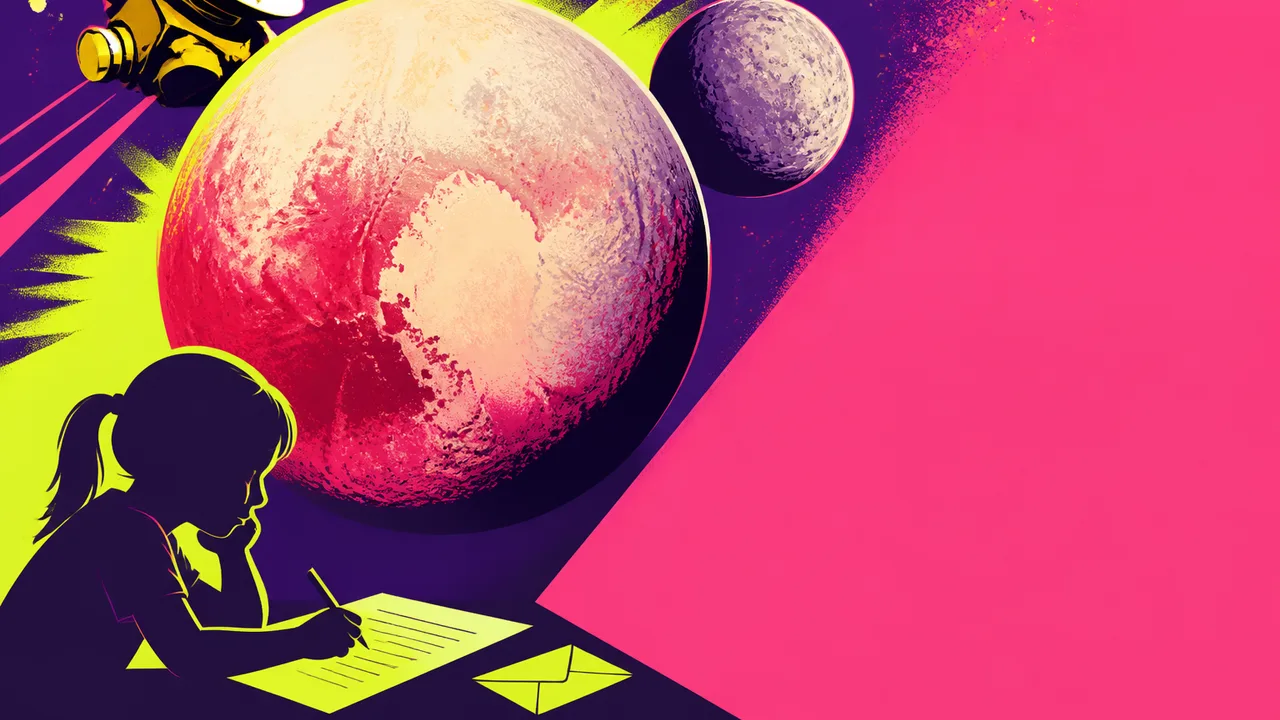
Photo: AI. Zephyr Cole
On April 9, 2026, a 10-year-old girl wrote a letter to NASA asking them to make Pluto a planet again. Reportedly, there were a lot of "pleases." And NASA administrator Jared Isaacman said, essentially, that they were looking into it.
That's the kind of story that's easy to dismiss as charming noise — a child's petition, a bureaucrat's polite non-answer. But the Astrum team's new deep-dive on Pluto makes a compelling case that something real is churning underneath the sentiment. Not just nostalgia. An actual scientific argument about whether the definition we're using is any good.
Let me walk through what we know, what we don't, and where the genuine tension sits.
The demotion, and what drove it
Pluto was discovered in 1930 and held planet status for 76 years before the International Astronomical Union pulled the rug out in 2006. The IAU's new three-part definition required a planet to orbit the Sun, achieve hydrostatic equilibrium (roughly spherical shape), and — fatally for Pluto — clear the neighborhood around its orbit.
Pluto clears nothing. It shares its orbital space with thousands of Kuiper Belt objects: plutinos, Orcus, Lempo, and plenty of others. Compared to the other eight planets, which have gravitationally dominated their orbital zones, Pluto is a minor player in a crowded suburb.
But here's where the Astrum video surfaces a tension that deserves more attention than it usually gets: Jupiter has approximately 100,000 Trojan asteroids sharing its orbit. Earth has around 10,000 asteroids in its neighborhood. The "cleared neighborhood" criterion is, strictly speaking, a matter of degree, not kind. As the video puts it, "if Pluto failed its definition on this count, shouldn't Jupiter?"
That's not a throwaway line. It points to a real problem with the 2006 definition — it uses a qualitative threshold that the IAU never precisely quantified. Planetary scientist Alan Stern, principal investigator of New Horizons, has been making this argument for years: the clearing criterion is so poorly defined that it would technically exclude Earth and Jupiter if applied rigorously at sufficient distance from the Sun.
The Charon complication
The story of how Pluto got demoted runs directly through a discovery that almost wasn't made. In 1978, astronomer James Christy was reviewing photographic plates of Pluto at the US Naval Observatory — plates that had been marked as defective because Pluto appeared as an elongated blob rather than a clean point of light. Most astronomers had written these off as instrument error. Christy, who had spent years photographing binary stars, noticed that while Pluto's image was smeared, the background stars on the same plates were perfectly sharp. If the blur were caused by atmospheric distortion or a faulty telescope, everything in the frame would be affected. Only Pluto was.
He went back through archived plates as far as 1965. The bulge moved systematically around Pluto with a period of 6.4 days — exactly matching Pluto's own rotation. What everyone else had labeled a flaw was a moon. A large one. Christy named it Charon, after his wife Charlene, and only later discovered that Charon was already the name of the mythological ferryman of the dead — the underworld, of course, being Pluto's realm. Sometimes the universe just cooperates.
Charon's discovery did something immediate and important: it let astronomers calculate Pluto's mass for the first time using Kepler's laws. The result was sobering. Pluto weighs in at about a sixth of Earth's Moon — far smaller than anyone had assumed. And Charon itself is about 12% of Pluto's mass, a ratio with no parallel in the solar system. Our Moon is only about 1.2% of Earth's mass. The two bodies are so comparably sized that their shared center of gravity — the barycenter — sits not inside Pluto, but in empty space between them, roughly 960 kilometers above Pluto's surface.
This makes Pluto-Charon genuinely strange. Both bodies are mutually tidally locked: Pluto always shows the same face to Charon, and Charon always shows the same face to Pluto. If you stood on Charon's Pluto-facing side, Pluto would be a motionless disk hanging in the sky, never rising or setting. The IAU actually considered classifying the pair as a double planet in 2006 before setting that proposal aside in favor of the broader dwarf planet reclassification.
What New Horizons found
None of the classification debate fully prepares you for what the New Horizons flyby revealed in July 2015. The probe spent nine years traveling to Pluto, transmitted data at 1–2 kilobytes per second, and took 15 months to downlink the full dataset. What came back was not the inert, frozen rock many expected.
Pluto has dunes — transverse dunes, 2,000 square kilometers of them, formed from methane ice particles transported by winds in an atmosphere so thin we didn't think it could move anything. It has a heart-shaped nitrogen plain, Tombaugh Regio, where glacial flows actively cycle nitrogen between the eastern and western lobes. It has potential cryovolcanoes: Wright Mons stands 4 kilometers tall with a central depression reminiscent of a volcanic caldera, surrounded by suspiciously fresh terrain with almost no impact craters. A 2019 study presented at the Lunar and Planetary Science Conference argues that mountain ranges in the Al-Idrisi Mons area have likely migrated eastward through solid-state convection — a process that would require a layer of liquid water beneath the ice to drive it.
A subsurface ocean on Pluto. Smaller than Earth's Moon, 5.9 billion kilometers from the Sun, yet potentially harboring liquid water through radiogenic heat from its core.
Charon's story is, if anything, more dramatic. Its equatorial canyon system — Serenity Chasma among others — runs at least 1,800 kilometers and plunges 7.5 kilometers deep. Four times longer than the Grand Canyon, nearly five times deeper. These aren't river canyons; they're pull-apart faults, evidence that Charon's entire crust was once stretched to its breaking point. The culprit: a subsurface ocean that formed from primordial heat, then froze. Water expands when it freezes. The expanding ice pushed the crust outward until it ruptured. As one researcher described it, Charon "tore itself apart at the seams like Bruce Banner becoming the Hulk."
The southern hemisphere, Vulcan Planitia, is a vast smooth plain resurfaced by cryovolcanic flows — icy slurry forced through the cracks and flooding the surface. The northern hemisphere, Oz Terra, is ancient, cratered, fractured. Two totally different geological histories on one small moon.
And then there's Mordor Macula, Charon's deep reddish-brown north polar cap, named for Tolkien's black land. It's almost certainly tholins — complex organic molecules cooked from methane by UV radiation. Where the methane came from is an open question. The leading hypothesis is that Pluto's atmosphere, slowly escaping into space, is captured by Charon's gravity, cold-trapped at the pole during its century-long winters, and then irradiated into tholins when sunlight returns. The competing hypothesis says the methane came from Charon's own cryovolcanic outgassing. Either way, Mordor Macula is a visible record of either Pluto's slow atmospheric loss or Charon's deep geological past — possibly both.
The definition problem
So where does all this leave the planet question?
The honest answer is: in productive uncertainty. The IAU's 2006 definition solved one real problem — the proliferating list of potential planets that would have resulted from counting Eris, Makemake, Sedna, Quaoar, and others alongside Pluto — but introduced another. "Clearing the neighborhood" is a criterion that scales with a body's distance from the Sun and the density of material in its orbital zone, making it less a physical property of the object itself than a description of its context.
Some scientists argue that geological complexity should factor into planetary classification — that a world with active or recently active cryovolcanoes, a possible subsurface ocean, nitrogen weather cycles, and dune fields is qualitatively different from a dead rock. The Astrum video notes this camp exists, though it doesn't fully adjudicate between views. That seems about right for where the scientific community actually stands.
The IAU definition is a human convention. Astrum makes this point directly: "The only thing that truly makes an object a planet is enough people agreeing that it is. The term planet is entirely a human definition." That's not relativism about physical reality — Pluto's mass and orbital dynamics are what they are regardless of what we call it. But it's a fair reminder that taxonomic categories are tools, and tools can be redesigned when they stop doing useful work.
NASA doesn't control the IAU. A 10-year-old's letter doesn't convene a General Assembly. But the underlying question — whether "clearing the neighborhood" is the right test, whether geological activity should matter, whether the Pluto-Charon binary deserves its own category — those are legitimate scientific debates, not just popular sentiment dressed up as astronomy.
The dwarf planet formerly known as the ninth planet turns out to have dunes, cryovolcanoes, a possible ocean, a moon that tore itself apart from the inside, and a red polar cap that may be painted by its companion's escaping atmosphere. Whether that makes it a planet probably depends on what you think planets are for.
More Like This
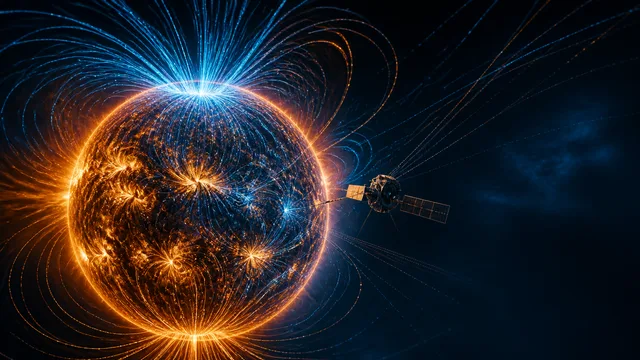
Solar Orbiter Captures First Direct View of the Sun's Poles
Solar Orbiter has captured the first direct images of the Sun's poles, revealing a chaotic magnetic field mid-reversal—and what it means for space weather forecasting.
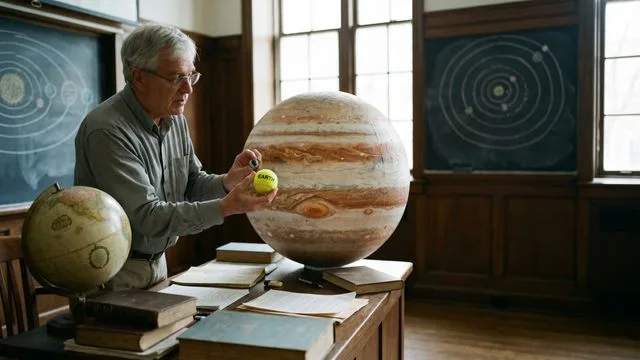
Video Shows Solar System's Vast Scale Through Walkable Model
The solar system is mostly empty space—and the numbers make that viscerally clear. Here's what happens when you shrink Earth to a tennis ball.
Why Finding Earth's Twin Among Exoplanets Is So Hard
The TRAPPIST-1 system looks promising—seven rocky planets, three in the habitable zone. But tidal locking and migrating gas giants make it far more complicated.
Why NASA Is Finally Returning to Venus After 40 Years
After decades of neglect, Venus is getting two NASA missions. Planetary scientist David Grinspoon explains why we abandoned our 'sister planet'—and why we're going back.
How the Moon Formed: One Impact or Three?
The giant impact hypothesis has dominated lunar science for 40 years. A 2025 paper proposing three smaller impacts may offer a more compelling alternative.
Solar Flares, Earth's Magnetosphere, and StormWall
Recent X-class solar flares and CMEs have prompted serious discussion about Earth's space weather vulnerability—and a theoretical plasma shield called StormWall.
Neil Turok's Case for Quantum Gravity Without Strings
Neil Turok argues quadratic gravity—a 1970s idea—may solve quantum gravity without strings or extra dimensions. Here's what that claim actually rests on.
Electric and Magnetic Fields Explained From First Principles
From ancient amber to Gauss's law: how physicists replaced "action at a distance" with the field concept that underpins all of modern physics.