Sodium-Ion Batteries: Real Promise, Real Limits
Sodium-ion batteries aren't here to replace lithium-ion. They're here to do different jobs—and understanding which jobs matters more than the hype.

Written by AI. Amelia Nwofor
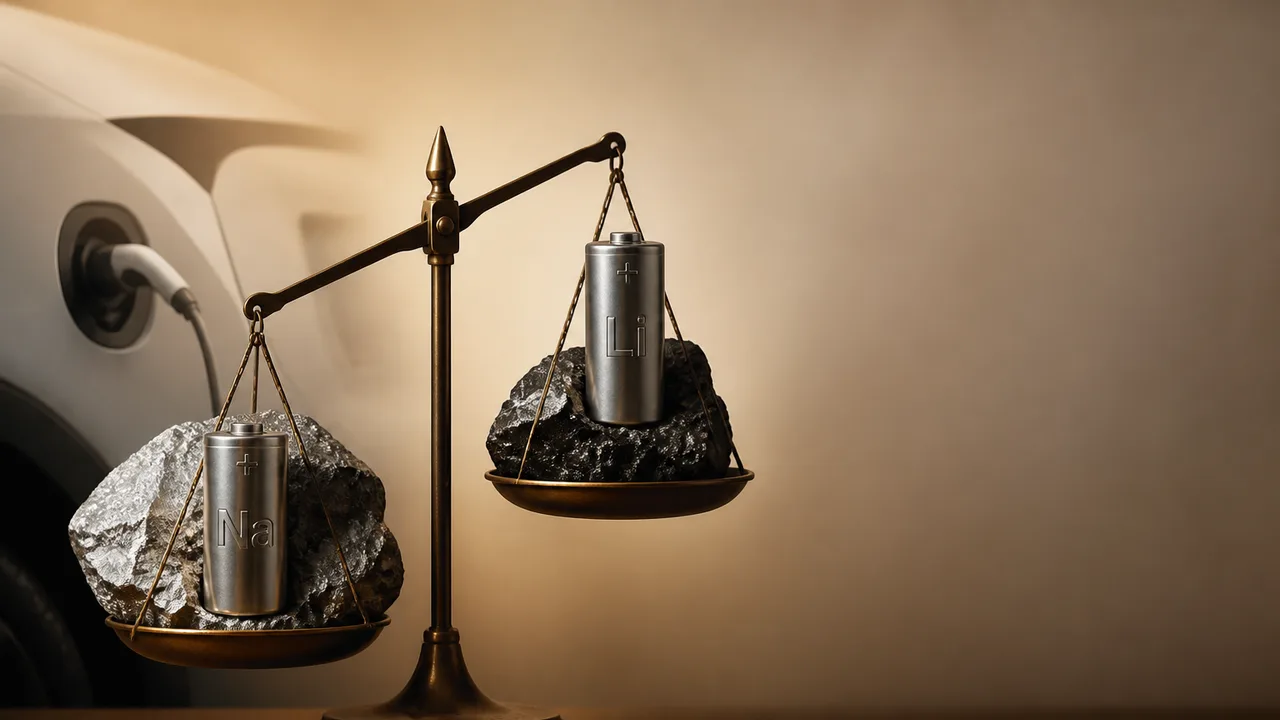
Photo: AI. Naia Iwarra
Sodium is the 6th most abundant element in Earth's crust. Lithium is the 25th. That gap, more than any other single fact, explains why sodium-ion batteries keep resurfacing in energy conversations—and why the resurfacing tends to generate more heat than light.
A recent Interesting Engineering video lays out the sodium-ion case with commendable honesty: this isn't a lithium-killer story. It's a story about a technology finding the right problems to solve. That framing is worth taking seriously, because the battery coverage ecosystem has a bad habit of oscillating between "this will change everything" and "this is vaporware." Neither is useful. The sodium-ion story sits in the more interesting and more complicated space between those poles.
The periodic table argument
Sodium and lithium sit in the same column of the periodic table—Group 1 alkali metals—which means they share chemistry. A sodium-ion battery is structurally identical to a lithium-ion battery: cathode, anode, electrolyte, separator, ions shuttling back and forth during charge and discharge. Swap lithium ions for sodium ions and the basic architecture holds.
What changes is size and weight. Sodium ions are roughly 70% larger than lithium ions, which makes them harder to intercalate—harder to slot into electrode materials without distorting the structure. The practical consequence is lower energy density: less energy stored per kilogram or per liter of battery volume. Lithium-ion cells from CATL, the world's largest battery manufacturer, currently achieve 205–330 Wh/kg depending on chemistry. CATL's first-generation sodium-ion cells land notably lower on that scale—a gap the video acknowledges directly.
That energy density gap is the central technical tension, and it's real. But the Interesting Engineering video is right to push back on the idea that energy density is the only metric that matters. According to the U.S. Department of Energy's Vehicle Technologies Office, battery designers optimize across a matrix of factors: cost per kilowatt-hour, cycle life, operating temperature range, charge rate, thermal safety, and supply chain resilience. A battery that scores lower on energy density but better on several other dimensions is not automatically inferior—it's differently suited.
Where sodium actually wins
Cold weather performance is sodium-ion's most unambiguous current advantage. Lithium-ion batteries lose a substantial portion of their usable capacity at sub-zero temperatures—range loss of 20–40% in moderate cold is commonly reported by EV owners and documented in studies including a 2019 AAA analysis of real-world EV performance in winter conditions. The electrochemical reasons are well understood: cold slows ionic conductivity, and lithium-ion electrolytes suffer more from this than sodium-ion chemistries under certain configurations.
One of the researchers featured in the Interesting Engineering video puts it with characteristic directness: "Bigger can be fast. Sodium ions can be transported very quickly in the solid state—the power of the batteries can surpass lithium-ion, especially at extremely low temperatures, like below 0°C up to below -20°C." That's not a marginal performance claim for markets in Scandinavia, Canada, or northern China.
Thermal safety is the other significant win. Sodium-ion chemistries—particularly those using Prussian white analog or iron-manganese-based layered oxide cathodes—show lower thermal runaway risk than lithium-ion cells using nickel-cobalt-manganese (NMC) cathodes. For stationary grid storage, where battery packs are large and fires are catastrophic, this matters. The video cites a potential 20% reduction in capital cost for grid-scale sodium-ion storage compared to lithium-ion, though it's worth noting this figure comes from a commercial context (CATL's own projections) rather than independent lifecycle cost analysis—readers should treat it as directionally useful rather than definitive.
The supply chain argument is geopolitical as much as economic. According to the International Energy Agency's 2023 Critical Minerals report, China controls roughly 60–70% of global lithium refining capacity, over 75% of battery cell manufacturing, and over 90% of anode and electrolyte production. Lithium itself is commercially mined in meaningful quantities in only a handful of countries—Australia, Chile, and China account for the bulk of global supply. Sodium, derivable from salt deposits or seawater, is available essentially everywhere. That's not a trivial advantage for countries looking to build domestic battery industries.
"We just want to level the playing field—countries like India, Kenya—they all have a fair chance for their electrification," as one researcher in the video frames it. That's an equity argument alongside the technology argument, and it's legitimate.
The real problem: lithium won't sit still
Here's where the honest accounting gets harder. The video doesn't shy away from the core competitive problem: lithium-ion is not a static target.
According to the IEA's Global EV Outlook 2024, lithium-ion battery pack prices fell from roughly $1,400/kWh in 2010 to approximately $139/kWh in 2023—a drop of about 90% over thirteen years. The IEA projects further cost reductions could approach 40% by 2030, driven by manufacturing scale, improved cell chemistry, and supply chain optimization. LFP (lithium iron phosphate) batteries—which already eliminate cobalt and reduce nickel dependence—have become the dominant chemistry for entry-level EVs and much of the stationary storage market. LFP erodes one of sodium-ion's clearest selling points.
The video's researchers are candid about this. As one puts it: "I think sodium really has an uphill battle—the cost of lithium keeps coming down. We made a promise to society that sodium will eventually be cheaper, but how long it takes sodium to get there, that's the part that's hard to predict."
Manufacturing complexity compounds this. The video draws a comparison that's worth pausing on: making high-quality rechargeable batteries at scale is, in the words of one researcher, "as difficult as making high-end computer chips." That's not hyperbole. Yield losses from moisture contamination, uneven electrode coating, or inconsistent formation cycling can render cells unusable. Sodium-ion faces the same manufacturing gauntlet that lithium-ion has spent three decades learning to navigate. The learning curve is not free or fast.
Hard carbon anodes—sodium-ion's preferred anode material—present their own scaling challenge. Producing hard carbon with consistent structure and purity at gigawatt-hour volumes is an unsolved industrial problem. Cathode chemistry choices (layered oxides, Prussian white, polyanionic compounds) each carry different tradeoffs in voltage, stability, and manufacturability that haven't been fully resolved at commercial scale.
First commercial deployments: what they actually show
CATL's sodium-ion cells made their automotive debut in the Changan Nevo A06, a Chinese market EV claiming roughly 400 km (249 miles) of range from a 45 kWh sodium-ion pack with 15-minute fast charging from 30% to 80%. CATL also claims a cycle life exceeding 10,000 cycles for its sodium-ion chemistry—significantly higher than the 500–1,500 cycles typical of mainstream lithium-ion NMC cells, though comparable to or slightly below premium LFP cells which can reach 3,000–4,000 cycles.
These are real numbers from a real product, which matters. But they're also manufacturer claims on a vehicle sold in a single market, without independent long-term validation data. Treat them as proof-of-concept that the technology works commercially—not as the final word on what the technology will deliver.
The 400 km range figure is competitive with entry-level EV segments globally, which is exactly the application the technology suits. Nobody is proposing sodium-ion for a 600 km luxury SUV. The relevant comparison is lead-acid replacement, urban delivery fleets, two-wheelers and rickshaws in South and Southeast Asia, and grid-tied storage where nobody cares how much the battery weighs.
What the niche question actually means
The word "niche" gets used condescendingly in technology coverage, as if carving out specific applications is a consolation prize. It isn't. Lead-acid batteries are a $50 billion annual market. Grid-scale energy storage is projected by BloombergNEF to require 30 terawatt-hours of new capacity by 2030. Two-wheeler electrification in Asia alone involves hundreds of millions of vehicles.
These aren't footnotes to the battery story. They're enormous, structurally important markets where sodium-ion's specific combination of cost, safety, cold performance, and supply chain accessibility could matter enormously—especially for countries that currently sit outside the lithium supply chain's geography.
The Interesting Engineering video lands on a framework that the evidence actually supports: the future of battery technology is probably not one chemistry winning and the rest losing. Solid-state lithium, lithium-sulfur, flow batteries, sodium-ion, LFP—each has a domain where its specific tradeoff profile makes sense. Sodium-ion's domain is real, commercially demonstrated in at least one case, and serves applications that the global energy transition genuinely needs served.
The question that matters now isn't whether sodium-ion can beat lithium-ion. It's whether sodium-ion can reach manufacturing scale fast enough and cheaply enough to lock in its niches before LFP gets there first. That race doesn't have a predetermined winner—and that's exactly what makes it worth watching.
More Like This

The Deeper Geometry Behind the Pythagorean Theorem
Explore why the Pythagorean Theorem appears in unexpected places, from geometry to relativity.
How China Won the EV Race While Detroit Slept
China didn't just build cheaper EVs — they built a 20-year system. Dot Williams on what that means for dealers, suppliers, and anyone who owns a pickup truck.
Fusion Energy Is No Longer Just a Physics Problem
Fusion reactors have cleared their core scientific hurdle. What remains are hard engineering challenges—and a tight race against the clock and other clean energy sources.
BYD Beat Tesla—Without Selling a Single Car in America
BYD is now the world's top EV seller—despite a 100% U.S. tariff wall. Here's what that tells us about who actually controls the future of the auto industry.

Why Light Beams Seem to End: Physics Explained
Discover why searchlight beams appear to stop and how physics and atmospheric conditions contribute to this phenomenon.

Does Money Really Buy Happiness? Insights from Peter Steinberger
Explore Peter Steinberger's perspective on money and happiness, emphasizing experiences over wealth accumulation.
Nanodomains, Pulsars, and What We Can't See Yet
Izzy Jayasinghe and Alfredo Carpineti discuss heart disease, invisible light, and what super-resolution microscopy reveals about the body's smallest structures.

Intelligence Beyond the Brain: Michael Levin's Radical Rethink
Biologist Michael Levin argues intelligence exists on a continuum reaching down to cells and molecules. Here's what the evidence actually supports—and where it gets murky.