Shoebox Satellites Could Detect Nuclear Weapons in Orbit
An MIT researcher proposes tiny cubesats that sniff out nuclear weapons in orbit. Here's what the physics can do—and what no satellite can fix.

Written by AI. Zara Chen
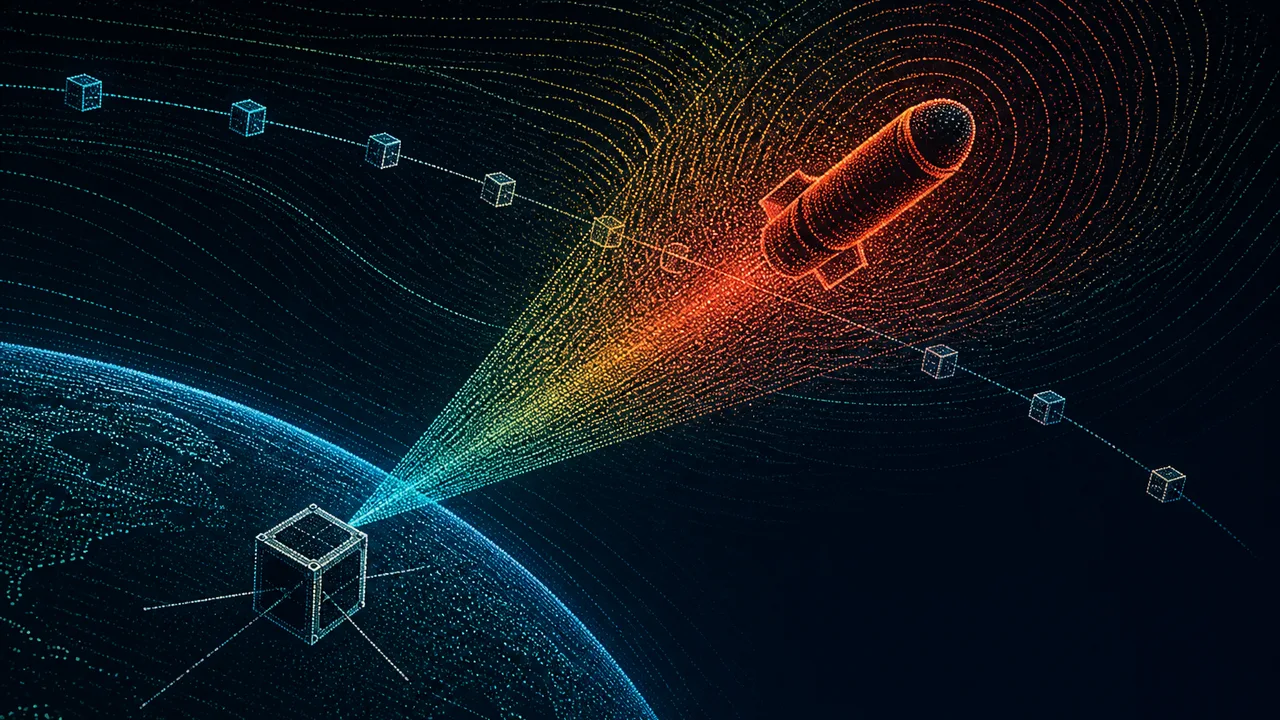
Picture this: somewhere above your head, right now, there might be a nuclear weapon in orbit. Not a hypothetical future weapon. A real one, tucked inside something that looks from the ground like just another satellite doing satellite things. And here's the genuinely unsettling part — as of today, we have no reliable way to know. You can't exactly knock on a spacecraft's door and ask what's inside.
That gap — between what we suspect might be up there and what we can actually verify — is exactly what one MIT researcher is trying to close. And the proposed solution is very 2026: a shoebox.
Wait, We Actually Don't Know?
Right. Space.com reports that no reliable way currently exists to detect and defuse a nuclear bomb in space. Sit with that for a second. We're in a moment where LEO is getting crowded — thousands of commercial and government satellites, more launching every month — and the honest answer to "does anyone have a hidden nuke up there" is basically a shrug.
The 1967 Outer Space Treaty prohibits placing nuclear weapons in orbit, but treaties only work when there's some mechanism to check compliance. Ground-based radar can track orbital objects. It cannot tell you what an object is carrying. You can observe a satellite's orbit, its size, its behavior — none of that tells you about the payload. Suspicion isn't verification.
That's the actual problem Areg Danagoulian, a nuclear science and engineering professor at MIT, is trying to solve. His proposal, covered in depth by Science News and Space.com, involves a constellation of small "9U" cubesats — each one roughly the size of a large shoebox — equipped with radiation detectors that can sense emissions from an unexploded nuclear bomb.
Okay But How Does a Shoebox Sniff Out a Nuke?
The physics here is genuinely clever, and I'll try not to butcher it. Earth's Van Allen radiation belts — the donut-shaped zones of high-energy particles trapped by our planet's magnetic field — are full of fast-moving protons. Danagoulian's insight, according to Science News, is that those high-energy protons would interact with uranium inside a nuclear weapon, producing a distinctive stream of neutrons. A nearby cubesat carrying the right detectors could pick up neutrons coming from the direction of a suspect satellite and flag it as something worth a much closer look.
It's essentially using the radiation environment of space itself as an interrogation tool. The belt does the work; the satellite just listens. That's a genuinely elegant approach to a problem that's stumped people for decades.
Slashdot notes that Danagoulian works through a specific scenario: Russia launches a suspected space-based nuclear weapon. The cubesat constellation picks up the neutron signature. Now you have something actionable — not just a political accusation, but scientific evidence to bring to international forums. That shift from "we think" to "here's the data" is enormous when you're talking about the kind of accusation that could reshape global security.
The Part Where It Gets Complicated (It Always Gets Complicated)
Here's where I have to be straight with you: even if this technology works perfectly — and it's still a proposal, not a deployed system — the harder problem isn't technical. It's everything else.
Start with the threat itself. A nuclear detonation in low Earth orbit wouldn't just be a massive explosion. The electromagnetic pulse from such a blast would fry the electronics of satellites operating nearby. Think about what actually lives in LEO right now: GPS systems, communications infrastructure, Earth observation networks, weather satellites. The internet backbone that most of the world's financial transactions run through. An EMP event at orbital altitude could knock out vast swaths of that infrastructure in ways that would take years and hundreds of billions of dollars to rebuild. That's not science fiction — it's the scenario that keeps space security researchers up at night. (A separate concern that sometimes gets bundled in here is Kessler Syndrome — the runaway collision-cascade scenario where debris from one collision creates more debris, which creates more collisions. But to be precise: Kessler Syndrome, as Space Safety Magazine explains, is triggered by physical collisions between objects, not by EMP. A nuclear detonation's EMP effects and a debris cascade are two different catastrophes. Both are bad. Don't let anyone conflate them, including me.)
So detection matters. But here's the thing nobody in the press release wants to say out loud: detection is not deterrence. Knowing a nuke is in orbit doesn't get it out of orbit. Danagoulian's proposal tells you what's up there. It does not tell you what happens next. That part — the "okay we found one, now what" part — is a political problem that no cubesat constellation can solve.
The Dual-Use Problem That Everyone's Avoiding
There's another angle here that I think deserves more air than it's getting. A constellation of satellites capable of closely approaching and monitoring other satellites, equipped with sensitive radiation detectors, is also just... a constellation of inspection satellites. Which is a capability that every major space power would dearly love to have for reasons that have nothing to do with arms control.
Think about the range of things you could do with a fleet of maneuverable microsatellites that can get close to another country's spacecraft. You could verify treaty compliance, sure. You could also conduct surveillance on military satellite capabilities. You could potentially threaten or interfere with adversary satellites. The detection system and the reconnaissance system are, in terms of hardware, basically the same system. What separates them is intent and who's in charge.
That dual-use reality means the international conversation around this proposal is going to be complicated — and not in an abstract policy-document way. China and Russia would have obvious reasons to view a U.S.- or Western-operated cubesat constellation conducting close-proximity approaches to their satellites as a military capability wearing an arms-control costume. The response could easily be "we're building our own." Which means the proposal to create a verification regime could accelerate the exact kind of space militarization it's trying to prevent. Not because anyone is acting in bad faith — just because that's how security dilemmas work.
Who operates this constellation matters enormously. A unilateral U.S. program looks very different from a UN-administered verification mechanism. But getting the major space powers to agree on who's in charge of an orbital inspection regime — essentially, who gets to approach whose satellites and report on what's inside — is the kind of negotiation that would make any arms control diplomat reach for a drink. The Financial Times frames this as addressing "danger of conflict in increasingly crowded orbits," which is accurate, but that framing also papers over exactly how contested the path to any solution is.
So Where Does This Actually Leave Us?
India Today frames Danagoulian's proposal as a potential enforcement mechanism for the Outer Space Treaty — a way to give a 1967 agreement actual teeth in a 2026 orbital environment. That framing is optimistic but not wrong. Treaties without verification are just polite suggestions. If a small satellite can transform "we think you might have a nuke up there" into "here is neutron-flux data from your satellite's orbital trajectory," that's a real shift in what arms control can look like in space.
But the gap between a clever physics proposal from an MIT lab and an internationally accepted, politically neutral verification system is... vast. Wider than LEO, probably. Closing it requires the kind of trust-building between adversarial space powers that we don't exactly have in abundance right now.
The shoebox can sniff out the bomb. The hard part is getting everyone to agree to let it.
More Like This

This Creator Got Shadowbanned on YouTube in 25 Days—On Purpose
A vidIQ creator deliberately shadowbanned their channel with AI-generated content to expose how YouTube's algorithm actually works. The results are wild.

Master Remote Access with Comet Pro KVM
Explore the Comet Pro KVM for seamless remote PC access: Wi-Fi 6, out-of-band management, and Tailscale security.
PocketCube Satellites: Earth Observation for $30K
Satellites small enough to hold in your hand can now image Earth at 6–12m resolution. But who controls the data—and who bears the cost of what orbits above us?

Avi Loeb on Methane, Microbes, and Interstellar Objects
Avi Loeb tells Brian Keating that JWST methane data from 3I/ATLAS is puzzling enough to warrant a microbe hypothesis—and explains why a dark comet might be Soviet.
![Man in Laravel cap looking thoughtful beside phone displaying "Debounce for [301]" hashtag on pink background](https://static.buzzrag.com/articles/laravel-13-6-drops-debounceable-jobs-and-json-health-checks/thumb-5e646253.webp)
Laravel 13.6 Drops Debounceable Jobs and JSON Health Checks
Laravel 13.6 introduces debounceable jobs, JSON health check responses, and Cloudflare email support. Here's what developers need to know.
Planet Labs, Orbital AI Compute, and the Chip Tax
Planet Labs CEO Will Marshall argues chip efficiency—not launch cost—will determine who wins the race to put AI compute in orbit.

Anthropic Found a Secret Tracker in Claude Code
A hidden tracker in Claude Code was secretly monitoring Chinese users until a security researcher exposed it. Here's what happened and why it matters.

US and China Train Almost All the World's AI Models
US and Chinese companies train nearly every major AI model the world uses. Here's what that concentration means for global power, values, and sovereignty.