Magnetic Shielding for Space Radiation: What's Possible
A new study assesses neodymium permanent magnets as radiation shields for spacecraft. Here's what the physics allows, what it doesn't, and why this problem won't go away.

Written by AI. Olivia Meng
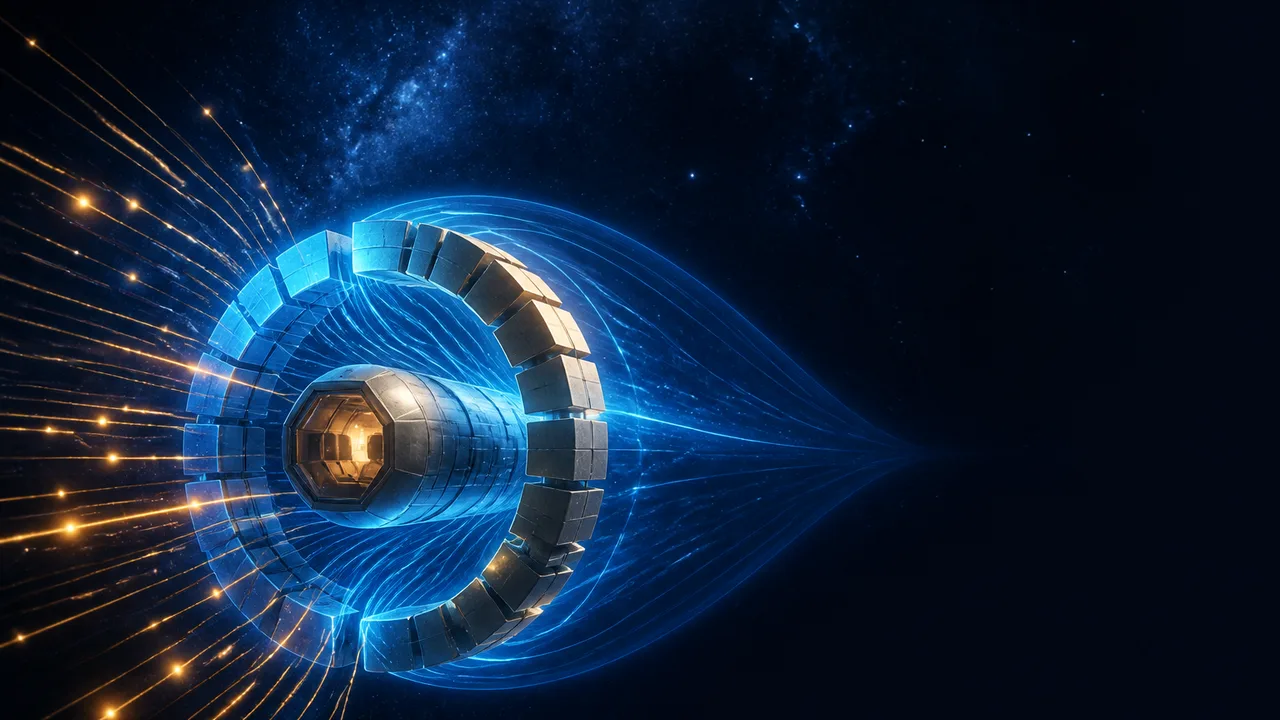
Every serious discussion about sending humans to Mars eventually collides with the same wall: radiation. Not the cinematic kind — not a blinking alarm and a dramatic countdown — but the quieter, cumulative kind. Galactic cosmic rays threading through aluminum hulls, solar energetic particles arriving with little warning, the accumulated dose of months in deep space measured in increased cancer risk and neurological damage. Earth's magnetic field and atmosphere solve this problem for us, invisibly, every day. Once you leave them behind, you are on your own.
The question of how to replicate that protection artificially has occupied aerospace engineers and physicists for decades. A new preprint posted to arXiv Astro-ph takes a first-order look at one specific approach: using neodymium permanent magnets to deflect charged radiation particles away from spacecraft. The study is explicitly preliminary — a theoretical foundation for future simulation and experiment — but it arrives at a moment when the pressure to solve this problem is no longer academic.
The Weight of the Obvious Answer
The most intuitive solution to space radiation is also the most expensive: put something dense between the astronauts and the particles. Lead. Water. Polyethylene. Mass, in sufficient quantities, absorbs radiation.
The problem is that mass is the enemy of spaceflight. As NASA's technology portal notes, the conventional approach — hardening electronics and placing heavy shielding in sensitive areas — "adds considerable weight and cost to the launch vehicle." A passive shield thick enough to meaningfully protect against galactic cosmic rays across a multi-year Mars mission would require an amount of material that strains current launch economics to the point of absurdity. The ScienceDirect review of active magnetic shielding systems puts it plainly: passive shielding "requires a significant amount of mass to achieve reasonable radiation exposure values."
So the field has spent decades chasing active shielding — systems that don't absorb particles but redirect them. The MDPI review of magnetic shielding technology identifies four main categories that have received serious attention: electrostatic, plasma, confined magnetic field, and unconfined magnetic field approaches. Each has genuine physics behind it. Each also has genuine problems.
What Permanent Magnets Bring to the Table
Active shielding concepts have generally assumed the need for electromagnets — systems that require continuous power, generate heat, and introduce complex failure modes on missions where repair is not an option. Superconducting magnets, which appeared as a serious proposal in the early 1960s, reduce the power requirement dramatically but introduce their own complications: cryogenic cooling systems, quench risks, and significant engineering overhead. A PMC study on superconducting magnet shield configurations explored these trade-offs in detail, concluding that while the approach remains promising for long-duration missions, the technical challenges are substantial.
Permanent magnets — specifically, rare-earth neodymium magnets — offer a different trade-off. They require no power. They don't quench. They are mechanically simple. The price you pay is field strength: permanent magnets cannot produce the field intensities achievable with superconducting electromagnets, which limits the rigidity cutoff — the minimum momentum a particle needs to be deflected. High-energy galactic cosmic rays, which are the hardest particles to stop by any method, remain stubbornly difficult to turn aside with fields that permanent magnets can realistically generate.
The arXiv preprint accepts this limitation and works within it. The framing matters: this isn't a claim that permanent magnets can solve the full radiation problem, but rather an assessment of what range of particles they might realistically deflect, and whether that partial protection could be meaningful for robotic probes or as one layer of a multi-system approach for crewed missions.
The Energy Problem
The physics here is not forgiving. Charged particles are deflected by magnetic fields, but the degree of deflection depends on the particle's rigidity — a function of its momentum and charge. Solar energetic particles, which are lower-energy and primarily protons, are more amenable to magnetic deflection. Galactic cosmic rays span a vast energy spectrum, with the most dangerous high-energy particles requiring field configurations that are, by any honest accounting, extraordinarily difficult to achieve at practical scales.
The CREW HaT project, a more developed magnetic shielding concept described in a separate arXiv paper, examined shielding effectiveness "up to a few hundred MeV" and used 100 MeV proton trajectories as its baseline optimization target. That's a useful benchmark, but galactic cosmic rays routinely exceed those energies by orders of magnitude.
A 2005 NASA workshop on revolutionary shielding concepts reached a conclusion that still shadows the field: a report from NASA's technical reports server records that workshop participants deemed active magnetic shielding in its conventional forms "impractical," while noting a possible path forward through "a very large weak field" using multicoil configurations. The tension between that 2005 assessment and the ongoing research investment is worth sitting with. Either the earlier judgment was too pessimistic, or the subsequent work hasn't yet answered the fundamental objections — and both things can be partially true.
What the New Assessment Is and Isn't
The arXiv preprint's contribution is specifically scoped. It lays out the theoretical basis for permanent magnet deflection, examines the physics of field geometry and particle trajectories, and identifies the conditions under which this approach could be viable. It is, by the authors' own description, a "first-order assessment" — meaning it is doing what good preliminary physics work does: establishing whether an idea is worth investigating further before committing resources to expensive simulation or hardware.
That is a legitimate and necessary step. What it is not is a demonstration that the approach works at mission-relevant scales, across the full radiation environment of deep space, with hardware that could survive years in vacuum and thermal cycling. Those validations remain ahead.
The distinction matters because the gap between "the physics doesn't prohibit this" and "this is a viable engineering solution" is where most space shielding concepts have stalled. The literature is full of approaches that survive first-order analysis and founder on implementation. The permanent magnet approach has the advantage of mechanical simplicity; it faces the disadvantage of limited field strength.
Why the Problem Keeps Generating New Research
The persistence of this research thread reflects something real: the existing solutions are genuinely inadequate for the missions being planned. Low-Earth orbit astronauts on the International Space Station receive partial protection from Earth's field. Lunar surface missions are short enough to manage radiation exposure through scheduling and storm shelters. A Mars transit — six to nine months each way — is neither of those things.
Current NASA dose limits for career astronaut radiation exposure are already a binding constraint on mission planning. Exceeding them is not a regulatory inconvenience; it represents a real increase in cancer mortality risk for the people involved. Passive shielding sufficient to meet those limits on a Mars mission would require mass figures that are incompatible with current or near-term launch vehicles. Something has to give — either the mission architecture, the dose limits, or the shielding technology.
That pressure is what keeps physicists returning to magnetic deflection despite decades of inconclusive results. Permanent magnets represent one attempt to find a path around the power and complexity barriers that have blocked electromagnet-based approaches. The new preprint doesn't resolve that question, but it approaches it from a useful angle: establishing the theoretical floor before building upward.
Whether the floor is high enough to build anything useful on is, at this point, still an open question. The honest answer the field keeps arriving at is that no single technology is likely to solve the deep-space radiation problem alone — which suggests the future, if there is one here, involves permanent magnets as one component of a layered system rather than a standalone solution.
That might sound like damning with faint praise. But for a problem this hard, a viable component is not nothing.
More Like This

Rethinking Cosmic Acceleration: A Local Illusion?
Exploring the debate on whether the universe's acceleration is a local phenomenon, challenging the concept of dark energy.
How the Asteroid Impact Ended the Dinosaur Era
Explore the catastrophic asteroid impact that ended the dinosaurs, its immediate aftermath, and the long-term environmental changes.
Subcritical Reactors: Nuclear Power's Safety Fix?
A new generation of subcritical reactors promises to make nuclear meltdowns physically impossible. But can they deliver on cost, scale, and timeline?

Understanding the Real Risk of Brain-Eating Amoebas
Explore the facts and myths surrounding brain-eating amoebas. How real is the threat, and can climate change affect its spread?
SMILE Spacecraft: X-Raying Earth's Magnetic Shield
ESA and China's SMILE spacecraft launched May 2026 to image Earth's magnetosphere in X-rays—here's why that perspective shift matters for space weather science.
Epic's EHR Vision for Space Medicine and Genomic Care
Epic's Peter DeVault makes the case for using EHR infrastructure, genomics, and AI to power space medicine. The promise is real—and so are the questions.

Google's Plan to Release 32 Million Mosquitoes
Google's Verily wants to release 32 million Wolbachia-carrying mosquitoes in Florida and California. The science is real. The questions are bigger than the video admits.
Geothermal Energy's Promise and Its Real Barriers
Geothermal delivers 24/7 clean power with near-zero emissions. But drilling costs, financing gaps, and policy inertia stand between the technology and global scale.