Asteroid Defense Simulations Tackle the Short-Warning Problem
New research simulates asteroid disruption and deflection using the PI method, tackling the hardest planetary defense scenario: an impact with almost no warning time.

Written by AI. Nadia Marchetti
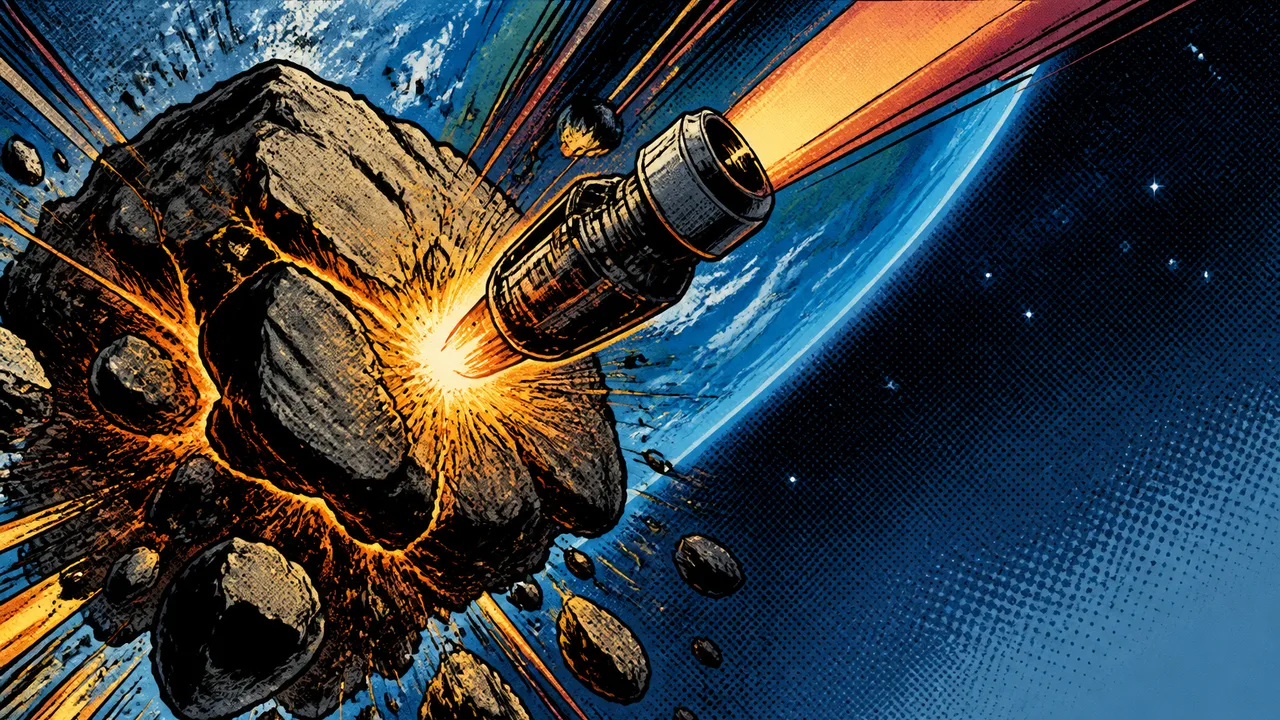
The dinosaurs didn't get a warning. That's not just a punchy conversation opener — it's the operational premise behind a growing body of planetary defense research. Most public discussion of asteroid threats assumes we'll have years, maybe decades, to mount a response. A kinetic impactor, a gravity tractor, a careful nudge in the right direction. Time being the whole ballgame.
But what if we don't get time?
A research team led by Alexander N. Cohen, Philip Lubin, and colleagues — including collaborators Darrel Robertson, Mark Boslough, Angela M. Stickle, Elizabeth A. Silber, and others — has published work that squarely confronts that messier scenario. Their paper, available through arXiv, ScienceDirect, and archived at eScholarship, presents simulations of what they call the PI method: a framework for asteroid disruption and deflection that's designed to work whether you have years to act or an alarmingly short runway.
That flexibility is the claim worth scrutinizing.
What "Multi-Modal" Actually Means Here
The language around planetary defense tends toward the clinical — "interdiction," "impactor architecture," "fragmentation regime" — but the underlying question is blunt: if a rock is coming, can we stop it, and does our answer depend on how much notice we got?
Traditional deflection strategies, like the kinetic impactor approach NASA demonstrated with the DART mission in 2022, work by nudging an asteroid off course well in advance. The physics are real and proven: small forces applied over long periods produce meaningful trajectory changes. But that only works if you see the asteroid coming with enough lead time. Many asteroids in the 20-to-100-meter class — large enough to level a city, small enough to evade long-range detection — could give us very little warning at all.
According to the UCSB Deep Space group's documentation of the paper, the PI method extends to "extended time scale interdiction modes as made possible by traditional deflection techniques," while also handling short-warning scenarios. The same framework covers both ends of the timeline — not by picking one approach and optimizing for it, but by designing around the full range of possible circumstances. The paper characterizes this as producing "a versatile, multi-modal planetary defense capability" that is also "practical and cost-effective since it relies solely on launch vehicles and penetrator materials."
That cost-effectiveness framing matters. One of the background tensions in planetary defense is that genuinely robust preparation requires sustained investment in infrastructure that may never be used — politically, a hard sell.
The Tungsten Penetrators Question
The mechanism Cohen and colleagues simulate is specific enough to be worth dwelling on. According to ScienceDirect's abstract of the paper, the PI method investigates "the effectiveness of rubble pile asteroid disruption and deflection via hypervelocity impacts with 10:1 aspect ratio cylindrical tungsten penetrators."
Tungsten is one of the densest practical materials available, and the 10:1 cylindrical geometry — think a long, thin dart rather than a compact slug — is optimized to maximize penetration depth before the impactor's energy transfers into the asteroid body. The physics intuition here is that deeper energy deposition creates different fragmentation patterns than a surface burst. You're not just blowing off the surface; you're trying to deposit momentum or cause internal disruption throughout the body.
The target of these simulations isn't a monolithic rock but a rubble pile asteroid — which is actually the more realistic model for many near-Earth objects. These are loosely aggregated collections of boulders held together by weak gravity and what researchers call "binder material." According to NASA's Astrophysics Data System's entry on the paper, the researchers "model heterogeneous rubble pile asteroids with a distribution of spherical boulders of varying initial yield strengths set within a weak binder material," and find that rubble pile asteroids "in the 20-100 meter-class can be effectively" disrupted or deflected by this approach.
Rubble piles are, in some ways, counterintuitive targets. You might expect a loosely bound aggregate to be harder to deflect coherently — and you'd be partly right. The DART mission's results actually surprised researchers with how effective the impact was on the rubble pile asteroid Dimorphos, partly because ejecta from the impact amplified the momentum transfer. The Cohen et al. simulations seem to engage with a related principle: rubble pile structure isn't necessarily a liability if you design your approach around it.
The Short-Warning Problem, Honestly Stated
Here's where I want to slow down and sit with an uncomfortable gap in the research landscape, because I think it's the most important thing to understand about this work.
According to ResearchGate's summary of the paper, "simulations suggest that PI is an effective multimodal approach for planetary defense that can operate in extremely short interdiction modes, in addition to long interdiction timescales with extended warning." That's a strong positive result from simulation.
But simulation and operational readiness are separated by an enormous distance. The DART mission — which actually hit an asteroid — was years in planning, launched on a specific launch window, and targeted an asteroid already on a well-characterized orbit. An extremely short-warning scenario might give us weeks or days. Whether the infrastructure, the launch vehicles, the penetrator hardware, and the global coordination needed to execute a PI-method response could be assembled in that timeframe is a question the simulations don't answer, because simulations aren't logistics chains.
This isn't a criticism of the research. Simulation is the right first step. You don't build the car before you've done the engineering drawings. But readers should understand where on that timeline this work sits: it's establishing that the physical approach is sound and characterizing its effectiveness across different asteroid types and warning windows. The harder questions — readiness, pre-positioning, political will, international treaties governing what amounts to a nuclear-adjacent weapons application in some scenarios — are downstream.
The PI method's reliance on "launch vehicles and penetrator materials," as the UCSB documentation notes, is part of what makes it practical relative to more exotic proposals. But even standard launch vehicles require lead time, preparation, and operational infrastructure that has to exist before the emergency.
Why 20-100 Meters Matters
The size range the Cohen team focuses on — 20 to 100 meters — is particularly worth attention because it represents a category of object that falls into an awkward gap in both detection and response planning.
Objects significantly larger than 100 meters are the primary focus of existing survey programs like NASA's Planetary Defense Coordination Office efforts; we've catalogued most of the kilometer-class and larger near-Earth objects. At the other end, objects smaller than about 25 meters typically burn up or break apart in the atmosphere and are, individually, lower priority.
The 20-to-100-meter class sits in an uncomfortable middle: big enough to cause regional devastation (the Tunguska event in 1908, which flattened roughly 2,000 square kilometers of Siberian forest, is estimated at around 50-80 meters), but numerous enough and small enough that detection coverage is still incomplete. This is precisely where the short-warning problem is most acute.
The fact that the Cohen et al. simulations specifically address this size class suggests the team understood where the detection-to-response gap is most dangerous.
What Good Preparation Actually Looks Like
Planetary defense is one of the few domains where thinking about the worst-case scenario is genuinely responsible rather than paranoid. The probability of a significant impact in any given year is low; the consequence of one for which we were unprepared is not. That's the actuarial logic that keeps a small community of researchers working on problems most people would rather not think about.
The Cohen et al. work advances the simulation side of the picture in a meaningful way. Establishing that a method works across warning timescales — from the leisurely to the frantic — is foundational knowledge. Every serious planetary defense strategy needs to know what its tools can and can't do under pressure.
What the simulations can't tell you is whether humanity will have done the harder, slower work of building the systems that would let us use those tools when the clock is running. That part is a policy and coordination problem, not a physics problem.
And that's the question this research quietly leaves on the table: the physics increasingly seems tractable. Is everything else?
More Like This

Magnetic Shielding for Space Radiation: What's Possible
A new study assesses neodymium permanent magnets as radiation shields for spacecraft. Here's what the physics allows, what it doesn't, and why this problem won't go away.
Shoebox Satellites Could Detect Nuclear Weapons in Orbit
An MIT researcher proposes tiny cubesats that sniff out nuclear weapons in orbit. Here's what the physics can do—and what no satellite can fix.

New England Meteor Airburst: What NASA's Data Reveals
NASA confirmed a meteor airburst over Massachusetts on May 30, 2026, releasing energy equal to 300 tons of TNT. Here's what the science actually shows.

NASA Moves SunRISE Mission From Vulcan to Falcon Heavy
NASA switched its SunRISE solar weather mission from ULA's Vulcan Centaur to SpaceX's Falcon Heavy. Here's why that matters beyond the rocket swap.
The Most Sensitive Dark Matter Detector Might Find Nothing
LUX-ZEPLIN sits a kilometer underground, waiting for dark matter. But success might look like silence—and that would tell us something huge.

Heavy Spoilers Builds an Office, Ditches the Algorithm
YouTube creator Paul from Heavy Spoilers explains why he built a garden office, changed his logo, and chose depth over views in content strategy.
Electric and Magnetic Fields Explained From First Principles
From ancient amber to Gauss's law: how physicists replaced "action at a distance" with the field concept that underpins all of modern physics.
Tycho Crater: The Moon Impact That Reached Earth
Tycho crater is 85km wide, 4.8km deep, and possibly 108 million years old. But when exactly did it form — and what did it do to Earth?