NASA Moves SunRISE Mission From Vulcan to Falcon Heavy
NASA switched its SunRISE solar weather mission from ULA's Vulcan Centaur to SpaceX's Falcon Heavy. Here's why that matters beyond the rocket swap.

Written by AI. Mei Zhang
I cover biotech. I spend most of my time thinking about CRISPR, gene therapy trials, and whether a startup's "breakthrough" is real or a press release in a lab coat. So why did a rocket swap pull my attention skyward this week?
Because I recognized the pattern. Fragile infrastructure. A single point of failure. The quiet, systemic risk nobody wants to name out loud until something actually breaks. I've watched that story play out in genomics supply chains and biosample logistics. And now I'm watching it play out 180 miles above Earth, where NASA just made a decision that's worth a lot more scrutiny than it's getting.
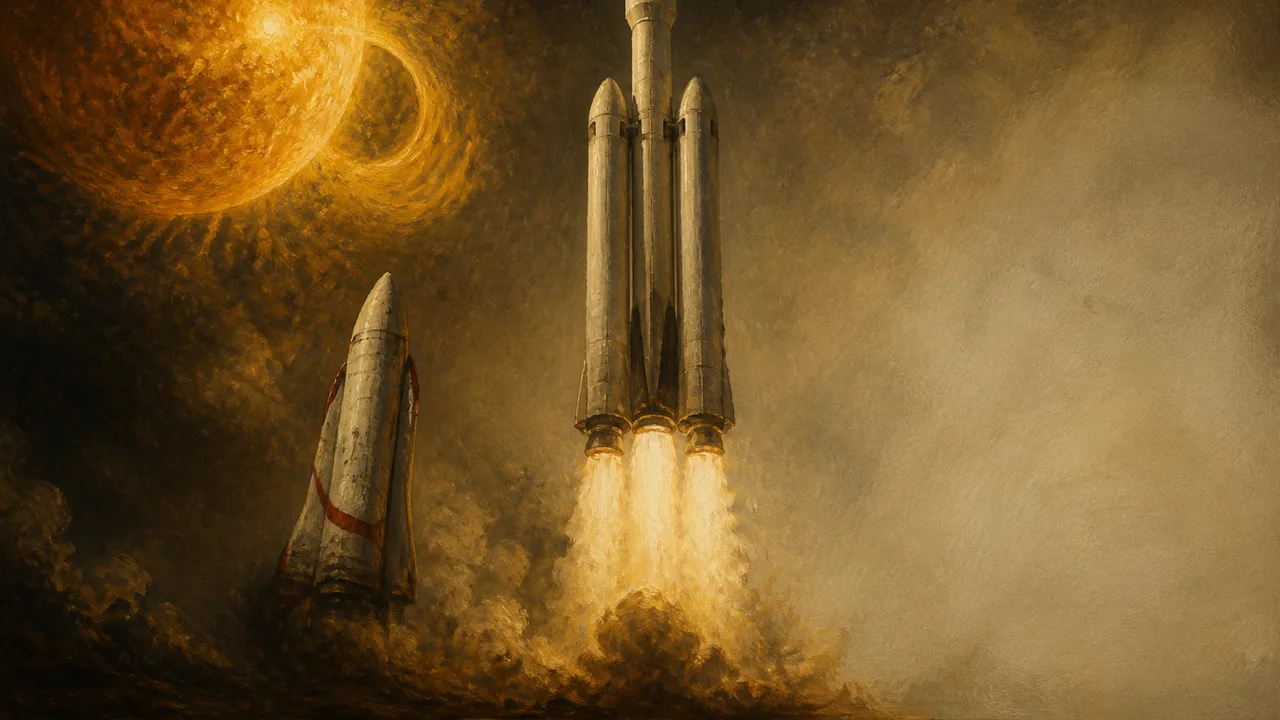
NASA announced this month that its SunRISE mission — the Sun Radio Interferometer Space Experiment — has been reassigned from a United Launch Alliance Vulcan Centaur rocket to a SpaceX Falcon Heavy, launching from Kennedy Space Center in Florida. According to NASA's own mission blog, the updated launch date hasn't been set yet. A mission update, a new rocket, no new timeline. That's not a footnote — that's the story.
So what even IS SunRISE?
Six SmallSats. Working together as a single giant radio telescope in space. According to News9Live, those six spacecraft will work in concert to detect and track solar particle storms — eruptions from the sun that hurl charged particles toward Earth at speeds that make our entire technological civilization look extremely fragile.
Here's why I actually care about this as someone who doesn't usually cover orbital mechanics: a significant solar particle storm — on the scale of historical events like the 1859 Carrington Event — wouldn't just cause a pretty aurora. It would fry power grid transformers that take months to replace. It would knock out GPS. It would degrade satellite communications. It would make your contactless payment fail, your flight get grounded, your hospital's backup systems run hard. The 1989 geomagnetic storm knocked out power to millions in Quebec. None of that is hypothetical catastrophizing — it's documented history with a very clear "and it could happen again" footnote attached.
SunRISE's job is to give us better early warning — to watch how solar particle storms form and accelerate so we can predict when one is actually threatening. Better prediction means more time to harden the grid, reroute satellites, protect the infrastructure. This mission is, in the plainest terms, a piece of the early warning system for something that could affect every person on Earth with an electrical device. Which, at this point, is all of us.
Delaying it is not an abstract inconvenience.
Why Vulcan keeps losing passengers
Space.com reported that SunRISE has been "swapped out again" — and that word again is doing real work in that headline. This isn't the first NASA payload that's walked away from Vulcan Centaur's manifest.
Talk of Titusville noted that ULA's manifest keeps shrinking, and points to "two close calls during the ascent of ULA's Vulcan rocket" as part of what's driving this erosion. The specifics of those incidents matter, and I'd want more sourced detail before characterizing them fully — but the pattern they've created is legible even from the outside: missions are leaving. Quietly, one by one, they're finding a different ride.
ULA's Vulcan Centaur was supposed to be the next-generation workhorse that kept ULA competitive in an era when SpaceX had made reusability look easy and cheap. It hasn't gone smoothly. And NASA, which has science missions on the line and no particular loyalty to any one launch provider, is making the pragmatic call.
That's fair. That's how this is supposed to work.
But here's where my ethics antenna wakes up: is this actually competition producing better outcomes for public science — or is it starting to look like one provider winning so consistently that "competition" becomes a word we use to describe a market that has already consolidated?
One provider to launch them all
SpaceX's Falcon Heavy is genuinely impressive. It's powerful, it has a track record, it can handle complex payloads. NASA moving SunRISE to Falcon Heavy, as Meteorological Technology International reported, is a defensible technical decision. I'm not disputing that.
What I'm sitting with is the systemic picture. When one commercial provider holds this much of the manifest for critical public science missions, what happens when they have a bad year? Scientific redundancy — having more than one reliable path to orbit — isn't a luxury. It's a risk management strategy. The genomics world learned this with sequencing platforms: when Illumina had supply chain issues, entire research programs paused. The labs that had hedged, that had kept relationships with Oxford Nanopore even when it wasn't the cheapest option, kept running.
NASA's relationship with multiple launch providers was that hedge. And it's getting thinner.
Who bears the cost when the hedge disappears? Not SpaceX. Not ULA. It's the researchers whose mission windows close. It's the public who waits longer for early-warning infrastructure that exists specifically to protect them. It's the taxpayers who've already funded years of mission development on a timeline that keeps slipping.
I'm not saying NASA made the wrong call on SunRISE. Given the reported issues with Vulcan's recent performance, switching to a proven vehicle to protect a mission this scientifically important is hard to argue against. But there's a difference between a smart individual decision and a healthy structural outcome — and the accumulation of smart individual decisions can still produce a fragile system.
The question nobody's asking loudly enough
The Vulcan Centaur was supposed to give the U.S. launch market a genuine alternative to Falcon Heavy for large, demanding payloads. A real competitor. Not just for the economics of it, but because having two reliable, independent paths to orbit matters for national science infrastructure the same way having two suppliers for a critical medical ingredient matters for public health.
SunRISE getting moved to Falcon Heavy is the right call for SunRISE. The NASA mission blog frames it straightforwardly: new launch vehicle, mission continues, date TBD. Clean. Pragmatic.
But what's ULA's path back to a full manifest? What does it mean for the next mission, and the one after that, if the de facto answer to "which rocket?" becomes reflexive rather than evaluated? And if Falcon Heavy ever hits a significant operational pause — a reality no launch system is immune to — what exactly is the backup plan for the missions we've stacked on it?
SunRISE exists to warn us about what happens when a single catastrophic event overwhelms infrastructure we assumed was resilient. The irony of that mission riding on an increasingly concentrated launch ecosystem is not subtle. It's not a verdict on any company. It's just a question that deserves a direct answer before we need one.
More Like This

How Maxwell Unified Electricity and Magnetism
A compass needle twitched in 1820 and set off a chain of discoveries that now powers every wireless signal in your life. Here's the physics behind it.

SpaceX Hits 600 Falcon 9 Booster Reuses
SpaceX reached 600 flight-proven Falcon 9 booster launches on July 13-14, 2026. Here's what that number actually means for spaceflight economics.

Solar Orbiter Captures First Direct View of the Sun's Poles
Solar Orbiter has captured the first direct images of the Sun's poles, revealing a chaotic magnetic field mid-reversal—and what it means for space weather forecasting.
The SpaceX IPO That Could Land in Your 401(k)
SpaceX's $2 trillion IPO isn't just a Wall Street story. Thanks to index fund rules, it may already be headed for your retirement account.

Black Hole Paradox: Are Reference Frames the Key?
Exploring how reference frames might resolve the black hole information paradox.

U.S. Science Brain Drain Threatens American Innovation
Neil deGrasse Tyson warns the U.S. is losing its scientific base to budget cuts and brain drain. What that means for innovation, and for the future.

Pancreatic Cancer Treatments That Could Change Everything
NALIRIFOX, daraxonrasib, and a personalized mRNA vaccine are reshaping pancreatic cancer treatment. Here's what the breakthroughs mean—and who can actually access them.

Ancient Egyptian Princesses Were Trained Weapon Users
New skeletal analysis of five Middle Kingdom mummies reveals ancient Egyptian princesses used bows and daggers — and a bias that buried that fact for decades.