U.S. Science Brain Drain Threatens American Innovation
Neil deGrasse Tyson warns the U.S. is losing its scientific base to budget cuts and brain drain. What that means for innovation, and for the future.

Written by AI. Olivia Meng

Photo: AI. Ondine Ferretti
The American scientific enterprise has long run on a circulatory system most people never see: federal grant money flowing to university labs, academic researchers rotating through government agencies, postdoctoral fellows moving between institutions, disciplines, and discoveries. It is not glamorous infrastructure. It does not photograph well. And for decades, it worked so reliably that its existence was taken entirely for granted.
Neil deGrasse Tyson, astrophysicist and director of the Hayden Planetarium, is not taking it for granted anymore.
In a recent StarTalk video, Tyson walks through what he sees as a quiet unwinding of that system — one that he argues carries consequences for American health, economic competitiveness, and national security that will not be visible until they are very difficult to reverse. The argument is worth sitting with carefully, not because Tyson is infallible, but because the structural observation at its center is harder to dismiss than the political controversy surrounding it.
The Circulatory System, and What Happens When It Clots
The mechanism Tyson describes is specific. Rotating academic appointments — scientists from universities doing tours of duty inside agencies like the National Science Foundation, advising bodies like the White House and Congress — have, in his account, been significantly curtailed. Simultaneously, grant funding to university researchers from agencies like the National Institutes of Health has contracted, meaning fewer labs can sustain the graduate students and postdoctoral researchers who constitute the actual workforce of basic science.
Tyson puts the federal workforce number starkly: more than 15,000 scientists lost from the ranks of the federal government in recent years, by his account. That figure comes from him directly, and it is worth noting that specific counts vary depending on methodology and which agencies are included — but the directional claim aligns with documented reductions in federal science staffing and grants that have been widely reported.
What gets cut, he notes, often looks expendable from the outside. A grant proposal whose title only a hundred people on earth can parse. A research program with no obvious quarterly application. "You cut it and you look like you're saving money," Tyson says, "when what you're doing is you're cutting out at the kneecaps the future competitiveness of this nation."
The argument for basic research has always had to fight against this optics problem, and Tyson's best weapon against it is history. His college physics professor, Nobel laureate Edward Purcell, discovered nuclear magnetic resonance — the behavior of atomic nuclei in strong magnetic fields — while studying atoms and molecules in space. He had no interest in medicine. Decades later, that discovery became the MRI scanner. Research into Gila monster venom, pursued by scientists curious about lizard biochemistry, eventually contributed to the development of GLP-1 weight loss medications. The chain of causation in both cases stretched across decades and disciplines, with no one at the origin point aiming for the destination.
"You cannot predetermine that," Tyson says of curiosity-driven research's ultimate value, "because you have no idea."
This is the honest version of the pro-basic-science argument: not that every grant will pay off, but that the payoffs come from directions nobody predicted, and that foreclosing them requires a certainty about future needs that nobody possesses.
The Slide
Tyson's most structurally interesting passage concerns China, and it is the clearest illustration of how gradual, compounding shifts can look invisible until they aren't.
The first generation of Chinese graduate students came to the United States, studied, and stayed. The second generation came, trained, and returned to build Chinese graduate programs. The third generation never came at all — they were trained in China and remained there. Three generations. No single dramatic rupture. Just a gravitational field that slowly reversed.
"This is a slide," Tyson says. "It's not a cliff. If you fell off a cliff or were pushed off a cliff, you would notice that."
That distinction — slide versus cliff — is the most precise thing he says in the entire video, and it lands because it names the exact mechanism by which slow-moving crises escape public attention until they become emergencies.
From where I sit, covering climate and environmental science, that description maps onto something I have watched happen on my own beat. The agencies whose research underpins what we know about atmospheric chemistry, ocean heat content, and ecosystem stress — NOAA, EPA's research arms, the interagency bodies that fund climate modeling — depend on the same circulatory system Tyson is describing. Academic researchers rotating through, grant-funded university science feeding into federal knowledge bases, postdoctoral researchers carrying methodological expertise between institutions.
What I have observed, gradually and without any single announcement, is the thinning of that circulation. Climate scientists at universities describe grant timelines stretching and uncertainty growing around renewal. Researchers who would previously have considered federal science careers are, in some cases, making different calculations. The talent doesn't vanish — it redirects. Some of it goes into the private sector, where it serves different priorities. Some of it, increasingly, goes to institutions elsewhere that are actively courting it. European research councils, in particular, have not been passive observers of what is happening in the United States.
"I have colleagues who've gotten a phone call from Germany, from France, from Spain saying, 'We've got a fully funded lab here. I know your expertise and I know you're running out of funding. Why don't you bring your whole operation to us?'" Tyson says.
The phrase "cherry-picked" is his. It is the right word. It implies that what is leaving is not the median — it is the exceptional, the established, the exactly-the-people-you-most-need-to-keep.
What the Slide Costs, Specifically
Here is where Tyson's argument earns its weight, and where I think it needs to be extended beyond his framing.
The knowledge these researchers carry is not interchangeable with what private R&D produces, and not because corporate scientists are less talented. It is because the incentive structures are categorically different. Corporate R&D, Tyson notes, runs on quarterly reporting cycles and revenue pathways. You cannot write a grant proposal for discovering something nobody knows to look for yet, and no CFO will authorize budget for a research program whose output cannot be predicted because it doesn't exist yet.
In the climate space, this distinction is not abstract. The models that project sea level rise, the observational datasets that track ice sheet dynamics, the atmospheric chemistry research that underpins our understanding of how feedback loops accelerate warming — none of that was produced by corporate R&D. It came from the exactly-the-kind-of-patient-basic-science that is now under pressure. And the gap between what we know and what we still need to learn is not shrinking. The questions are getting harder and more urgent simultaneously.
That is not a trivial coincidence of timing.
The Capacity Question
Tyson closes by invoking two historical moments of American scientific mobilization: the response to Sputnik in 1957, which produced NASA within a year and a moon landing within twelve, and the wartime acceleration that took plutonium from isolation to weaponization in roughly five years. His point is not that crisis is a good way to run a science policy. His point is that the capacity to respond to crisis is itself something that must be maintained. You cannot build a moon program from a standing start. You can only accelerate what already exists.
That is where Tyson lands, and it is a reasonable place to land. But I keep returning to his slide metaphor, and to a question he does not quite put this way: what happens to response capacity during the slide itself?
The Sputnik moment worked because there was a generation of trained scientists and engineers to mobilize. The Manhattan Project worked because there was accumulated scientific knowledge — about nuclear physics, about plutonium chemistry — to weaponize rapidly. Both historical examples of American snap-response depend on a pre-existing base that made rapid scaling possible.
If the circulatory system has been thinning for years before the moment of recognition arrives — if the postdoctoral pipeline has narrowed, if the rotating appointments have lapsed, if the labs have relocated to Munich and Madrid — then the response Tyson is counting on may find itself reaching for a foundation that is no longer there.
That is not pessimism. It is the one question his historical optimism does not fully answer. And it is, I think, the question that the next few years will answer for us, whether we are paying attention or not.
More Like This
Public Trust in Science Is Fragile and Complicated
Trust in science is eroding—but the data is more complicated than the panic suggests. Here's what's actually happening, and why it matters.
NASA Moves SunRISE Mission From Vulcan to Falcon Heavy
NASA switched its SunRISE solar weather mission from ULA's Vulcan Centaur to SpaceX's Falcon Heavy. Here's why that matters beyond the rocket swap.
Unraveling Time and Reality with Sean Carroll
Explore time, black holes, and reality with Sean Carroll, as science and philosophy intertwine in our understanding of the universe.
Mass Extinction Risk: How Overdue Are We?
Joe Scott surveys Earth's extinction history—supervolcanoes, asteroid strikes, a 2023 Greenland megatsunami—and asks which catastrophe is statistically nearest.
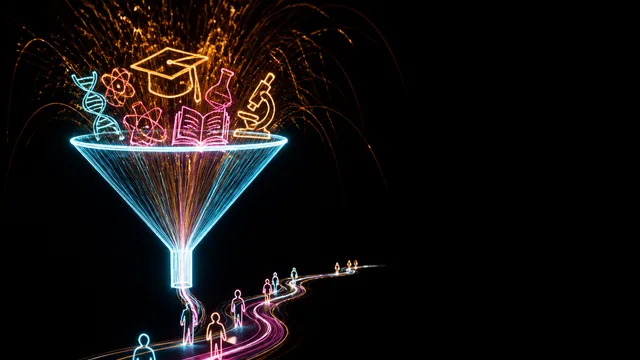
U.S. PhD Admissions Fall 15%: A Threat to Science
PhD admissions at top U.S. research universities dropped 15% this fall. Here's what that means for the science pipeline—and why it's harder to fix than it looks.
Exploring Black Holes and Asteroids with StarTalk
Neil deGrasse Tyson delves into black holes, asteroids, and more in StarTalk's latest Cosmic Queries episode with Chuck Nice.
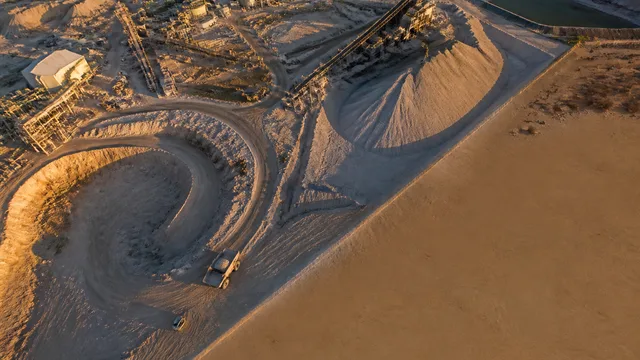
Mountain Pass Mine and the U.S. Rare Earth Supply Gap
The Mountain Pass mine once supplied 70–80% of global rare earths. Here's how the U.S. surrendered that dominance—and what it actually takes to rebuild it.

Smartphones and the Global Baby Bust
John Burn-Murdoch's data on falling global birth rates points to smartphones as a key driver—and the mechanism looks familiar to anyone who covers collective action failures.