Mountain Pass Mine and the U.S. Rare Earth Supply Gap
The Mountain Pass mine once supplied 70–80% of global rare earths. Here's how the U.S. surrendered that dominance—and what it actually takes to rebuild it.

Written by AI. Olivia Meng
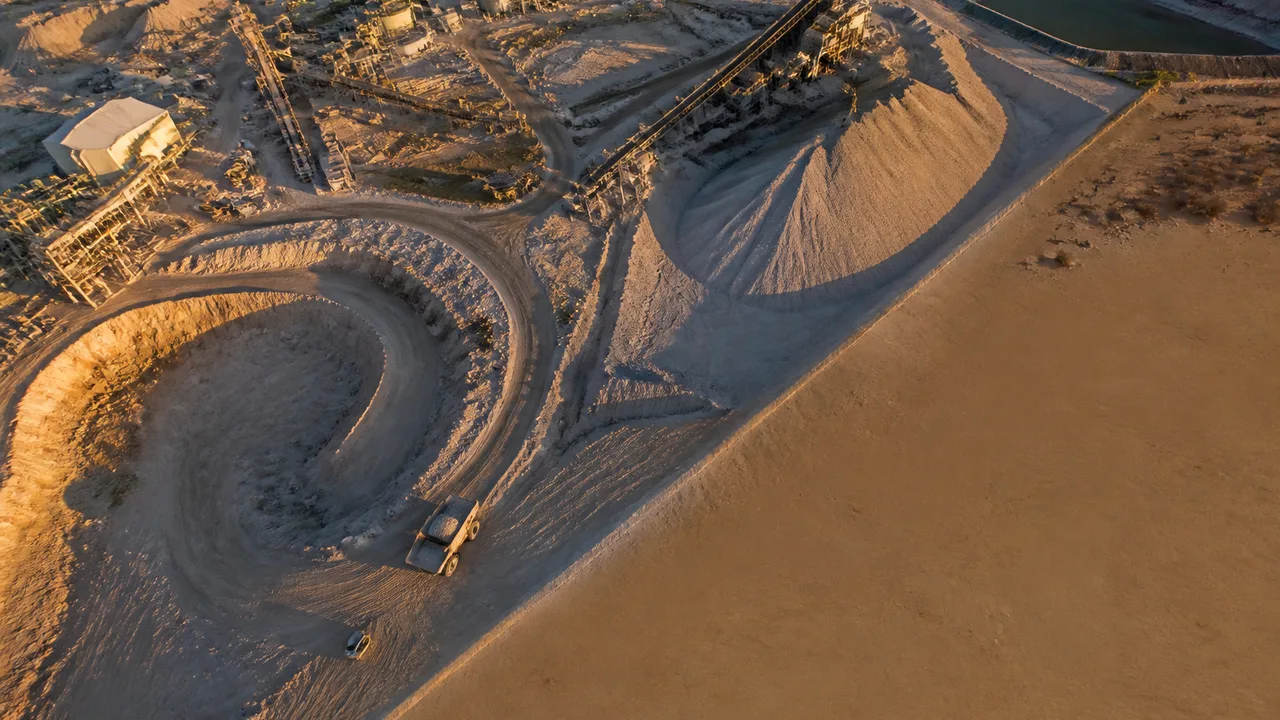
Photo: AI. Rio Sanchez
Dusty terraces cut into a brown mountainside. A few processing buildings. Some trucks. From the road, the Mountain Pass mine in the Mojave Desert looks like the kind of industrial relic you'd drive past without slowing down. It is, in fact, one of the most geologically extraordinary mineral deposits on Earth — and the site of one of the more consequential industrial abdications in recent American history.
The question worth sitting with is not whether Mountain Pass can produce rare earth elements. It already is. The question is whether mining alone means anything when the processing infrastructure that turns ore into usable materials has spent three decades consolidating on the other side of the planet.
What makes the rock unusual
To understand why this particular patch of Mojave Desert matters, you have to start with the chemistry. Most rare earth deposits contain less than 1% rare earth oxide by weight. The richest zones at Mountain Pass yield between 8 and 12%. That is not a marginal improvement — it restructures the entire economics of extraction. Moving and crushing rock to find trace concentrations is expensive; moving and crushing rock that is already dense with target material is a fundamentally different industrial proposition.
That concentration is the product of something that happened 1.4 billion years ago. Ancient continental rifting created deep fractures through which an unusual carbon-rich magma — a carbonatite — ascended from the mantle. Unlike the silicate magmas that form common rocks, this melt carried carbon, fluorine, and heavy metals. As it cooled, those elements locked together into a fluorocarbonate mineral called bastnäsite, which became the primary host for cerium, lanthanum, neodymium, and europium. The resulting structure, known as the Sulfide Queen carbonatite stock, concentrated those elements with a specificity that most deposits — including the world's largest, Bayan Obo in Inner Mongolia — do not replicate. Bayan Obo is also carbonatite-linked, but its minerals are dispersed across a vast iron ore matrix averaging less than 1% rare earth oxide by weight.
The element mix matters as much as the concentration. Neodymium is the backbone of high-strength permanent magnets — the kind that run electric vehicle motors and wind turbine generators. Cerium and lanthanum are industrial workhorses in catalysts and glass polishing. Europium, historically, supplied the red phosphor in color televisions. This particular deposit arrived pre-loaded with the elements that the twentieth century — and now the twenty-first — actually needed.
How the U.S. squandered a 30-year head start
Mountain Pass was not discovered through strategic foresight. In April 1949, two prospectors named H.E. Woodward and Clarence Watkins were sweeping the Clark Mountains with a Geiger counter, chasing uranium in the post-war atomic rush. Their detector spiked over a reddish-brown outcropping. The rock did contain trace thorium, but what geologists from the Bureau of Mines identified was bastnäsite — the richest rare earth deposit on Earth. The prospectors had missed what they were looking for and found something far more valuable.
By 1952, the Molybdenum Corporation of America had established full mining operations. Through the 1970s and 1980s, the mine produced roughly 15,000 metric tons of rare earth oxides annually, supplying an estimated 70 to 80 percent of world demand. An integrated chemical processing plant ran alongside the open pit, separating individual elements at high purity. The site was, as MysteryOfTheMap's video puts it, "the headwaters of an essential industrial chain." Military radar components, precision optics, guidance system magnets — the downstream applications were not trivial.
Then China moved. Beginning in the late 1980s, Beijing constructed rare earth infrastructure around Bayan Obo as a coordinated state project, not a market-driven commercial venture. State subsidies, low-interest loans, relaxed environmental oversight, and integrated mining-to-refining operations allowed Chinese producers to price their materials well below what Mountain Pass could match. Throughout the 1990s, rare earth prices fell. American producers bled.
Mountain Pass was also undone from within. The facility's aging wastewater system, managing the highly acidic effluent from chemical processing, failed in 1998. A pipeline rupture spilled roughly 300,000 gallons of radioactive, heavy-metal-laden water into the surrounding Mojave National Preserve, contaminating the desert floor with thorium, uranium, lead, and radium — a documented inventory consistent with reporting on similar rare earth processing spills — and threatening the desert tortoise population. The EPA and California's Department of Toxic Substances Control launched investigations that exposed years of accumulated environmental liability. Processing halted. Cleanup costs piled onto losses from cheap Chinese imports.
In 2002, Mountain Pass closed. The United States — which had pioneered the global rare earth industry — was left without any domestic separation capacity.
The pattern of failed revivals
The mine's subsequent history reads as a case study in how market optimism can mistake the first step for the whole staircase.
When rare earth prices spiked sharply in 2010 amid geopolitical tensions around China's export restrictions, Wall Street poured capital into a newly formed company called Molycorp, which had acquired Mountain Pass and promised a complete domestic solution it called Project Phoenix — mining and advanced chemical processing under one roof. The company raised approximately $1 billion in its July 2010 IPO. The ambition was real. So were the engineering challenges.
Rebuilding complex chemical processing infrastructure from scratch, under California's environmental permitting requirements, proved far more difficult and expensive than projected. As Molycorp struggled with delays and cost overruns, Chinese producers increased supply and global rare earth prices collapsed. By 2015, carrying more than $1.7 billion in debt and unable to operate its new processing facility at a profit, Molycorp filed for Chapter 11 bankruptcy.
In 2017, a consortium including JHL Capital, QVT Financial, and Shanghai Resources purchased the Mountain Pass assets from the bankruptcy estate for $22 million, forming MP Materials. The Pentagon subsequently awarded the company a Defense Production Act contract — the precise dollar figure was not independently verified for this article — to fund domestic rare earth separation work and a pilot magnet manufacturing line. The intent was explicit: close the gap between pulling ore from the ground and producing the refined materials that defense systems and clean energy hardware actually require.
The bottleneck is chemical, not geological
Here is the core problem that successive revivals have repeatedly underestimated: mining is the easy part.
According to the International Energy Agency's analysis of rare earth elements, China controls approximately 91% of global rare earth separation and refining and around 94% of permanent magnet manufacturing. Mountain Pass currently produces roughly 15% of the world's raw rare earth concentrate. That figure is meaningful. It is not, by itself, supply chain independence.
Turning raw concentrate into separated oxides — and then into the neodymium-iron-boron magnets that go into EV motors and wind turbines — requires a specific industrial process called solvent extraction. Concentrate passes through dozens of sequential stages, mixed repeatedly with organic acids and chemical solvents, with precise control of temperature and acidity at each step. The waste streams are highly corrosive. The engineering expertise to design, permit, and operate these hydrometallurgical facilities at scale has largely disappeared from the American industrial workforce over the past three decades. It cannot be conjured back by a single contract or a geopolitical crisis. It has to be rebuilt, trained, and sustained — which demands capital and policy patience that tends to outlast electoral cycles.
MysteryOfTheMap's video lands on the right diagnosis: "The geological wealth of Mountain Pass is a starting point, but the true strategic struggle is defined by the chemistry. The ore was never the hard part."
This is where the story gets uncomfortable. The clean energy transition — the one that was supposed to reduce dependence on unstable commodity markets — runs directly through rare earth permanent magnets. Every offshore wind turbine, every EV drivetrain, every grid-scale application of these technologies is downstream of a refining and magnet manufacturing capacity that the United States voluntarily let atrophy. Not through sabotage or miscalculation. Through the entirely rational, market-conforming decision to buy processed materials from whoever offered them cheapest, and to assume that supply chains, once constructed, are stable features of the landscape rather than institutional achievements that degrade the moment you stop tending them.
Mountain Pass is digging. MP Materials is processing more than it was. The Pentagon is involved in ways it wasn't a decade ago. These are real developments, not theater.
But the scale of what was lost is not measured in the ore still sitting in the ground — that's still there, as concentrated as it was when two prospectors stumbled across it in 1949. It's measured in the thirty years of processing knowledge, workforce expertise, and industrial infrastructure that quietly dissolved while the market was busy being efficient. Rebuilding a mine takes months. Rebuilding a supply chain takes a generation — and only if you decide, with some consistency, that you intend to.
More Like This

Rethinking Cosmic Acceleration: A Local Illusion?
Exploring the debate on whether the universe's acceleration is a local phenomenon, challenging the concept of dark energy.
How the Asteroid Impact Ended the Dinosaur Era
Explore the catastrophic asteroid impact that ended the dinosaurs, its immediate aftermath, and the long-term environmental changes.

Subcritical Reactors: Nuclear Power's Safety Fix?
A new generation of subcritical reactors promises to make nuclear meltdowns physically impossible. But can they deliver on cost, scale, and timeline?
Taiwan Spent Billions on DRAM and Lost Every Time
Taiwan dominates logic chips but repeatedly failed in DRAM memory. Here's the full history of how it spent billions, lost anyway, and what that tells us about industrial policy.

Understanding the Real Risk of Brain-Eating Amoebas
Explore the facts and myths surrounding brain-eating amoebas. How real is the threat, and can climate change affect its spread?

Japan's Deep-Sea Bet on Rare Earth Independence
Japan is spending half a billion dollars mining rare earths six kilometers underwater. The numbers don't work—and they're doing it anyway. Here's why that matters.

Smartphones and the Global Baby Bust
John Burn-Murdoch's data on falling global birth rates points to smartphones as a key driver—and the mechanism looks familiar to anyone who covers collective action failures.
Project Pele: The Pentagon's Portable Nuclear Reactor
The Pentagon's Project Pele aims to power remote military bases with a containerized nuclear reactor. Here's what the technology promises—and what it can't yet answer.