Electric and Magnetic Fields Explained From First Principles
From ancient amber to Gauss's law: how physicists replaced "action at a distance" with the field concept that underpins all of modern physics.

Written by AI. Nadia Marchetti
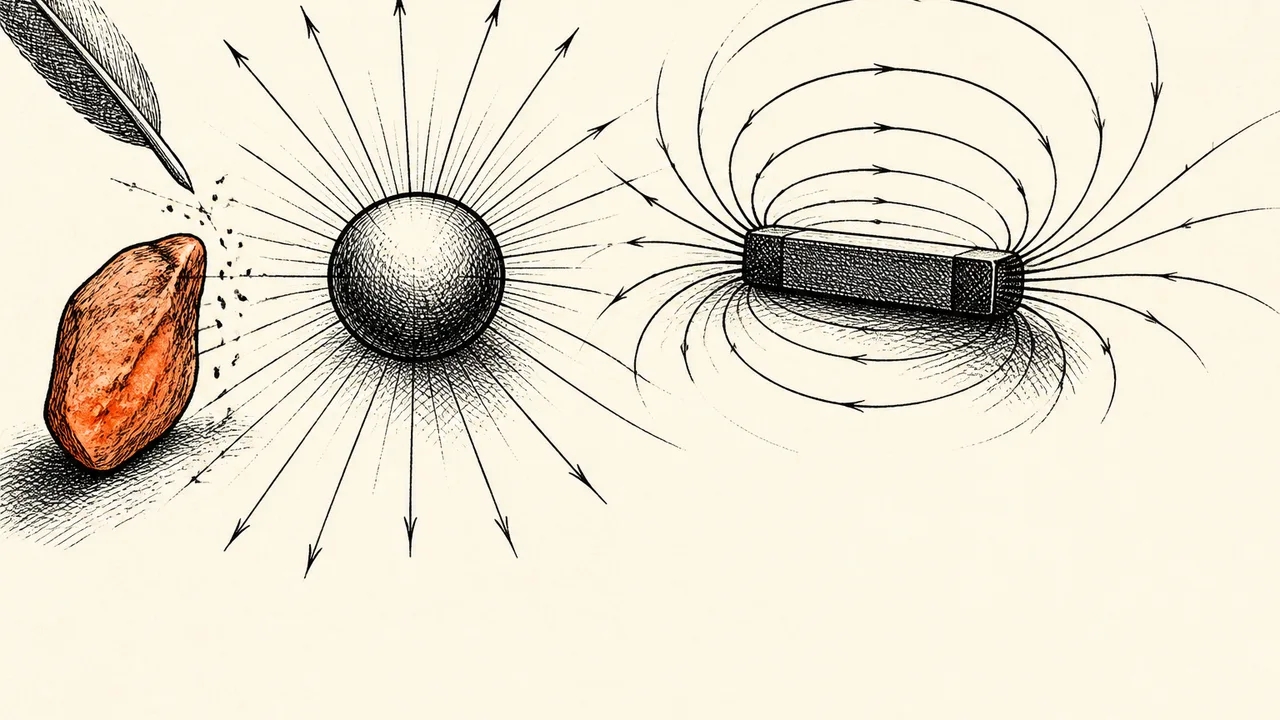
Photo: AI. Eira Pendragon
There's a question so obvious that most physics courses skip past it in the first ten minutes: how does one object reach out and push or pull another object it isn't touching?
A compass needle swings toward a magnet. Iron filings curl into elegant arcs around a bar magnet's poles. Two charged balloons drift apart as if something invisible is wedged between them. These are among the oldest observations in natural philosophy, and for a very long time — centuries, actually — nobody had a satisfying answer for what was doing the pushing. The Physics Explained channel's new video, "What Are Electric and Magnetic Fields, Really?", takes that question seriously enough to spend 36 minutes on it. The result is a patient, rigorous walk through one of physics' most important conceptual turns: from spooky action at a distance to the modern idea of the field.
It's a better origin story than most textbooks bother to tell.
Amber and Lodestones: A 2,500-Year Warm-Up
The video opens in ancient Greece, which is exactly where you should open if you want to explain why any of this is surprising. Around 600 BCE, Thales of Miletus noticed that rubbed amber could attract feathers and bits of straw across empty space. The Greek word for amber — electron — eventually lent its name to the entire discipline. Centuries later, Aristotle's successor Theophrastus wrote it up properly, though without much by way of explanation. People filed it as a curiosity and moved on.
Magnetism had a parallel track: lodestones, naturally magnetized iron ore, were known to attract iron. More strangely, a suspended chunk of lodestone would swing until it pointed north-south. A rock that knew which way was north. Petrus Peregrinus in the 13th century established that magnets have two poles, that opposite poles attract and like poles repel — a pattern that echoed what would eventually be discovered about electric charges. William Gilbert, physician to Queen Elizabeth I, made the decisive leap around 1600: the compass doesn't point to some distant mountain or celestial pole. It points because the Earth itself is a giant magnet.
Both threads — electric and magnetic — ran for over two millennia before anyone figured out what connected them.
The Problem with Action at a Distance
Benjamin Franklin gave us the positive/negative naming convention in the 18th century and confirmed that lightning was the same phenomenon as laboratory sparks, just at terrifying scale. Charles-Augustin de Coulomb, starting in 1785, pinned down the mathematics: the force between two electric charges falls off with the square of the distance between them. Double the distance, the force drops to a quarter. Triple it, the force becomes one-ninth. Tidy, elegant, measurable. (Henry Cavendish had found the same result earlier, but never published — one of physics history's more frustrating footnotes.)
But Coulomb's law, for all its precision, smuggles in a deep philosophical problem. If two charges are sitting in space with nothing between them, how does one know the other is there? Does information jump instantaneously across the gap? Does the first charge somehow dispatch an invisible arm to grab the second? This was called "action at a distance," and as the video puts it, it "was deeply uncomfortable to many physicists."
The discomfort was justified. Action at a distance isn't just aesthetically unsatisfying — it creates real physical problems once you start asking questions about time delays and what happens when charges move.
Faraday's Radical Reframe
The person who started dismantling action at a distance was not a mathematician or a theorist. Michael Faraday was the son of a blacksmith, had almost no formal education, and began his career binding books. He read them as he bound them. He attended lectures by the chemist Humphrey Davy at the Royal Institution, wrote up his notes carefully, sent them to Davy, and eventually talked his way into a job as Davy's assistant. What he lacked in formal training he made up for with something rarer: physical intuition of almost eerie depth.
Faraday's intervention was conceptual rather than mathematical. Instead of imagining one charge reaching across empty space to tug on another, he proposed that a charge changes the space around it. That change — the field — exists everywhere in the surrounding region, even before any second charge shows up to be affected. When a second charge does arrive, it doesn't interact with the first charge directly; it interacts with the field the first charge has already laid down in its vicinity.
The video captures this shift well: "Rather than imagining one charge directly pulling on another across empty space, Faraday pictured the influence of a charge as extending throughout the space around it."
This might sound like metaphysics, but it has a precise mathematical form. Place a small positive "test charge" at a point in space. Measure the force on it. Divide by the test charge's magnitude. What you're left with is the electric field strength at that point — independent of the test charge, a property of the space itself. Do this at thousands of points and you have a map of the field.
Field Lines, Flux, and Gauss
Field lines are Faraday's visual language for this map. They show the direction a positive test charge would initially move if released, and their density — how tightly packed they are — represents field strength. Crowd together near a charge, spread apart in empty space. Around a positive charge they radiate outward; around a negative charge they point inward; between an electric dipole (one positive, one negative charge), they arc from the positive to the negative in elegant curves.
The video is careful to flag a common misreading: "Field lines are only a visual representation. They are not literal threads running through space. The electric field exists at every point, including all the points between the particular lines we chose to draw."
That caveat matters. A field is a continuous mathematical object defined at every point in space. Field lines are like the contour lines on a topographic map — useful guides, not the terrain itself.
From field lines, the video builds to flux — a measure of how much field passes through a given surface. Picture dividing a surface into tiny patches, finding the component of the field pointing directly through each patch, multiplying by the patch area, and summing everything up. That sum is the flux. The formal machinery involves a surface integral, but the intuition is simple: flux counts how much field is "threading" through a surface.
And this leads to Gauss's law, the first of Maxwell's four equations: the total electric flux through any closed surface equals the net electric charge enclosed, divided by a constant (the permittivity of free space). The radius of the surface doesn't matter. Shrink or expand the enclosing sphere around a charge — the field gets stronger or weaker, the surface area grows or shrinks, and these effects cancel out perfectly, leaving only the charge inside. Reshape the sphere into a cube or a crumpled mess — same result. The flux cares only about what's enclosed.
Where Magnetism Diverges
Magnetic fields follow the same field-line logic. Iron filings on paper over a bar magnet trace out a pattern that mirrors the electric dipole picture almost exactly: lines emerging from the north pole, looping around, re-entering at the south pole. Magnetic flux can be defined the same way as electric flux. And so a natural question arises: is there a magnetic version of Gauss's law?
There is — and it's strikingly different. The magnetic equivalent says that the total magnetic flux through any closed surface is always zero. Not "depends on the enclosed charge." Always zero.
The reason is structural. Electric charges come in isolation — you can have a positive charge sitting alone in space with no negative charge anywhere nearby. Magnetic poles don't work that way. Every north pole comes packaged with a south pole. Cut a bar magnet in half and you don't get a north piece and a south piece; you get two smaller magnets, each with both poles. The video puts it plainly: "As far as we know, magnetic poles always come in pairs."
This is not a technical accident. It's a fundamental asymmetry between electricity and magnetism, and it shows up mathematically in that zero. No isolated magnetic pole — no "magnetic monopole," in the jargon — has ever been observed. So for any closed surface, whatever magnetic flux enters must also exit. The net is always zero.
(This is worth sitting with, because it's genuinely strange. Particle physics has theoretical reasons to expect monopoles to exist — and extensive experimental programs have searched for them. So far: nothing. The broken circuit that Maxwell later diagnosed as missing from the classical picture of electromagnetism is in some ways downstream of this asymmetry.)
What the Field Actually Is
By the end of this first installment, the Physics Explained video has laid down two of Maxwell's four equations without ever invoking Maxwell by name. Gauss's law for electricity: charges create electric fields, and the flux tells you how much charge is enclosed. Its magnetic counterpart: magnetic field lines form closed loops, never beginning or ending on isolated poles, so net magnetic flux through any closed surface is always zero.
What the video leaves deliberately open — saved for part two — is the deeper question: if magnetic fields aren't produced by isolated magnetic charges, what does produce them? The answer involves moving electric charges, changing electric fields, and the insight that nearly ended the tidiness of classical physics before Maxwell stepped in and patched the gap. That Faraday-to-Maxwell arc is one of science's great collaborative stories across time, two men who never worked together but whose ideas fit together like interlocking gears.
For now, though, the ground-level concept is worth holding: space isn't empty. It's structured. A charge doesn't reach out and grab things — it modifies the space around it, and other things respond to that modification. We swapped a mystery (action at a distance) for a description (the field), and the description turned out to be so precise and so powerful that it eventually unified electricity, magnetism, and light into a single framework.
Whether the field is "real" in some deep ontological sense, or whether it's a spectacularly useful mathematical fiction, is a question that remains genuinely open. Physics as a discipline has made its peace with being agnostic on that particular point.
More Like This
The Mathematical Pattern Everyone Believes But No One Can Prove
For 150+ years, mathematicians have believed in a pattern that seems obvious—yet remains unproven. Here's why the Riemann Hypothesis matters.
The Broken Circuit That Revealed Light Is Electromagnetic
How James Clerk Maxwell solved a capacitor paradox and discovered that light is electricity and magnetism dancing together through empty space.
Can Quantum Physics Only Work From God's View?
Physicist Renato Renner argues quantum theory has a blind spot: it can't describe the observer doing the describing. What does that mean for physics itself?
The Messy, Brilliant History of Divergence and Curl
How Hamilton's quaternion obsession, Maxwell's electromagnetism, and a self-taught telegraph operator gave us the vector calculus we use today.

The Two Poles Theorem Solves a Geometry Puzzle
A geometry puzzle about two walls and a man's height reveals a classical theorem — and a surprising connection to teamwork math. Here's what's actually going on.
The Hidden Math Holding Climate Science Together
Dialect's video on the covariant derivative explains the math quietly powering climate models, ice sheet measurements, and atmospheric science.
Tycho Crater: The Moon Impact That Reached Earth
Tycho crater is 85km wide, 4.8km deep, and possibly 108 million years old. But when exactly did it form — and what did it do to Earth?

Why All Mammals Share Seven Neck Bones
Giraffes and humans both have seven cervical vertebrae. The evolutionary reason involves Hox genes, cancer risk, and the surprising anatomy of the diaphragm.