The Messy, Brilliant History of Divergence and Curl
How Hamilton's quaternion obsession, Maxwell's electromagnetism, and a self-taught telegraph operator gave us the vector calculus we use today.

Written by AI. Amelia Nwofor
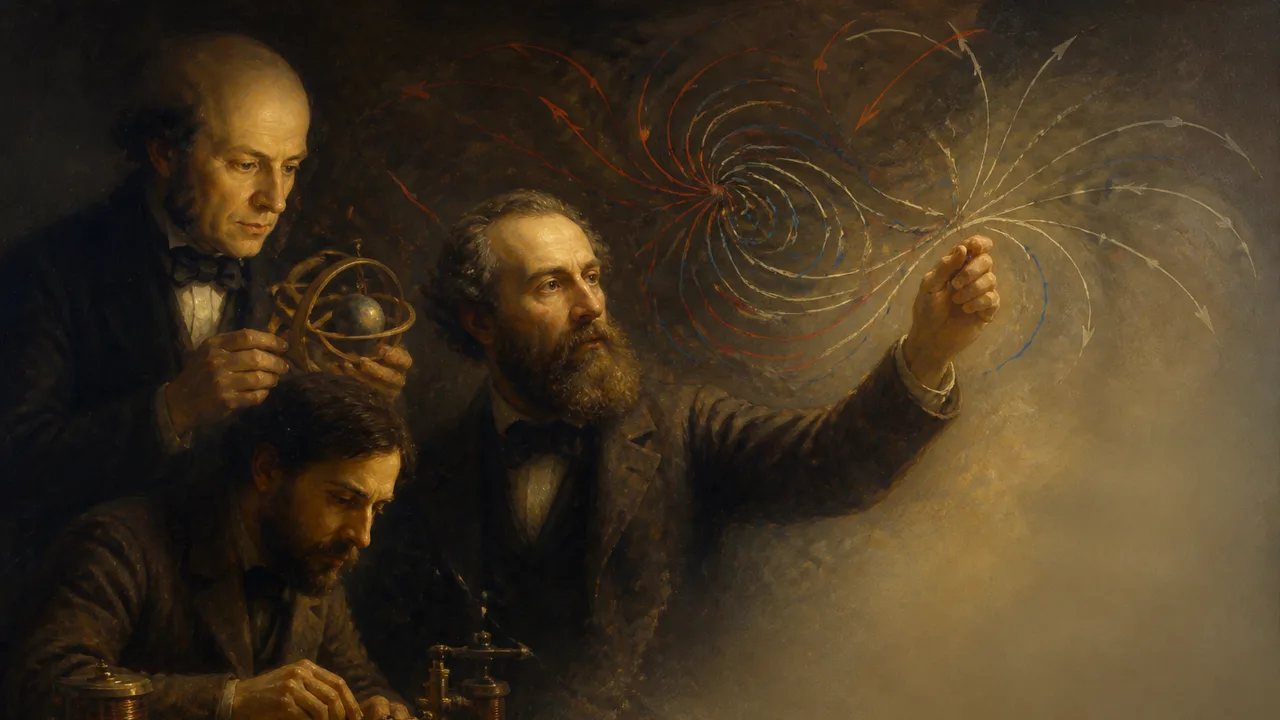
Photo: AI. Henrik Solberg
Every STEM student eventually encounters divergence and curl — usually in a multivariable calculus course, usually without any explanation of where they came from or why they're shaped the way they are. They arrive fully formed, like furniture that was already in the apartment. A recent video from the channel Abide By Reason makes a compelling case that this is a shame, because the actual origin story is strange, contested, and considerably more interesting than the textbook presentation.
The short version: it took the better part of a century, at least half a dozen major mathematical figures, one act of bridge graffiti, and a self-educated telegraph operator working unpaid in his parents' house to get there. The longer version is worth sitting with.
Vectors weren't always a thing
The story starts earlier than you might expect. Newton's Principia (1687) contains what we now recognize as vector operations — force, momentum, velocity, the parallelogram rule for combining them. But as the video notes, quoting a scholar of the period: "with Newton, a host of vectoral entities, though not the concept of a vector, entered into physical science." Newton was doing something that looked like vector addition without having the framework to call it that. The concept was latent in the physics; the mathematics hadn't caught up.
That gap — between using something and formally understanding it — is a recurring feature of this history. It's worth keeping in mind as a general epistemological point: much of science operates this way. Tools work before anyone knows exactly why.
The formal concept of a vector didn't crystallize until William Rowan Hamilton arrived in the 1840s, and even then it emerged as a byproduct of something else entirely.
Hamilton's detour through four dimensions
Hamilton's actual goal was more ambitious and more peculiar than inventing vectors. He wanted to algebraically represent rotations in 3D space — to do for three dimensions what complex numbers had done for two. Complex numbers, as mathematicians had gradually worked out, could be interpreted geometrically: multiplying by i was equivalent to rotating 90° on the complex plane. Hamilton wanted an analogous system for one dimension up.
He spent years on the problem and couldn't crack it. The breakthrough came on October 16, 1843, while crossing a canal bridge in Dublin. The insight was counterintuitive: you can't represent 3D rotations algebraically with a three-component number. You need four components. As Hamilton wrote to a friend: "there dawned on me the notion that we must admit in some sense a fourth dimension of space."
He was so struck by this that he carved the fundamental formula into the stone of Broom Bridge on the spot. People still walk that route every year on October 16th — Hamilton Day — to reenact what the video cheerfully calls his "famous act of mathematical graffiti."
The system he'd discovered was quaternions: 4D complex numbers with three imaginary components (i, j, k). They satisfied almost all the ordinary rules of arithmetic — except one. Quaternion multiplication is non-commutative: ij ≠ ji. At the time this was genuinely shocking. The video describes it as "the first person in history to discover a whole new kind of algebra," which is accurate and worth sitting with. The idea that you could have a mathematically consistent number system where order of multiplication mattered was not intuitive in 1843.
Vectors, in Hamilton's framework, were the imaginary part of a quaternion. The real part he called a scalar. When you multiplied two quaternions together, the scalar part of the result turned out to be equivalent to what we now call the dot product, and the vector part was equivalent to the cross product. Both fell out of quaternion multiplication as natural byproducts.
Hamilton spent the rest of his life developing quaternion theory — an 800-page textbook, over a hundred papers — and his contemporaries were not universally convinced he was spending his time well.
The physicists who actually made it useful
The connection between quaternions and physical reality was established not by Hamilton but by two Scottish scientists born in the same year: Peter Guthrie Tait and James Clerk Maxwell. They'd been friends since school in Edinburgh, which is one of those biographical facts that sounds like a convenient fiction but apparently isn't.
By the 1850s and 60s, Tait was working on the mathematics of heat while Maxwell was probing electromagnetism. Tait dug into Hamilton's quaternion work, adapted Hamilton's differential operator, and gave it the name nabla — still in use today. He also made quaternion theory significantly more accessible, which mattered because the original exposition was not exactly reader-friendly.
Maxwell, urged by Tait to study the theory, wrote back that he was "getting converted to quaternions." He eventually used the framework to write his Treatise on Electricity and Magnetism, in which he proposed names for what the nabla operator produced. The scalar part he called convergence; the vector part he named curl — a term that stuck immediately and survives unchanged. Maxwell's treatise condensed his original 20 equations down to eight in quaternion form. It is, by any measure, one of the most consequential scientific documents ever written.
But Maxwell's equations still referenced electromagnetic potentials — mathematical scaffolding that not everyone thought corresponded to anything physically real. That's where the final figure enters.
The telegraph operator who finished the job
Oliver Heaviside is the kind of figure who doesn't fit neatly into the standard narrative of scientific progress. Born in London in 1850, he left school young, worked briefly as a telegraph operator, then quit his job, moved back in with his parents, and spent his time teaching himself advanced mathematics and physics. His account of discovering Maxwell's treatise at his local library is worth quoting directly: "I remember my first look at the great treatise of Maxwell's when I was a young man. I browsed through it and was astonished. I saw that it was great, greater, and greatest. I was determined to master the book and set to work."
He mastered it. And then he improved it.
Heaviside's two core contributions were, first, a fully worked-out theory of vector analysis — vectors as objects in 3D space, representable by a single letter, independent of any coordinate system — and second, a radical simplification of Maxwell's equations. He eliminated all references to potentials and reformulated everything in terms of two physical quantities: the electric field and the magnetic field. The result was four equations. Those four equations are what every physics student learns today.
He also renamed Maxwell's "convergence" as divergence (technically its negative), completing the terminology we now use.
At roughly the same time, working independently in America, Josiah Willard Gibbs developed an identical theory of vector analysis, also heavily influenced by Maxwell. The parallel discovery is one of those recurring patterns in scientific history that raises genuinely interesting questions about whether these developments were, in some sense, inevitable given the state of the field — or whether two unusually perceptive people just happened to read the same book at the same moment in history.
What the history actually tells us
The Abide By Reason video presents this as a fairly linear story of progress, and in broad strokes that's fair. But there are tensions worth noticing that the narrative glosses over a little.
For one thing, quaternions lost. Hamilton's framework — which is arguably more mathematically unified — was replaced by the Heaviside-Gibbs vector system, which is more computationally convenient but strips out some of the deeper algebraic structure. Whether that was the right trade-off is a question that hasn't fully closed; quaternions eventually made a comeback in computer graphics and aerospace applications precisely because of their superior handling of 3D rotations.
For another, "discovery" is doing a lot of work in this story. Hamilton discovered quaternions; Maxwell named curl; Heaviside named divergence and fixed the equations. But Tait's role in transmitting and translating Hamilton's ideas is easy to underweight, and the video is honest about noting that he was the one who actually got Maxwell to engage with the framework. Science rarely moves by solitary genius.
What the history does illustrate clearly is that the tools we use to describe physical reality don't arrive pre-packaged. Divergence and curl weren't waiting to be found — they were constructed, incrementally, by people who were often trying to solve different problems entirely. Hamilton wanted to represent rotations. He got vectors. Maxwell wanted to describe electromagnetism. He got divergence and curl. Heaviside wanted to simplify equations. He got the modern formulation of electrodynamics.
The standard curriculum presents the destination. The history shows you the route — and the route is usually stranger, more collaborative, and more contingent than the destination implies.
By Amelia Nwofor, Science Desk Editor
More Like This

Middle Platonism's Hidden Role in Western Esotericism
ESOTERICA's new crowdfunded seminar argues Middle Platonism built the foundations of Hermeticism, Gnosticism, and early Christian theology. Here's what that means.
Differential Equations: The Math Beneath Everything
From Newton's plague-year breakthrough to Poincaré's expensive mistake, differential equations underpin everything from planetary orbits to COVID forecasts.
The Brachistochrone: Why the Fastest Path Curves
A 1696 math puzzle about falling beads reshaped all of physics. The brachistochrone problem is stranger—and more consequential—than it first appears.
The Broken Circuit That Revealed Light Is Electromagnetic
How James Clerk Maxwell solved a capacitor paradox and discovered that light is electricity and magnetism dancing together through empty space.
Medicine's Strangest History, Explained
Medical historian Richard Barnett unpacks lobotomies, Typhoid Mary, penicillin, and why the history of medicine is a mirror for the present.
The Hidden Math Holding Climate Science Together
Dialect's video on the covariant derivative explains the math quietly powering climate models, ice sheet measurements, and atmospheric science.

How Newton Calculated Pi With Calculus
Newton didn't set out to calculate pi—he built a universal method for finding areas under curves. Pi was just what came out when he tested it on a circle.
Space Is Accelerating Brain Disease Research on Earth
UC San Diego researcher Aline Martins explains how brain organoid experiments aboard the ISS are generating new leads for Alzheimer's, Rett syndrome, and aging.