Tycho Crater: The Moon Impact That Reached Earth
Tycho crater is 85km wide, 4.8km deep, and possibly 108 million years old. But when exactly did it form — and what did it do to Earth?

Written by AI. Nadia Marchetti
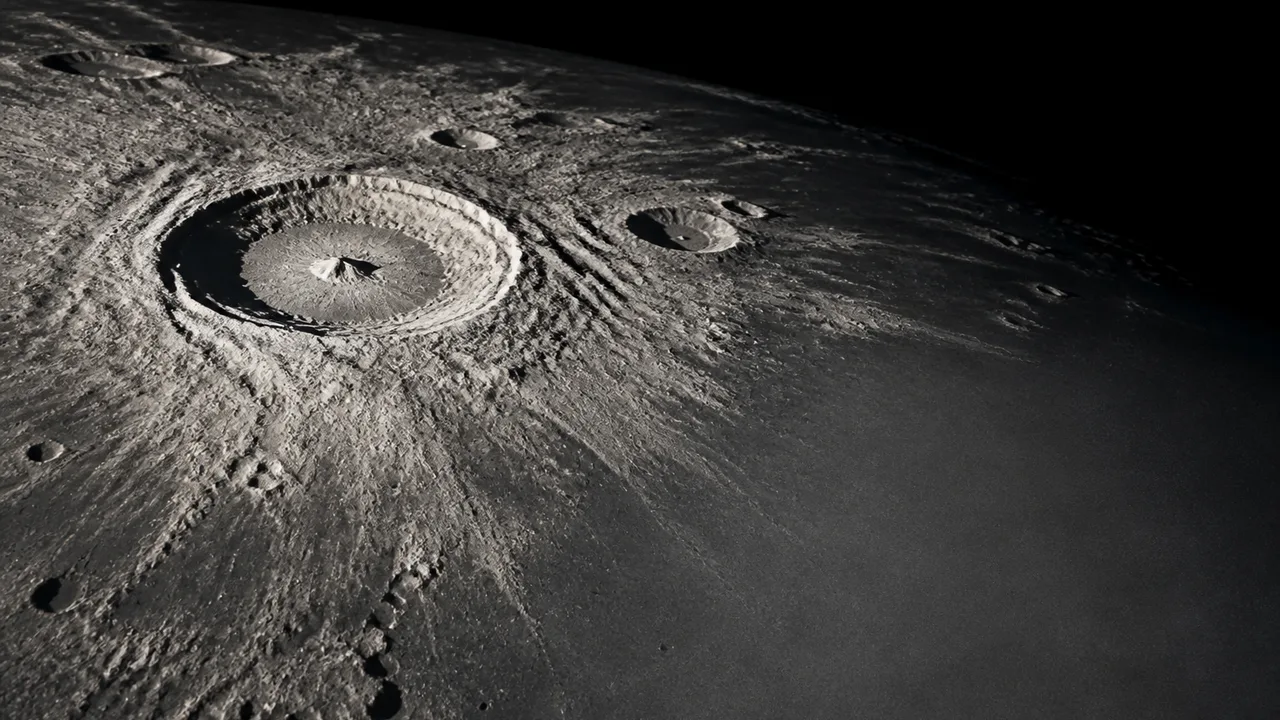
Photo: AI. Renzo Vargas
Look at a full moon long enough and Tycho eventually pulls focus. It's the one that looks almost painted on — a bright, almost defiant scar near the lunar south, with white rays fanning out like something exploded there not that long ago. Cosmically speaking, something did.
Tycho crater is 85 kilometers across and 4.8 kilometers deep, which makes the Grand Canyon feel like a decorative groove. In a recent Astrum video, presenter Alex McColgan walks through what we know about Tycho — its formation, its fingerprints on Earth, and the genuinely strange problem of not being able to pin down exactly when it happened. The science here is solid and well-sourced, and the open questions are real ones, not filler. What follows is worth slowing down for.
A Crater That Came From Inside the Moon
Tycho isn't just big — it's a specific kind of big. It's classified as a complex crater, which means the impactor was energetic enough to do something counterintuitive: punch down so hard that the rock beneath rebounded upward. The result is Tycho's central mountain, a 2.5-kilometer peak sitting in the middle of the crater floor like something that needed to get out.
That mountain turns out to be made of entirely different rock than the crater's basin or rim. This makes sense once you understand what happened: deeply buried bedrock got yanked to the surface by the rebound. It's the same physics as a water droplet hitting a still pond — the edges of the impact rush inward, collide in the middle, and force material upward. In Tycho's case, that material was formerly kilometers underground.
NASA's Lunar Reconnaissance Orbiter has photographed the peak in enough detail to identify smooth sections, blocky sections, gullies, fine deposits at the base. All of it consistent with a formation event that was violent, then hot, then slowly cooling. Scientists want to sample that peak specifically because it's essentially a geological core sample of the lunar interior — material from depth, now sitting on the surface.
There's also a horizontal line running across the peak that caught researchers' attention. McColgan describes it as a high watermark — not of water, but of molten rock. After the impact, the entire crater floor became a lake of superheated melt. Sections of the surrounding rim broke off and fell in, generating what the video calls "a tsunami of molten rock" that sloshed against the mountain. The line is where that tsunami reached. The crater floor we see today is largely solidified impact melt — a frozen record of one of the most violent moments in the moon's recent history.
2,250 Kilometers Away
The story gets stranger when you zoom out. In 2013, researcher Tim Krüger and colleagues at the Institute of Planetology mapped more than 3,000 melt pools in the area surrounding Tycho — burning fragments of regolith flung outward by the impact. The distribution of those pools told them something specific: the asteroid didn't hit straight down. It came in at an oblique angle, 35 to 45 degrees, arriving from the southwest. One direction had noticeably fewer melt points, which is exactly what you'd expect from an angled impact.
But the ejecta didn't stop there. The Apollo 17 mission landed at the Taurus-Littrow Valley, 2,250 kilometers from Tycho, and one of its targets was something called the light mantle — a bright streak across the valley floor, the remnant of the only known long-runout landslide on the moon. For decades, no one was entirely sure what triggered it, or how such a massive debris flow traveled so far across an airless, low-gravity surface.
In 2025, a team led by geologist Julia Magnarini at London's Natural History Museum finally opened two pristine Apollo 17 core samples that had been sealed since 1972. Using medical-grade micro CT scanning, they found that the falling rocks had ground themselves into fine powder during the collapse — that powder then lubricated the slide, letting massive debris flow like fluid across the lunar surface. A neat mechanism. But it still left one question open: what started the collapse?
The answer, based on further analysis of the same samples: impact melt glass, traced back to Tycho. Fragments of superheated glass, thrown more than 2,000 kilometers from the impact site, crashed into the slopes of South Massif and triggered the landslide. As McColgan puts it, "this really gives you a sense of how far this glass flew."
The energy budget that makes this plausible is staggering. The Tycho impact is estimated to have released energy equivalent to 30 trillion tons of TNT — roughly 2 billion Hiroshima-scale nuclear detonations simultaneously.
Glass That Reached Earth, and a Date We Can't Confirm
With an impact that size, some ejecta didn't just fly around the moon. It escaped lunar gravity entirely and fell toward Earth. The estimates from a lunar and planetary science conference suggest enough material landed to cover the entire planet in a layer 0.1 to 0.3 millimeters thick. Some 30% burned up in the atmosphere; the remaining 70% reached the surface as meteorite fragments, scattered over days to weeks.
Cosmic ray exposure dating of Apollo glass samples placed the Tycho impact at roughly 108 million years ago — late Early Cretaceous, peak dinosaur era. That timing, if accurate, means non-avian dinosaurs would have watched the moon flash brilliantly one night, then glow orange for days afterward as the impact melt slowly cooled.
Here's where the story gets genuinely unresolved. If Tycho rained material on Earth 108 million years ago, there should be a corresponding layer of impact glass — tektites — somewhere in the fossil record. But there are only five known tektite fields on Earth produced by meteor impacts, and none of them connect to Tycho.
More directly: Lund University researcher Elena Martin searched Pacific Ocean sediment samples spanning 103 to 117 million years old, specifically looking for Tycho meteorite material. She found essentially nothing — one grain that might be lunar in origin, but without the chemical signature expected from Tycho specifically. Her doctoral research suggests Tycho could actually be older than 117 million years, which would push it outside the sediment window she examined. But that conflicts with the Apollo glass dating.
"It is still not clear exactly when the asteroid that impacted Tycho occurred," McColgan acknowledges plainly. "That's something only further study will be able to confirm."
That's not a rhetorical hedge. It's an accurate summary of a genuine scientific gap.
What We're Still Missing
The uncertainty about Tycho's age isn't a failure of methodology — it's a consequence of working with incomplete material. The Apollo samples represent specific locations on the moon, not the whole moon. Pacific sediment records have gaps. Tektite fields are geographically clustered and preservation is imperfect. Any one of these lines of evidence could be missing something.
What would resolve it? Direct sampling of Tycho's central peak, which would give an unambiguous age from the impact melt itself. That requires boots on the ground — or at minimum, a robotic mission tasked specifically with Tycho. The Artemis program has astronauts returning to the lunar surface in 2028, with eventual plans for a permanent lunar base. McColgan notes that a future mission to Tycho specifically could "answer once and for all the numerous questions about Tycho's origins."
There's also the Earth-side angle. Somewhere in the geologic record, Tycho's bombardment of our planet left a layer. We haven't found it, but that doesn't mean it isn't there — just that we haven't looked in the right place, or with the right methods, or recognized it when we have. The tektite gap feels less like a closed case and more like an open invitation.
In the spring of 2024, NASA's Lunar Reconnaissance Orbiter captured before-and-after images of a fresh 225-meter crater — the largest new impact ever recorded during the orbiter's 17-year mission. Deep inside, scientists detected dark glassy rock, flash-melted by the collision. A miniature Tycho, in real time, providing a small window into what the larger event must have looked like at scale.
That the moon is still getting hit, and that we caught one, is a useful reminder: this isn't purely ancient history. The Earth-moon system has been exchanging material for billions of years. It's still happening. We're just better at noticing now.
More Like This

Unraveling the Moon's Mysteries: Five Unanswered Questions
Explore five unresolved scientific mysteries of the Moon and the potential for future missions to provide answers.
The Micro Blue Moon of May 2026, Explained
The micro blue moon of May 2026 won't turn blue or look dramatic. Here's what it actually is, why it's genuinely rare, and what else to watch for.

Ancient Megastructures That Still Puzzle Engineers
From Göbekli Tepe to the Great Pyramid, these ancient sites raise genuine questions about what early human societies were capable of building—and how.

Heavy Spoilers Builds an Office, Ditches the Algorithm
YouTube creator Paul from Heavy Spoilers explains why he built a garden office, changed his logo, and chose depth over views in content strategy.

Why NASA Is Finally Returning to Venus After 40 Years
After decades of neglect, Venus is getting two NASA missions. Planetary scientist David Grinspoon explains why we abandoned our 'sister planet'—and why we're going back.
How the Moon Formed: One Impact or Three?
The giant impact hypothesis has dominated lunar science for 40 years. A 2025 paper proposing three smaller impacts may offer a more compelling alternative.
Electric and Magnetic Fields Explained From First Principles
From ancient amber to Gauss's law: how physicists replaced "action at a distance" with the field concept that underpins all of modern physics.

Why All Mammals Share Seven Neck Bones
Giraffes and humans both have seven cervical vertebrae. The evolutionary reason involves Hox genes, cancer risk, and the surprising anatomy of the diaphragm.