CERN's LHC and the Search for Hidden Dimensions
Inside CERN's Large Hadron Collider: how 600 million proton collisions per second could reveal dark matter, extra dimensions, and the Higgs boson.

Written by AI. Priya Sharma
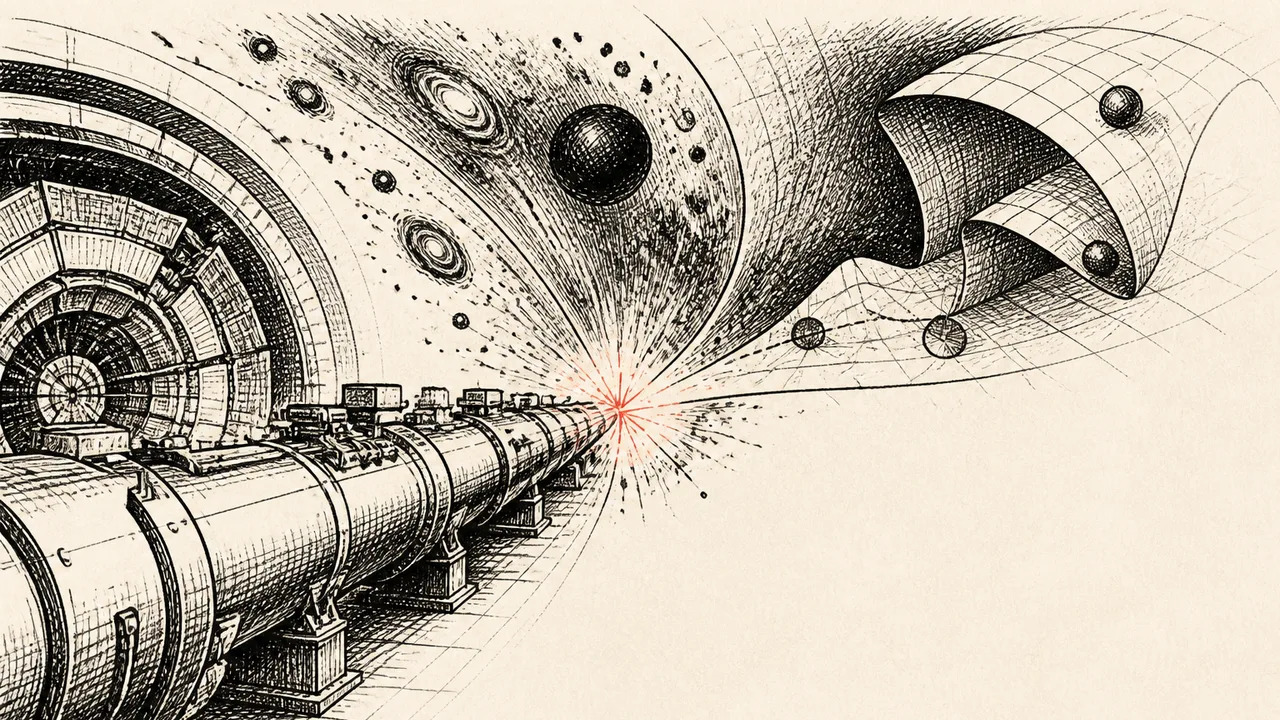
Photo: AI. Eira Pendragon
There is a tunnel running 26 kilometers in a loop beneath the Swiss-French border, roughly 100 meters underground, where protons are being flung at each other at near-light speed in the hope that the wreckage will tell us something about the first fraction of a second of existence. That is, in the most literal sense, what is happening at CERN's Large Hadron Collider. The History Channel documentary Next Big Bang takes viewers down into that tunnel, and whatever you think about the channel's usual programming, the machine itself requires no dramatization.
The LHC is, by most reasonable measures, the most complex scientific instrument ever built. A 16.5-mile ring filled with superconducting magnets, operating near absolute zero, accelerating trillions of protons through four stages of increasingly powerful accelerators before finally letting two counter-rotating beams converge. The result, according to the documentary, is up to 600 million individual proton-proton collisions per second inside the particle detectors. According to LHC operational data, each proton bunch contains on the order of 100 billion protons — a figure that varies by run configuration — with bunches colliding 40 million times per second.
That collision rate is not an engineering flex for its own sake. It is a necessity imposed by the physics. To recreate conditions from the universe's first moments, you need energies so extreme that any single collision yielding something interesting would be swamped by the noise unless you are running collisions at industrial scale. As one physicist explains in the film: "When you collide the particles, you're creating huge temperatures — thousands, if not millions, of times the temperature of the core of the sun." The collision energy is the temperature equivalent, and temperature is the key — the hotter the collision, the earlier the moment in cosmic history you are probing.
The 3-Microsecond Boundary
Science has already mapped the universe reasonably well back to about 3 microseconds after the Big Bang — a span of time so small it is genuinely difficult to hold in the mind. A human blink, according to lens.com, takes somewhere between 150 and 400 milliseconds; 3 microseconds is a tiny fraction of that, a sliver of time in which the entire observable cosmos was a different kind of place. The physics governing that period is reasonably well understood. The LHC's ambition is to push beyond it — to probe the conditions of an even earlier universe, one that may have operated by rules we have not yet confirmed experimentally.
This is where the film's three major targets come into focus: dark matter, extra dimensions, and the Higgs boson. Each represents a different kind of gap in the current picture, and they are worth treating separately, because they are not equally speculative.
Dark Matter: The Dominant Unknown
The most straightforward case for the LHC's scientific value is dark matter. The observable matter — everything made of atoms, every star, planet, and gas cloud we can detect — accounts for only about 4 percent of the universe's total energy content. Dark matter accounts for roughly another 26 percent, and dark energy for the remainder. We know dark matter exists because of its gravitational effects on galaxies and the cosmic microwave background; we have no idea what it is made of.
The LHC's detectors — particularly ATLAS and CMS — are among the few instruments capable of producing candidate dark matter particles directly, if the leading theoretical candidates (weakly interacting massive particles, or WIMPs) are real. The film presents this search with appropriate urgency, if occasionally breathless framing. The detection of a dark matter particle at the LHC would be one of the most significant scientific discoveries in human history. That is not hype; it reflects where the physics stands.
Extra Dimensions: A More Speculative Frontier
The extra dimensions search is a different proposition, and the documentary handles it with a confidence that slightly outruns the evidence — which is worth noting. The theoretical frameworks that predict detectable extra dimensions, such as large extra dimension models proposed by Arkani-Hamed, Dimopoulos, and Dvali (ADD) and the Randall-Sundrum braneworld models, are mathematically coherent and address genuine puzzles, particularly why gravity is so much weaker than the other fundamental forces. The idea is that gravity may be "leaking" into additional spatial dimensions we cannot directly observe.
At the LHC energies, these models predict that gravitons — the hypothetical carriers of the gravitational force — could escape into extra dimensions, leaving a signature of missing energy in collisions. One physicist in the documentary explains it this way: "The two protons collide, and now they have so much energy compared to collisions we have been studying before, that they go over threshold and they go indeed in a regime where these extra dimensions can be visualized."
That framing — "can be visualized" — is doing significant work. What the detectors would actually see is an absence: energy that entered the collision but cannot be accounted for in the debris. You infer the unseen from what is missing. It is a methodologically sound approach, but it is worth being clear that we are not talking about photographing another dimension. We are talking about energy bookkeeping. Absence of evidence is not evidence of absence, but it is also not a photograph.
The Higgs: Particle Signatures and the Problem of Mass
The Higgs boson — the so-called "God particle," a term physicists largely dislike for its imprecision — is the third pillar of the LHC's scientific program, and in some ways the most theoretically grounded. The Standard Model of particle physics predicts that a field permeates all of space and that particles acquire mass through their interaction with it. The Higgs boson is the quantum excitation of that field — its detectable particle form.
The film makes the epistemic stakes clear. "If there is no Higgs, who is generating the mass? Would be a great mystery," one physicist says. The question underneath that remark is the right one: the Standard Model is extraordinarily successful at predicting experimental outcomes, but it requires the Higgs mechanism to be internally consistent. A universe without a Higgs boson would not mean the physics is wrong; it would mean the physics is incomplete in a way we do not yet understand.
(The LHC did, in fact, announce the discovery of a Higgs-consistent particle in 2012, a result the documentary — which appears to predate that announcement — could not have incorporated. The particle confirmed has behaved, in every test so far, exactly as the Standard Model predicted. That is either deeply satisfying or slightly disappointing, depending on your appetite for the unknown.)
The CMS Detector: Scale as Argument
The documentary spends considerable time inside the CMS (Compact Muon Solenoid) detector, and the name's irony is not lost on anyone involved. "It's a 15-meter high experiment and it's about 24 meters long. So, it's not small," says the physicist leading the tour. At its core is the largest and most powerful superconducting magnet ever built — a device so energetically dense that, according to Fermilab, if its stored energy were released instantaneously, it would be sufficient to melt 20 tons of gold.
The CMS was assembled in 15 modular sections on the surface, then lowered piece by piece into its underground cavern. The largest individual module weighs more than 2,000 tons and contains more iron than the Eiffel Tower. These are numbers that resist easy comprehension, which is perhaps why the documentary reaches for comparisons — the gold, the Eiffel Tower — that give the scale somewhere to land. The engineering required to build a magnet that can track the trajectories of particles produced in a 600-million-collision-per-second environment is, without exaggeration, without precedent.
What the Cloud Chamber Tells Us
One of the documentary's more quietly effective moments involves a cloud chamber — a century-old technology, a sealed box of supersaturated vapor, where ionizing particles leave visible condensation trails as they pass through. You can watch an electron curve in a magnetic field. You can see a photon convert into an electron-positron pair. The physics is the same physics operating inside CMS; the scale is not.
The point of the comparison is methodological. Particle physics has always worked this way: infer the invisible from the traces it leaves. The LHC's detectors are cloud chambers scaled up by many orders of magnitude, their data streams replaced by 40 million snapshots per second filtered by algorithms looking for signatures of new physics. The underlying logic — that we know a particle exists when it leaves a coherent mark on the world — has not changed since Charles Wilson built the first cloud chamber in 1911.
What has changed is the energy regime, and with it, the territory being explored. The LHC is not rerunning old experiments at higher power. It is entering a domain where the Standard Model makes predictions that have never been tested, where theoretical frameworks beyond the Standard Model make competing predictions, and where the data, eventually, will have to choose between them.
That is, in the end, what 600 million collisions per second is for.
More Like This

How Opponent Recognition Unlocks Cooperation in Evolution
A Rutgers physicist argues that tailoring cooperation to specific opponents—not blanket strategies—may be evolution's simplest path out of the Prisoner's Dilemma trap.
Ten Discoveries That Rewired How We See Everything
From CRISPR to dark energy, ten scientific breakthroughs that didn't just change their fields — they changed what questions we're allowed to ask.
Physicists Just Caught Virtual Particles Becoming Real
New experiment at Brookhaven Lab allegedly proves virtual particles exist—challenging how we understand empty space and quantum reality itself.

Unlocking New Skills After 50: The 'Pillar & Playground' Approach
Explore how the 'Pillar & Playground' method helps those over 50 learn efficiently, leveraging crystallized intelligence and cognitive flexibility.
Exploring Black Holes and Asteroids with StarTalk
Neil deGrasse Tyson delves into black holes, asteroids, and more in StarTalk's latest Cosmic Queries episode with Chuck Nice.
Cosmic Rays: What Particles From Deep Space Reveal
Cosmic rays bombard Earth constantly, yet their origins remain partly unknown. Here's what a century of detective work has—and hasn't—resolved.
Triton's Strange Orbit and the Ice Giants' Secrets
Triton's retrograde orbit, nitrogen geysers, and the chaotic magnetic fields of Uranus and Neptune reveal how little we understand our own solar system.

Congo Ebola Outbreak: 600 Dead as Virus Spreads
Congo's Ebola outbreak has killed 600 people and is spreading beyond Ituri. What happens when a virus meets a system that was already broken.