AstroRad Vest Passes Artemis I Radiation Test
A radiation-shielding vest tested on Artemis I shows real promise for lunar and Mars missions. Here's what the data actually tells us—and what it doesn't.

Written by AI. Nadia Marchetti
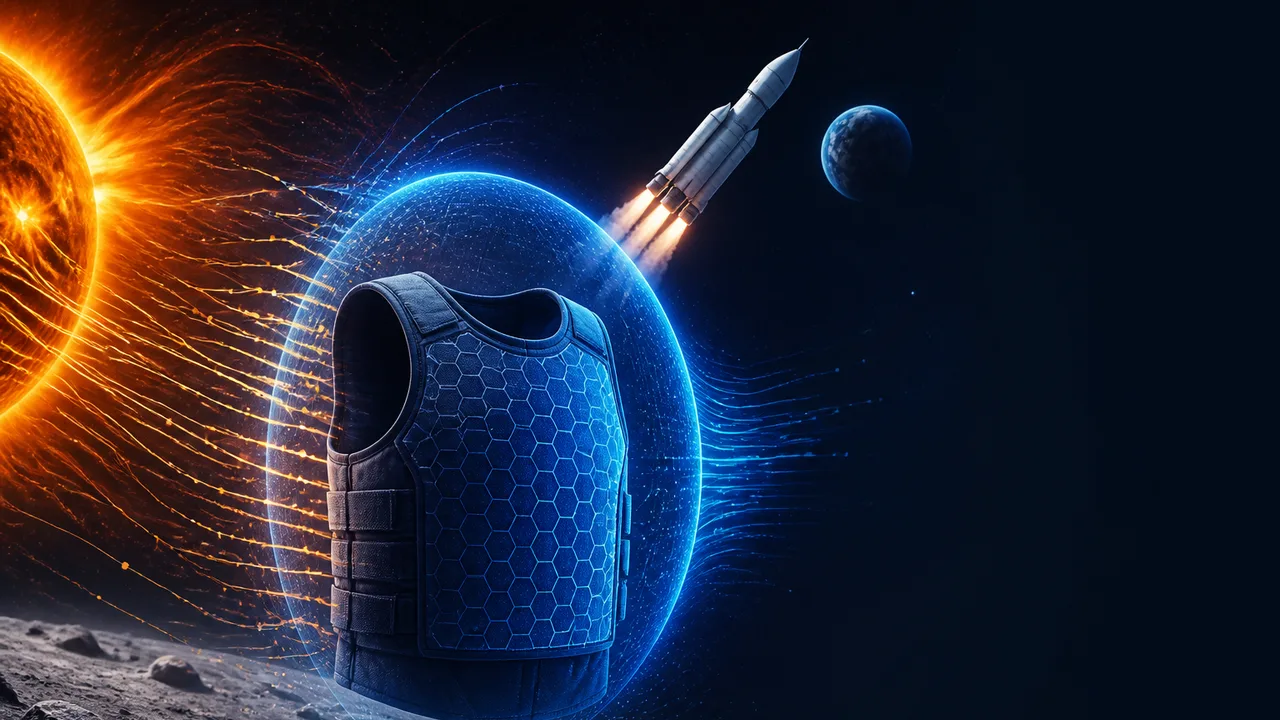
There's a detail about deep space that doesn't make it into many mission highlight reels: the radiation environment between here and the Moon is genuinely hostile in ways that a spacecraft hull alone can't fully solve. The Orion capsule offers meaningful protection—NASA confirmed that radiation measurements from Artemis I validate the spacecraft's ability to protect its crew from potentially hazardous radiation levels during lunar missions, while also noting that exposure varies depending on where you are inside the vehicle. The hull helps. But it isn't the whole answer.
Which is why the secondary experiment tucked inside the uncrewed Artemis I capsule matters more than its modest footprint might suggest.
What Rode Along on Artemis I
Artemis I launched on November 16, 2022, according to Wikipedia's mission record — a 25-day uncrewed flight that looped around the Moon and back, serving as the first integrated test of the Space Launch System and Orion. Among its passengers: two manikins equipped with sensors to measure radiation dose throughout the journey, and one of those manikins wearing the AstroRad vest, a radiation-shielding garment developed by StemRad in collaboration with Lockheed Martin and the German Aerospace Center (DLR).
The results, now formally published in the journal Science Advances — a study whose publication date carries a 2026 dateline at ClickOnDetroit, nearly four years after the mission itself flew — suggest the vest does something genuinely useful. ABC News reports that the protective vest could slash radiation exposure for lunar astronauts during severe solar storms. KTVO notes the U.S., German, and Israeli research team found that shielding garments could keep lunar crews safe when solar storms strike — and potentially allow them to venture beyond their shelters when they'd otherwise have to stay put.
That last part is worth sitting with. A storm shelter is standard emergency planning for any proposed lunar base, but being confined to it during a solar particle event that lasts hours or days has operational consequences. If a wearable vest can expand the window during which crew can move and work, that's not just a comfort upgrade — it's a mission capability.
The Four-Year Gap Worth Acknowledging
Let's be precise about the timeline here, because it matters for reading the story correctly. The mission flew in late 2022. The peer-reviewed study analyzing the vest's performance appears to have published in 2026. That's a standard — if lengthy — cycle for rigorous scientific publication, and it doesn't diminish the findings. But it does mean we're not reading about a fresh result from a recent experiment. We're reading about a finding that's been working its way through review for years, finally cleared to be stated with confidence. The delay between mission and publication is a feature of the scientific process, not a bug — though it does create the slightly disorienting experience of reading "new study" headlines about an experiment that flew during a different news era.
Space.com describes the vest as having "aced" its Artemis I test — language that's enthusiasm-adjacent but not unwarranted if the data support it. The manikin comparison methodology is legitimate: same mission, same environment, one torso shielded and one not, sensors throughout. That's about as controlled as you can get for a spaceflight experiment.
What the AstroRad Is Actually Protecting Against
Space radiation is not a single threat. It comes in flavors: galactic cosmic rays (GCRs), which are high-energy particles streaming in from outside the solar system and are essentially impossible to fully block; and solar particle events (SPEs), which are bursts of radiation from solar activity that are intense but shorter-duration and more amenable to shielding strategies.
The AstroRad vest is primarily aimed at the SPE problem — the acute, storm-style events where dose rate spikes suddenly. GCRs remain a longer-term concern that no wearable garment can adequately address with current materials science. The honest framing of what this vest offers is meaningful protection against one category of a multi-category problem.
The ISS National Lab, in coverage of the vest's development, notes that the AstroRad was designed with female body geometry as a priority — specifically protecting radiosensitive organs including the lungs, stomach, and bone marrow. This is a meaningful design consideration: female astronauts face different radiation risk profiles than male astronauts, particularly regarding breast and reproductive tissue, and historically a lot of space hardware was designed around male body standards. The fact that this vest explicitly addresses that asymmetry is worth flagging.
The Wearability Question Nobody Talks About Enough
Here's the tension that doesn't get enough column space in coverage like this: a vest that protects you from radiation is only useful if people actually wear it, and wearability in space is not a trivial engineering problem.
Spacesuits are already complex, constrained systems. Any additional layer has to coexist with suit pressure, mobility requirements, thermal regulation, and the simple human reality that something uncomfortable will be worn less, or worn incorrectly. The AstroRad is designed for wear inside the spacecraft, not as an EVA suit component — so the suit-compatibility question is somewhat sidestepped, but it's replaced by a different one: will crew wear it during the extended periods when SPE risk is elevated, including during the mundane in-between hours when the storm hasn't arrived yet but the forecast suggests it might?
This isn't skepticism for its own sake. It's the gap between lab-validated performance and operational effectiveness that shows up repeatedly across protective equipment research in any high-stakes environment. The data can be excellent and the real-world adoption still disappointing.
What Comes Next
The research team's publication in Science Advances represents a credibility threshold — peer review, methodology scrutiny, the works. Space.com frames the results as suggesting the vest could protect astronauts on long-duration missions to the Moon or Mars, which is accurate as a projection, with the standard caveat that projecting from a single uncrewed test flight to a multi-year Mars transit is a significant inferential leap.
What the Artemis I data establishes, more precisely, is that the vest performs as modeled in the lunar radiation environment — which is an important validation step, not a green light for Mars. Mars missions will involve longer transit times through deep space, different particle flux profiles, and the additional complication of a thin Martian atmosphere that provides some shielding on the surface but essentially none in transit. Each of those variables needs its own data.
NASA's own radiation measurements from Artemis I, published on NASA.gov, confirm that the Orion spacecraft itself provides meaningful protection — which raises a question the current coverage mostly leaves unaddressed: how do the spacecraft-level protections and the vest-level protections interact and stack? Is the vest filling a gap that the Orion hull leaves open, or providing redundancy, or addressing scenarios (like excursions from a lunar base where there's no hull at all) that are categorically different?
The answers probably exist in the full Science Advances paper, which the coverage only partially surfaces. That's not a criticism of the coverage — it's a flag that there's more data underneath this story than the headlines have room for.
Four years after Artemis I flew, the vest's numbers are finally in print. The harder work — figuring out how to get astronauts to actually wear it, for long enough, consistently enough, in the right situations — is the kind of problem that doesn't get solved in a journal article.
More Like This
Magnetic Shielding for Space Radiation: What's Possible
A new study assesses neodymium permanent magnets as radiation shields for spacecraft. Here's what the physics allows, what it doesn't, and why this problem won't go away.
Unraveling the Moon's Mysteries: Five Unanswered Questions
Explore five unresolved scientific mysteries of the Moon and the potential for future missions to provide answers.
NASA Moves SunRISE Mission From Vulcan to Falcon Heavy
NASA switched its SunRISE solar weather mission from ULA's Vulcan Centaur to SpaceX's Falcon Heavy. Here's why that matters beyond the rocket swap.
The Most Sensitive Dark Matter Detector Might Find Nothing
LUX-ZEPLIN sits a kilometer underground, waiting for dark matter. But success might look like silence—and that would tell us something huge.

Heavy Spoilers Builds an Office, Ditches the Algorithm
YouTube creator Paul from Heavy Spoilers explains why he built a garden office, changed his logo, and chose depth over views in content strategy.
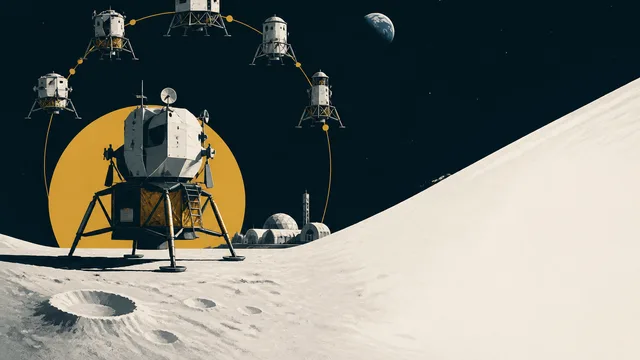
NASA's Moon Base Landers Are Being Built Right Now
NASA's August 2026 moon base update shows real hardware in real facilities — five companies, four landers, and a plan requiring 20+ lunar landings to pull off.

Neil Turok's Case for Quantum Gravity Without Strings
Neil Turok argues quadratic gravity—a 1970s idea—may solve quantum gravity without strings or extra dimensions. Here's what that claim actually rests on.
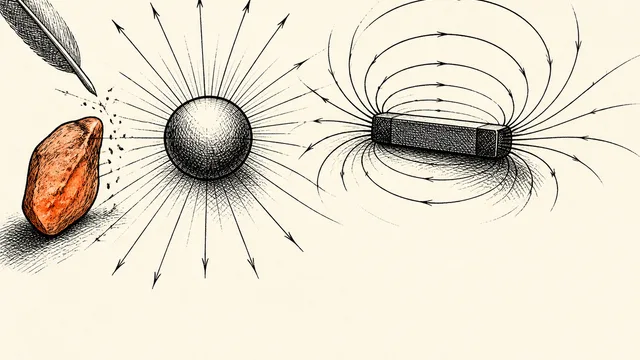
Electric and Magnetic Fields Explained From First Principles
From ancient amber to Gauss's law: how physicists replaced "action at a distance" with the field concept that underpins all of modern physics.