One Abandoned Surfboard and the Airline Rule Gap Behind It
A surfer reportedly left a board at a New York-area airport after a United and JetBlue baggage rule clash. What it reveals about flying with sports gear.

Written by AI. Priya Chandrasekaran
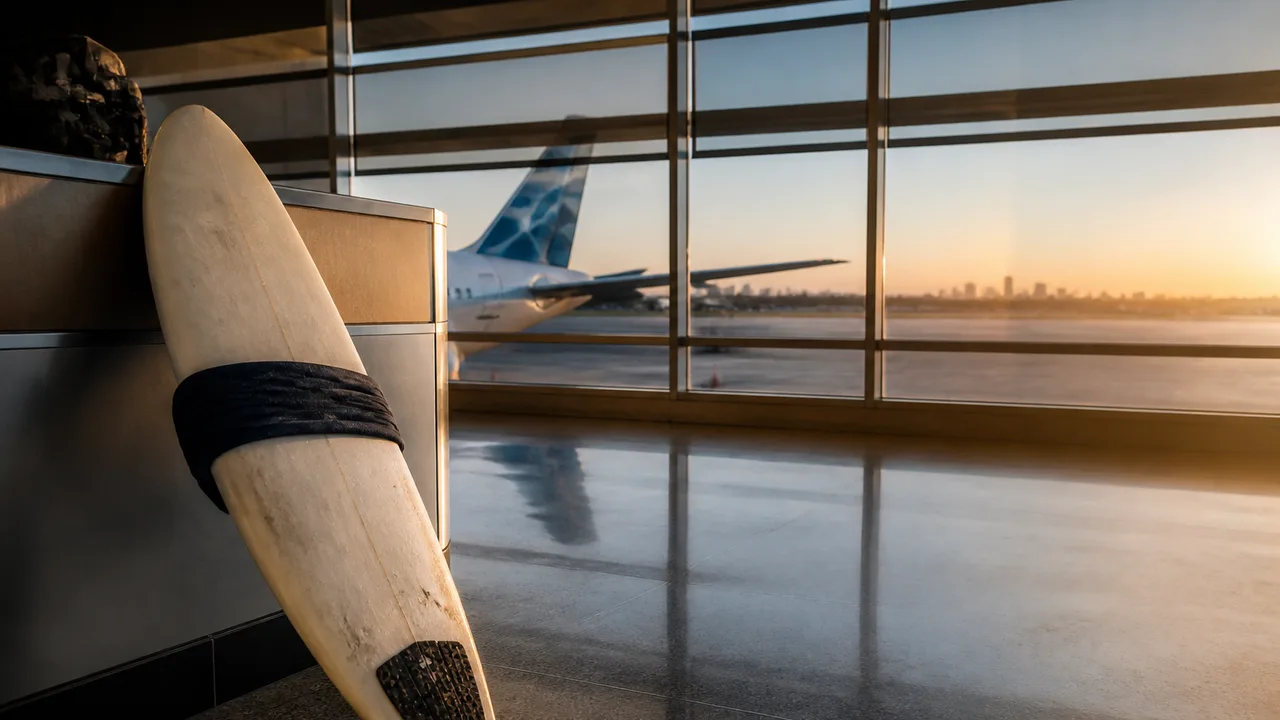
A surfboard is sitting unclaimed somewhere at a New York-area airport after its owner, who booked a ticket with United, was reportedly told by JetBlue, the carrier operating the flight, that the board could not fly.
According to Simple Flying, the passenger's own account included the phrase "I begged"; the outlet's headline frames JetBlue as having "allegedly forced" a United-booked passenger to leave the board behind. TheTravel covers the same episode as a collision between two carriers' baggage policies, one the traveler purchased into and one that held physical authority over the aircraft. The available reporting does not name the passenger, the exact airport, or a formal statement from either airline, so the specifics deserve caution. The system the episode exposes deserves attention regardless.
How a United Ticket Ends Up Under JetBlue's Rules
Airlines sell seats on aircraft they don't operate. Codeshare agreements mean your confirmation email can name one carrier while the metal you board belongs to a partner, and schedule changes and irregular operations routinely move passengers onto partner flights after purchase. When that happens, baggage authority moves with the operating carrier. The airline that sold you the ticket made promises based on its own contract of carriage; the airline that loads your bag enforces its own.
Anyone who has stood at a check-in counter with a board bag knows the moment this becomes concrete: the agent types, the screen refreshes, and the number that comes back has nothing to do with the confirmation email in your phone. At that point your alternatives collapse. You can't comparison-shop carriers from the front of the line, you can't drive your board home, and your flight leaves in ninety minutes.
This is the structural trap in the reported incident. Whatever the precise sequence, a booking that looked workable under one carrier's rules met a second carrier's rules after a change, and the passenger absorbed the entire loss: the fare, the trip, and the board itself.
Fifty Pounds and the Fees that Follow It
Fifty pounds is the number most US carriers write into their own contracts of carriage, the threshold where overweight and oversized fees begin. Each airline sets that line for itself; no government sets it for them. In practice it also functions as the handling limit for what a single worker will be asked to muscle onto a belt, which is why items past it move into a different fee and handling category altogether.
Across the published US fee schedules I've read while planning surf trips, board charges cluster between roughly $75 and $150 each way, with linear-inch caps that swing noticeably by carrier. A board that clears one airline's length limit can fail another's on the same route. Fares, routes, and ticket types shift the numbers again. The passenger encounters all of this at the end of the process, when the only remaining negotiation is with an agent whose screen shows the operating carrier's policy and whose hands are tied by it.
The equipment itself travels through a world you rarely see. Past the odd-size belt, a handler pivots a nine-foot bag by hand and decides, alone and in seconds, whether it fits the hold. Fins snap. Rails ding. Aircraft holds on regional jets swallow almost nothing over a few feet. Those physical realities are legitimate; the problem is that passengers meet them as surprises at the counter rather than as terms at the moment of purchase.
Why Skis Often Fly Cheaper than Surfboards
On many US carriers, skis and snowboards travel free or cheap, often in the same bags, on the same aircraft, handled by the same workers, while surfboards draw some of the highest equipment fees in the published schedules. Airlines don't generally explain the reasoning, so what follows is my reading of the pattern rather than a documented policy rationale.
Ski destinations are high-yield winter routes, and waiving a ski fee is cheap marketing aimed at customers who book lodges and lift tickets along with flights. Surfboards, by contrast, are awkward tapered tubes with fragile protrusions, prone to damage claims, and their routes include beach markets where demand is broad and price-insensitive. One equipment category functions as a marketing subsidy; the other functions as a revenue line. The passenger at the counter experiences both as a single, arbitrary rulebook.
The US Department of Transportation requires airlines to disclose baggage fees, and disclosure has pushed carriers to publish schedules that are at least findable. Disclosure does not harmonize the fees themselves, and it does nothing at all for a traveler whose itinerary changed underneath them after booking.
What a Traveler Can Actually Do
The reported episode points to a short, unromantic checklist:
- Identify the operating carrier before you book. The flight number reveals it; the airline's own site or a tool like the code list in your confirmation will show who actually flies the plane. Check that carrier's current sports equipment page, not the ticketing carrier's.
- Get the terms in writing. Dimensions, fees, and whether an interline or partner transfer preserves your baggage allowance. A chat transcript or an emailed confirmation from the airline is your only evidence at the counter.
- Recheck after any schedule change. A rebooking onto new metal can void everything you verified for the original flight.
- Price shipping as a real alternative. In my experience, domestic freight for a single board has run about the same as a round trip of airline surfboard fees, sometimes a little less, sometimes more with distance. The difference is that the quote arrives before you commit, from a company with a phone number, rather than at a counter with a departure board counting down behind you.
- Consider renting at the destination. It stings for anyone attached to their own board, but it eliminates the entire category of risk.
None of this fixes the underlying problem. It routes around it, individually, at the cost of the traveler's time.
The Standard that Doesn't Exist
One abandoned board is an anecdote. The pattern behind it is structural: an active-travel economy with hundreds of millions of participants and no interoperable equipment standard anywhere in the airline system. Bicyclists, surfers, skiers, and climbers all navigate a patchwork of carrier-specific contracts that can be rewritten by a schedule change the passenger never agreed to.
There is no technical obstacle to carriers agreeing on a common definition of sports equipment, a shared dimensional standard, and a rule that a ticket's baggage terms survive a rebooking between partners. The obstacle is that fees like these are revenue, and revenue is defended. Until that calculus changes, the most predictable board at any airport is the one leaning against the wall of a rental shop at the far end of the flight, and the airlines' published schedules remain, for the travelers who carry their own lives in fiberglass, a set of terms that apply only as long as nothing else goes wrong.
Priya Chandrasekaran
More Like This

Grocery Tourism Is One of Travel's Fastest-Growing Trends
Travelers are flocking to foreign supermarkets as a cultural experience. Here's what the grocery tourism trend reveals about how we understand place and food.

Istanbul's Layers: History, Faith, and Food
Rick Steves guides viewers through Istanbul's Byzantine ruins, Ottoman mosques, hammams, and tables. A food writer looks closer at what the camera catches and what it misses.

Vodka and Pierogi: Poland's Food Identity Explained
Rick Steves and guide Tomasz Klepacki explore what Polish vodka and pierogi reveal about Polish identity, tradition, and the meaning of home-cooked food.
Airport Theft at MIA Exposes Deep Trust Failures
A passenger's stolen Cartier watch, sold online, reveals the layered accountability failures behind airport baggage theft at Miami International Airport.

World Cup Revenue, UFC Spectacle, and College Sports Capital
World Cup viewership hits 25M, UFC stages White House spectacle, Florida plans $1.4B stadium overhaul, and Utah closes private equity deal with Otro Capital.

Solar Orbiter Captures First Direct View of the Sun's Poles
Solar Orbiter has captured the first direct images of the Sun's poles, revealing a chaotic magnetic field mid-reversal—and what it means for space weather forecasting.