Airport Theft at MIA Exposes Deep Trust Failures
A passenger's stolen Cartier watch, sold online, reveals the layered accountability failures behind airport baggage theft at Miami International Airport.

Written by AI. Priya Chandrasekaran
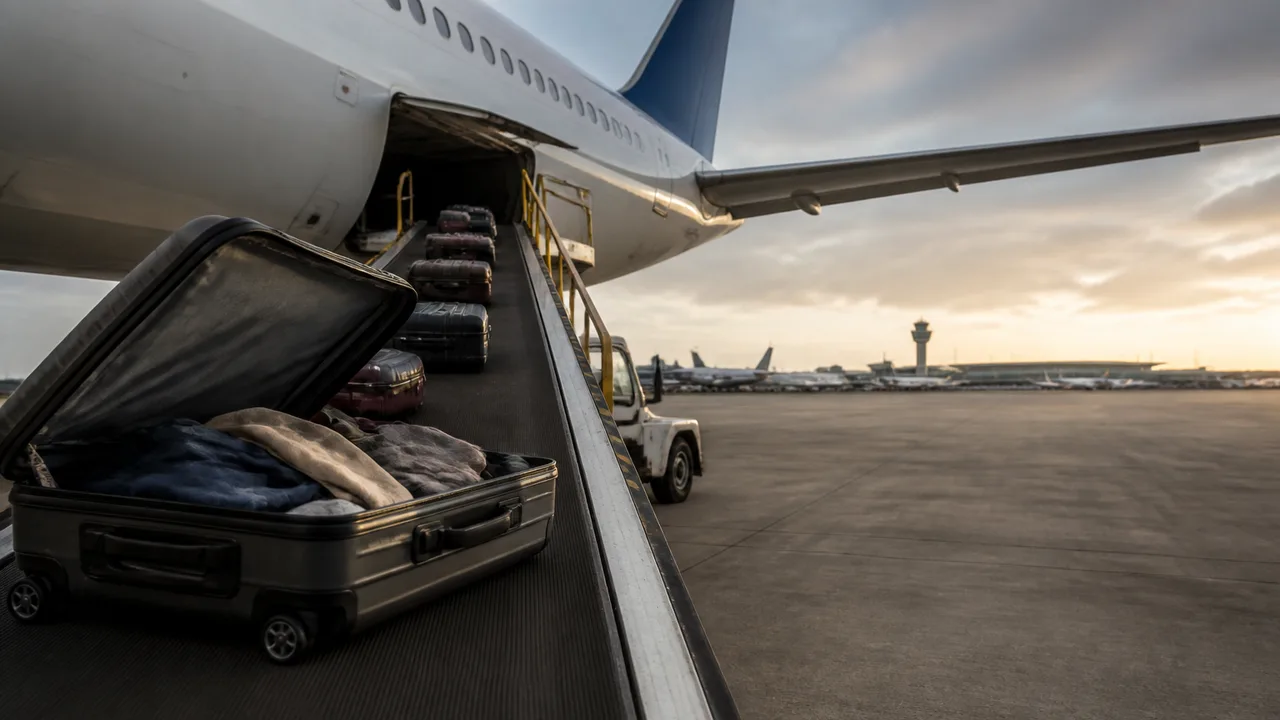
There is a specific, private act of surrender that every traveler performs at the check-in counter. You hand over a bag — packed with the particular logic of your life, your trip, your anxieties about what you might need — and you watch it disappear behind a rubber curtain. You do not know who will touch it next. You are trusting, in that moment, not just a person but an entire system: the airline, the airport authority, the contracted ground handler, the federal screener, the chain of custody that is supposed to carry your things from one city to another intact.
Most of the time, the system holds. But a story out of Miami this August is a useful reminder of exactly how thin that trust can run.
According to Local 10, a passenger's bag arrived in Miami on June 8 and then, in the way that lost bags sometimes do, simply did not arrive at all — at least not to its owner. What made this case different from an ordinary lost-luggage complaint was what happened next: the passenger, tracking his AirPods, located them inside Miami International Airport. And when he started searching online, he found one of his belongings listed for sale. The bag contained approximately $12,377.90 worth of valuables, including a Cartier Santos watch and those AirPods, per Local 10. The Miami-Dade Sheriff's Office subsequently arrested a contract worker at the airport in connection with the theft.
That is one incident. But it sits alongside a separate, parallel case involving TSA officers — not contractors — at the same airport. According to NBC Miami, new surveillance footage shows Transportation Security Administration officers at Miami International going through travelers' bags and allegedly stealing money during security screenings. Simple Flying reports that three TSA agents were arrested for fraud and grand theft after a passenger complained about missing property. Fox Business names three individuals — Josue Gonzalez, 20; Elizabeth Fuster, 22; and Labarrius Williams, 33 — as having been arrested in July and initially charged with organized scheme to defraud, according to Fox Business reporting.
Two separate cases. Two different categories of airport worker. One airport. And one very clarifying question: at what point does a pattern stop being a coincidence and start being a structural problem?
Here is the history that makes this genuinely strange, and I think it gets overlooked in the rush to cover the immediate facts.
The TSA was created in the aftermath of September 11, 2001, as a deliberate act of federalization. Before the TSA, airport security was handled by private contractors hired by individual airlines — a system that critics argued created exactly the kind of diffuse accountability and inconsistent vetting that allowed security failures to accumulate. The logic of creating a federal agency was, in part, that federal employees would be subject to more rigorous hiring standards, clearer chains of command, and more consistent oversight.
That logic still holds in theory. But the irony embedded in the current Miami cases is hard to ignore: TSA agents — federal employees, the people the post-9/11 reform was meant to produce — are now implicated in the same pattern of opportunistic theft that the old contractor model was criticized for enabling. Meanwhile, on the baggage handling side, the outsourcing model never went away. The contractor arrested in the Cartier watch case worked within a subcontracting structure that is simply the standard architecture of airport ground operations.
Research published in the journal Public Administration Review by Russell W. Mills, Christopher J. Koliba, and Dorit Rubi — "Ensuring Compliance From 35,000 Feet: Accountability and Trade-Offs in Aviation Safety Regulatory Networks" — examines exactly this problem: that aviation's layered regulatory network, with its mix of federal agencies, airport authorities, airlines, and subcontractors, creates accountability trade-offs that are structurally difficult to resolve. The question of who is responsible for what, and who answers to whom when something goes wrong, does not have a clean answer in the current system.
Miami International is not a small regional airport where oversight might be forgiven as a resource constraint. According to a press release from MIA's own communications office, the airport has recently reached unprecedented heights in passenger and cargo numbers, accompanied by historic investments in infrastructure. Scale, in other words, is not the problem. The airport is moving more people and more bags than ever. The question is whether the accountability architecture is keeping pace with that growth — and the evidence from this summer suggests it is not.
Let me stay with the Cartier watch for a moment, because I think it's doing more work in this story than just establishing the dollar value of the theft.
A Cartier Santos is a particular kind of object. It is portable wealth — compact, internationally legible, easily converted. It is the kind of thing you pack when you are traveling to a place where you want to arrive as a certain kind of person. Across many cultures, a fine watch is not just an accessory; it is a signal of standing, a family object, a gift that marks a transition. The passenger who packed it was not simply carrying consumer goods. He was carrying something that meant something.
What the AirPods tell us is equally interesting, though in a different register. He used them to find his bag — consumer tracking technology doing the work that airport security systems and baggage reconciliation software apparently could not. The TheTravel report frames this as a kind of detective story: the passenger found his bag in the digital world before law enforcement found it in the physical one. His AirPods were pinging from inside the airport. His belongings were listed for sale online. The trail was there. He just had to know where to look.
This is the quiet revolution in traveler self-protection that nobody formally announced: the proliferation of small, inexpensive tracking devices has given ordinary passengers a surveillance capability that airports, for all their cameras and screening technology, often cannot match in real time. The AirTag, the AirPod, the Tile — these are not security systems. They are consumer electronics that happen to create a paper trail. That they are now routinely used to solve luggage theft cases says something pointed about what official systems are failing to do.
MIA has announced the implementation of additional security protocols in the wake of these incidents, though the specific nature of those protocols has not been detailed in the reporting available. The airport's response is appropriate, but it is also, at this point, somewhat predictable — the institutional equivalent of saying the right thing after a bad outcome. What matters more is whether the structural questions get asked at all.
Those questions are not easy ones. If federal employees and private contractors are both implicated in the same pattern of behavior at the same airport, the problem is not simply about which employment category you choose. It is about the conditions — the oversight density, the camera coverage, the culture of accountability, the consequences for bad actors — that either deter theft or fail to. The TSA case, with its surveillance footage, suggests that cameras exist. The question is how consistently they are monitored and what happens when something appears on them.
For the traveler at the check-in counter, watching a bag disappear behind a rubber curtain, none of this institutional architecture is visible. What is visible is the receipt stub and the prayer.
The technology to find your bag when it's stolen is now in your pocket. The question worth asking is why that's become necessary.
More Like This

Small Group Italy Tours Are Reshaping Travel
Small group Italy tours promise authenticity over crowds. But do they deliver — and at what cost to the communities they claim to honor?

Flock Safety Cameras: Crime Tool or Privacy Risk?
Flock Safety's license plate readers are spreading fast. Retired Microsoft engineer Dave Plummer breaks down what they actually capture—and what's at stake.
A New Object in the Sky: The JetBlue Drone Strike
A JetBlue pilot reported hitting a drone on approach to JFK. What the incident reveals about airspace rules built before drones existed.

France Tests Low-Cost Rail Signalling for Rural Lines
France's NS2F consortium is trialling digital signalling tech to cut rural rail costs by 30%. Here's what's at stake for the towns trains forgot.

TSA Airport Security: Passenger Rights and Limits
From leaked master keys to surveillance programs, here's what TSA's checkpoint procedures actually look like — and what rights you have going through them.

Tauck's Seine River Cruise: What $10,000 Actually Buys
Travel + Leisure boards Tauck's MS Serene for a nine-night Seine cruise. Here's an honest look at what luxury river cruising delivers — and what it costs.

Which "Untranslatable" Words Are Real?
From hygge to mamihlapinatapai, RobWords fact-checks the internet's favourite "untranslatable" words — and finds gems, exaggerations, and outright fiction.
U.S. Customs Cash Rules: What Travelers Must Know
A $53,800 seizure at Fort Lauderdale Airport puts the $10,000 cash declaration rule back in focus. Here's what travelers actually need to know.