France Tests Low-Cost Rail Signalling for Rural Lines
France's NS2F consortium is trialling digital signalling tech to cut rural rail costs by 30%. Here's what's at stake for the towns trains forgot.

Written by AI. Priya Chandrasekaran
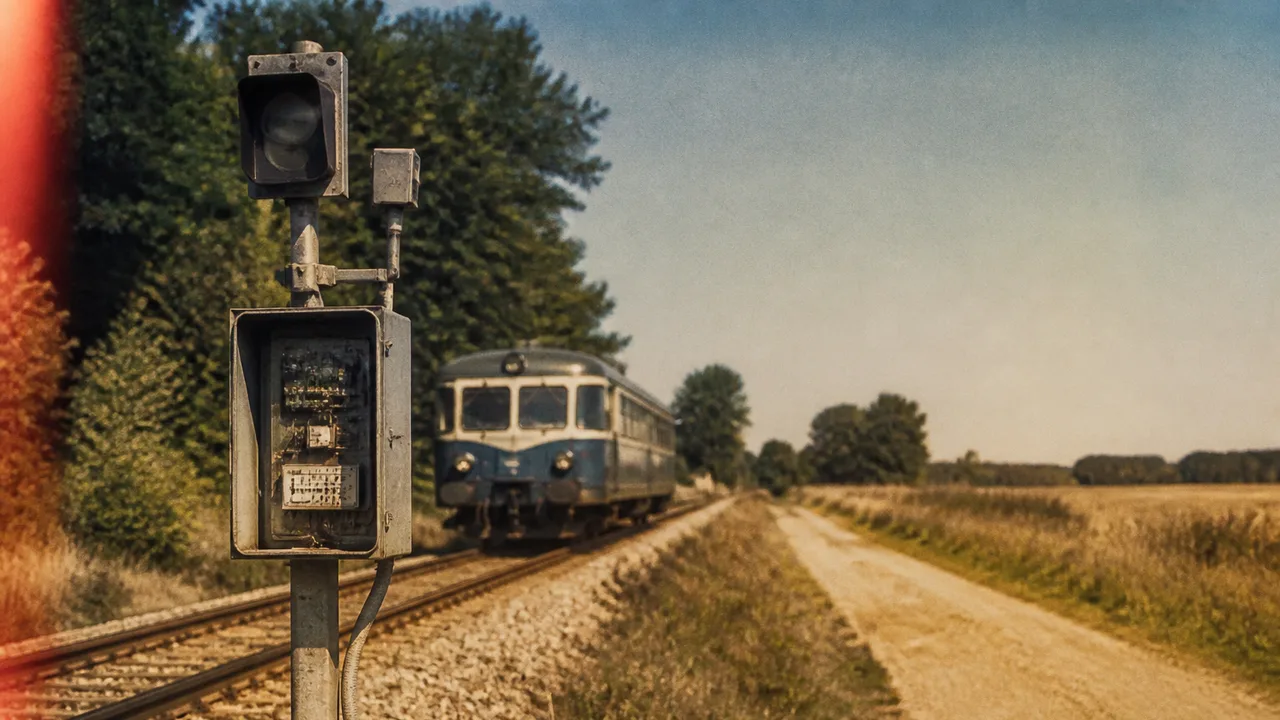
The station at Guéret, in the Creuse, is the kind of place that teaches you something about a country's priorities. The building is handsome in the way that Third Republic infrastructure always is — a certain confident stonework, high ceilings, the faint ghost of an era when the train was the event of the day. The timetable board, the last time I paid attention to it, had a quality of aspiration rather than fact. You could get somewhere from Guéret. Theoretically. The question was whether the service would actually be there when you arrived.
That sensation — the held breath of wondering whether the rural French rail network still counts you in — is the emotional context for a technical announcement that deserves more attention than it has received. A consortium led by Thales, with Hitachi Rail, Ferrocampus, and the heritage association Trains & Traction among its partners, has demonstrated NS2F — Nouvelle Signalisation Ferroviaire Frugale, or New Frugal Railway Signalling — on a test line near Limoges, as part of the broader SNCF Telli lightweight train programme. Railway Gazette reports that the system is designed as "a cost-effective, scalable and rapidly deployable train control approach for rural lines." Frugal is doing a lot of work in that acronym. It is also, in this context, a kind of radical act.
To understand why this matters, you have to go back before the spreadsheets.
France's rural rail network was not neglected by accident. It was neglected by argument, repeatedly rehearsed and eventually won by the people who preferred roads. The postwar aménagement du territoire project — the grand, centralist effort to modernise France's geography — was in many ways a road project, animated by a belief that the car and the lorry were the infrastructure of the future. The DATAR debates of the 1960s wrestled with whether rail could serve territorial equity, or whether it was simply too expensive a tool for too sparse a population. By the 1970s, the Rapport Guillaumat had made the case explicitly: some lines cost more than they were worth. Closures followed, quietly, over decades.
What that history left behind is a rural France that knows exactly what it lost. The towns that remember a through-train to Clermont-Ferrand or Brive or Rodez. The market vendors who used to load the early service and arrive with something fresh. The logic of that network — the way it stitched together the chef-lieux with the smaller communes, the way it meant a hospital appointment in the regional capital didn't require a car — that logic didn't expire when the last service ran. The need persisted. The infrastructure didn't.
That is the weight behind a piece of software-based signalling technology trialled near Limoges.
What NS2F actually does, technically, is replace the older relay-based signalling equipment that makes rural lines expensive to maintain. The Traveler describes "a compact, software-based signalling system that replaces older relay equipment and simplifies the interface with trackside signals and points." Relay signalling is robust but it is also heavy, expensive, and — critically — it requires specialist engineers to maintain and certify. For a rural line running two or three trains a day, the signalling overhead can be economically absurd: you are maintaining the safety architecture of a main line for a service that carries a few dozen passengers per journey.
The NS2F consortium's target, according to International Railway Journal, is to cut investment and operating costs on rural routes by 30% — and it is worth being precise here that this is the project's own stated target, not a verified outcome. The demonstration near Limoges is a proof-of-concept, not a deployed network. But 30% is a number that matters, because the economics of rural rail are not primarily about passenger revenue — they are about infrastructure cost. If you can halve the complexity of the signalling, you change the conversation.
The France 2030 Committee clearly thought the argument was worth funding. Railway-News reports that the committee awarded the Thales-led NS2F consortium €7,163,753 in public funding. That is not an enormous sum in the context of rail infrastructure — the signalling on a single urban metro project can run to ten times that — but it is a deliberate bet on a particular approach: not the gold-standard system designed for the TGV corridor, but the frugal system, purpose-built for the slow line through the hills.
SNCF itself is framing NS2F as inseparable from the TELLi railcar project — a lightweight, purpose-designed vehicle for low-frequency rural routes. SNCF Group's TELLi page describes tests running on a "laboratory" line around Limoges, with further trials of the frugal signalling system planned as the programme develops. The Limoges test loop is doing double duty: proving the vehicle and proving the signalling that would govern it. SNCF Group's innovation page notes that digital signalling trials started in 2025, which gives some sense of the timeline: this is a programme measured in years, not months.
Here is what I find genuinely moving about the NS2F concept, and I am going to stay with it for a moment before I explain why the obstacles are real.
There is a version of rural France that is not picturesque in the tourist sense. It is not the Luberon. It is the Creuse, the Aveyron, the Haute-Loire — the diagonale du vide, as French geographers have called it, the empty diagonal running from the northeast to the southwest where population density has been falling for a generation. In these places, the question of who can get somewhere is not abstract. It is the elderly woman with a rheumatology appointment in Aurillac who does not drive. It is the seventeen-year-old who wants to study somewhere that has a lycée with more than three options. It is the producer of lentils from the Puy who used to ship by rail and now pays for a lorry.
The romance of rural rail is real — the cream-painted stations, the single-carriage service threading through limestone gorges, the conductor who knows which passengers are going to the market and which are going to the hospital. But it would be a mistake to let the romance do all the work. The structural argument is that territorial equity is not compatible with a transport system that requires a car. France has made that incompatibility official policy for sixty years, and NS2F is a tentative, technically elegant attempt to undo some of the damage.
The gap between a successful demonstration near Limoges and a functioning rural rail network is not trivial, and it deserves honest description. Signalling is one piece of a system that also includes track maintenance, rolling stock, staffing, scheduling, and — perhaps most importantly — the political will to sustain a service through the years when ridership is recovering rather than thriving. Frugal signalling reduces one cost curve. It does not resolve the others.
There is also the question of safety certification. Railway signalling operates under stringent regulatory frameworks, and a novel, software-defined approach to train control requires the kind of meticulous safety case that takes years to build and validate. The NS2F consortium knows this; the structure of the programme, with its phased demonstrations and test lines, reflects it. But readers should understand that the distance from "demonstrated on a heritage line near Limoges" to "approved for regular passenger service" is substantial.
None of that makes the demonstration less significant. It makes it precisely what it is: a serious, well-funded attempt to solve a problem that Europe has been deferring for decades. The fact that it is happening in France, with a heritage railway association as one of the consortium partners, and that it is explicitly designed to be affordable rather than optimal, tells you something about which way the political wind is blowing.
I keep coming back to the smell of a boulangerie across the street from a small gare, the particular quality of early morning light on a provincial platform, the feeling of a network that once connected people and now requires them to justify their own existence to it. NS2F will not restore every closed line, and it would be unfair to ask it to. What it might do — if the cost targets hold and the safety cases pass and the political commitment endures — is lower the threshold at which a rural line becomes worth reopening.
That threshold is where the real story lives. Not in the software. In the people waiting on the other side of it.
More Like This
Light Rail Automation Borrows Tech from Cars and Satellites
Cities are automating light rail using car sensors and satellite positioning. Here's what that shift means for urban transit, safety, labor, and city design.

Small Group Italy Tours Are Reshaping Travel
Small group Italy tours promise authenticity over crowds. But do they deliver — and at what cost to the communities they claim to honor?
Luxury Train Journey Across Australia: Worth the Cost?
Explore a luxurious 80-hour train journey across Australia and its opulent offerings.
Seine-Nord Europe Canal: Building Through the Somme
France's €7.3bn Seine-Nord Europe Canal will link its waterways to Rotterdam and Antwerp—but it's being dug through ground that never finished burying its dead.
Toronto's Ontario Line: $27B Gamble on Transit's Future
Toronto's Ontario Line has ballooned from $10.9B to $27B with no opening date in sight. Here's what's at stake—and why the city's skepticism is entirely earned.

A New Object in the Sky: The JetBlue Drone Strike
A JetBlue pilot reported hitting a drone on approach to JFK. What the incident reveals about airspace rules built before drones existed.

Which "Untranslatable" Words Are Real?
From hygge to mamihlapinatapai, RobWords fact-checks the internet's favourite "untranslatable" words — and finds gems, exaggerations, and outright fiction.

What to Expect When Staying in European Hotels
European hotels operate by different rules than North American ones. Here's what actually differs—room size, beds, breakfast pricing, accessibility, and more.