Grocery Tourism Is One of Travel's Fastest-Growing Trends
Travelers are flocking to foreign supermarkets as a cultural experience. Here's what the grocery tourism trend reveals about how we understand place and food.

Written by AI. Priya Chandrasekaran
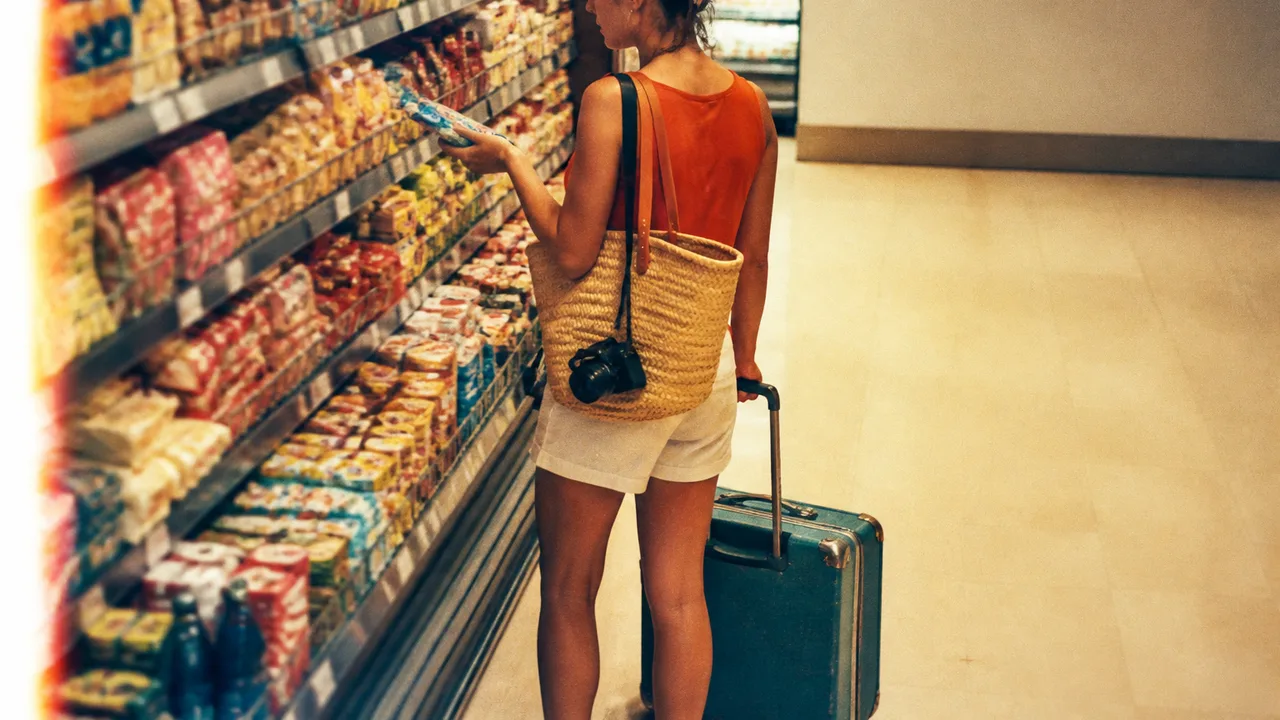
At 10:00 on a weekday morning in a Tokyo 7-Eleven, according to BBC Travel, the scene is not what you'd expect from a convenience store: tourists are pressed shoulder to shoulder, baskets full, studying egg sandwiches with the focused attention most people reserve for museum placards. Nobody is in a hurry. Nobody is just grabbing a coffee. They are, in the most earnest sense of the word, browsing.
This is grocery tourism — and by every available metric, it is no longer a niche quirk of the particularly curious traveler. Hilton's 2026 Trends Report, cited by BBC Travel, found that 77% of travelers enjoy visiting grocery stores abroad. Condé Nast Traveller named it one of the biggest travel trends of 2026. On TikTok, according to Time Out, posts related to "grocery store travel" have surpassed 50 million — a volume that suggests this is less a trend and more a settled behavior hiding in plain sight.
The question worth sitting with isn't whether this is happening. It clearly is. The question is what it actually means — for how we travel, for how we understand culture, and for the people whose everyday lives are being quietly converted into content.
The Supermarket as Cultural Text
There is a real intellectual case for the grocery store as a place of genuine discovery, and it doesn't require much stretching. A nation's supermarket is the distillation of its agricultural economy, its import relationships, its dietary taboos, its class structures, and its relationship with convenience — all organized into navigable aisles. Walk through a Greek dairy section, and you're in the middle of a centuries-old cheese culture that most restaurant menus can only gesture at. Stand in front of a German supermarket's bread wall at an Edeka or Rewe, and you begin to understand why the country's bread culture was added to UNESCO's list of intangible cultural heritage.
Noel Wolf, identified by the Daily Mail as a cultural expert at language learning platform Babbel, points out that German shopping culture itself is legible at the store level: layouts are designed to move customers through efficiently and independently, reflecting broader cultural values around purposefulness and personal space. A French supermarket, by contrast, feels — as Earths Attractions puts it — "curated, almost elegant," which tracks with how deeply aesthetic consideration is embedded in French food culture even at the commodity level.
These aren't small observations. They are exactly the kind of thing that a week of restaurant meals won't teach you, because restaurants are already performing for an audience. The supermarket isn't performing. It's just operating — which is what makes it genuinely revealing.
The Accessibility Argument
There's a democratic logic to grocery tourism that deserves to be taken seriously, not just as marketing language but as a structural reality of how travel works.
Michelin-starred meals are not equally available to all travelers. Private food tours, culinary classes with local chefs, curated market experiences — these have price tags that quietly filter who gets to claim "authentic" food travel. The supermarket charges nothing to enter. A grocery haul in Tokyo, Athens, or Dublin can cost the same as a mediocre airport sandwich back home and return significantly more cultural information.
BBC Travel makes this point directly: not everyone can afford a Michelin-starred meal or a private food tour, but nearly everyone can afford to wander a supermarket aisle. Tim Tams in an Australian Woolworths, Tayto crisps in an Irish convenience store — these are low-cost, high-signal souvenirs that also happen to be edible. The Daily Mail's roundup of expert picks by destination confirms the pattern: the items that travel writers and cultural observers flag as most worth seeking out are almost uniformly inexpensive, widely available, and deeply locally specific.
This is one of grocery tourism's clearest strengths: it distributes the rewards of food-based cultural discovery more broadly than most alternatives.
What Gets Flattened in the Frame
The tension, of course, is that "authentic" is a slippery word the moment it's applied to a multinational retail chain. The Tokyo 7-Eleven that has become a pilgrimage site for food tourists is a franchise operation under a global convenience store conglomerate. Its egg sandwiches are famous partly because they are genuinely excellent by any standard, and partly because they photograph beautifully and circulate well on social media. The 50 million TikTok posts that Time Out cites are not a neutral record of discovery — they are a feedback loop that has already begun shaping which supermarket experiences get surfaced to which travelers.
There is something worth naming here: when a store aisle becomes a tourist attraction, its character doesn't stay fixed. Products that go viral get restocked in larger quantities. Items that don't photograph well get quietly deprioritized. The supermarket that feels refreshingly un-curated today is, in many cases, only one trending hashtag away from becoming as stage-managed as a heritage village.
This is not an argument against grocery tourism. It's an argument for approaching it with the same critical awareness we'd bring to any form of cultural engagement. The Greek dairy aisle is not a museum exhibit — it's a supply chain connecting farmers, cooperatives, and retailers across a country with a genuinely complex agricultural economy. The Tayto crisp is beloved in Ireland with real historical and emotional weight, not because it's photogenic. Knowing that difference matters.
The Store Layout Is Also Data
One of the more underappreciated dimensions of grocery tourism is what the store's structure itself communicates, independent of any individual product.
Noel Wolf's observation about German supermarkets — that they're built for efficiency and self-direction — is a compressed lesson in how retail design encodes cultural expectation. Daily Mail reports his point that at Rewe and Edeka, the layout assumes customers know what they want and want to find it quickly, with minimal intervention. This is a meaningful contrast to the more browsing-friendly, sensory-layered layouts common in markets across South and Southeast Asia, or the generous cheese-and-wine sections in French chains where deliberation is structurally invited.
These aren't aesthetic accidents. They are the material form of different relationships to food, time, and social interaction — which is precisely why the observant traveler can learn more from twenty minutes in a foreign supermarket than from reading a tourism board's "food culture" explainer. The explainer tells you what the official story is. The store shows you how people actually live.
Grocery Tourism and the Question of Extraction
The piece of this conversation that tends to get skipped in trend coverage is labor. The items that grocery tourists covet — the artisan cheeses, the regional snacks, the seasonal produce — are produced by people working within specific agricultural and retail labor systems that vary enormously by country. The Greek dairy aisle that enchants a tourist from Chicago is connected to shepherds and cheesemakers operating within the EU's complex agricultural subsidy and PDO (Protected Designation of Origin) framework. The Australian Tim Tam is manufactured at scale within a corporate supply chain.
Neither of these facts cancels the pleasure of the experience. But they are part of the full picture of what you're holding when you put something in your basket abroad. A traveler who goes home with a bag of Irish Taytos has had a genuine encounter with Irish popular food culture. A traveler who asks who grew the potatoes, and what the conditions of that work look like, has had a deeper one.
The trend data suggests grocery tourism will keep growing. The 77% figure from Hilton's 2026 Trends Report is not a niche number — it describes a near-majority behavior. What that growth does to the stores themselves, to the communities around them, and to the products that get elevated by tourist attention is a story that hasn't fully played out yet.
The supermarket has always been a document of how a society feeds itself. The question now is what kind of reader the traveling public is prepared to be.
More Like This

Small Group Italy Tours Are Reshaping Travel
Small group Italy tours promise authenticity over crowds. But do they deliver — and at what cost to the communities they claim to honor?

A New Object in the Sky: The JetBlue Drone Strike
A JetBlue pilot reported hitting a drone on approach to JFK. What the incident reveals about airspace rules built before drones existed.

France Tests Low-Cost Rail Signalling for Rural Lines
France's NS2F consortium is trialling digital signalling tech to cut rural rail costs by 30%. Here's what's at stake for the towns trains forgot.
How to Travel More Like a Local, Practically
Mark Wolters of Wolters World breaks down what "living like a local" actually means—and the practical habits that separate tourists from travelers.

Gut Health Is Real. Most Gut Products Are Not.
Vox talked to doctors and researchers at Cedars-Sinai about what gut health actually means—and why most of what's being sold to you doesn't hold up.

Wildfires Are Reshaping Europe's Summer Holiday Map
Wildfires in Spain and France are pushing travelers toward shoulder seasons and cooler destinations. Here's what the data and experts say about Europe's shifting tourism.

Maladaptive Daydreaming: When Fantasy Becomes Escape
Maladaptive daydreaming is vivid, hours-long fantasy that disrupts real life. Here's what psychology knows—and doesn't—about this under-researched experience.

AI Code Review: Faster PRs, But at What Cost?
AI code review promises faster PRs and fewer bugs. IBM's Anna Gutowska breaks down how it works—and why human judgment still can't be automated away.