Gut Health Is Real. Most Gut Products Are Not.
Vox talked to doctors and researchers at Cedars-Sinai about what gut health actually means—and why most of what's being sold to you doesn't hold up.

Written by AI. Kira Yoshida
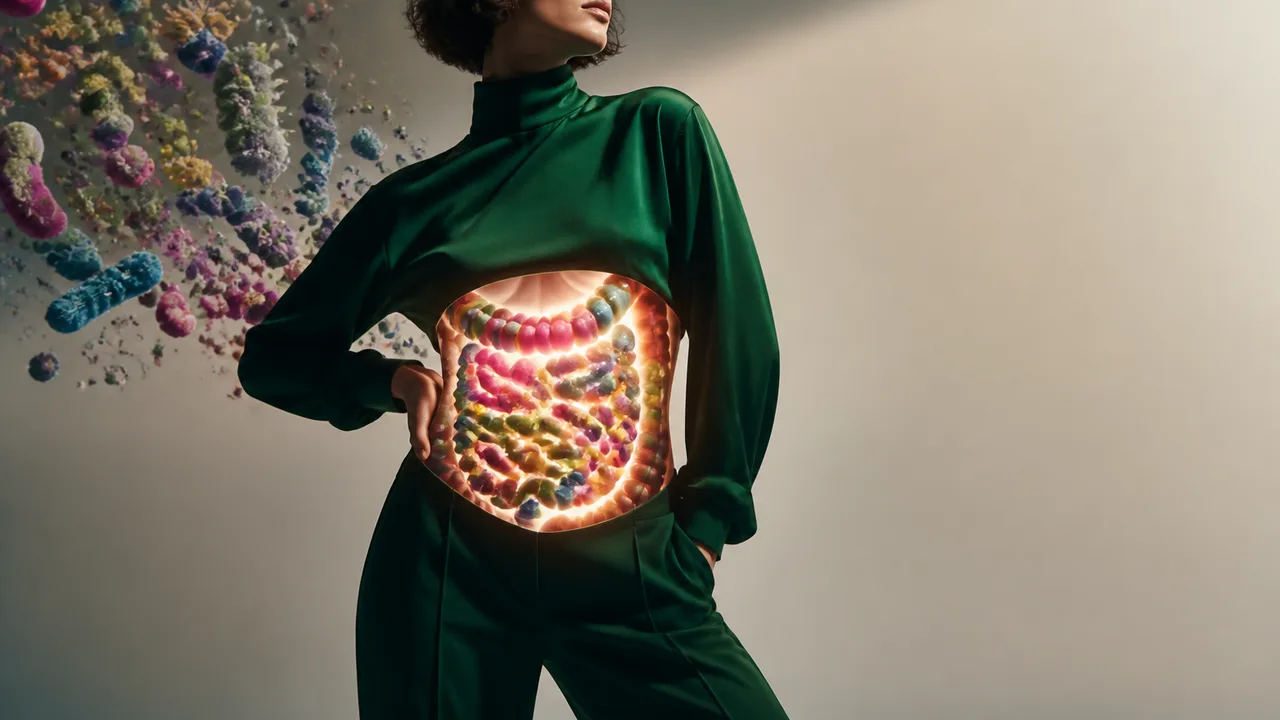
Photo: AI. Ines Cienfuegos
The hashtag #GutTok has over 6 billion views on TikTok. The global digestive health products market, according to Grand View Research, is worth over $60 billion—and it's projected to surpass $100 billion by 2033. Somewhere in between those two numbers lives one of the more fascinating collisions in modern health culture: a field of genuinely exciting science getting absolutely steamrolled by people selling you mushroom powders and parasite cleanses.
A recent Vox video, produced by Benjamin Stephen and drawing on interviews with doctors and researchers at Cedars-Sinai in Los Angeles, tries to thread that needle. It's worth watching—and worth unpacking—because the gap between what scientists actually know about the gut microbiome and what you're being sold in the wellness aisle is, let's say, significant.
What the science actually says
Start with the basics, because they're more interesting than the marketing suggests.
Your gut contains a staggering number of microorganisms—bacteria, archaea, fungi—that have co-evolved with humans across our entire existence as a species. They help digest food, extract energy, and produce compounds that travel through your bloodstream to affect organs nowhere near your stomach, including your heart, lungs, and brain. The experts in the Vox video describe it plainly: "They eat mostly what we eat. And their waste products have a huge role in determining a lot of aspects of our health."
The key metric researchers look to isn't the presence of any particular "good" microbe—it's diversity. One expert explains it this way: "We always describe each person's gut microbiome as being like a fingerprint." Each microbiome is unique, and a healthy one is a crowded, varied ecosystem, not a monoculture optimized for whatever strain happens to be trending. "When it comes to your gut microbiome, there's no good or bad bacteria. You need a lot of different kinds of bacteria in your gut."
When that ecosystem falls out of balance—a state researchers call dysbiosis—the symptoms are things most people recognize: bloating, abdominal pain, irregular bowel movements. About 40% of Americans, the video notes, report that GI symptoms disrupt their daily lives. That's not a niche problem.
The science here is real and active. Researchers are genuinely still figuring out the full picture—there's no established hardline definition of what a "healthy" microbiome looks like in measurable terms—which is part of what makes the field exciting. It's also, not coincidentally, part of what makes it vulnerable to exploitation.
Where the grift enters
Gut health stigma has historically kept people from discussing digestive issues openly. The Vox experts note that awareness really picked up in the 2010s, as probiotics entered mainstream consciousness and product marketing rushed to meet the moment. Labels appeared on supplements, beverages, and beauty products: supports gut health, boosts your microbiome. The wellness industry—worth over $6 trillion globally and largely unregulated—leaned hard into the language of science without much of its rigor.
Then social media influencers arrived, and things escalated.
The video cites Pew Research data showing that 40% of adults get health and wellness information from social media influencers or podcasts. Meanwhile, according to the video, 41% of health and wellness influencers identify themselves as some kind of healthcare professional—but most of them describe themselves as coaches or entrepreneurs. Those two facts, sitting next to each other, explain a lot about how coffee enemas become a thing people seriously consider.
One of the Vox experts captures the dynamic well: "It's midnight and you're scrolling TikTok and you see somebody who is like, 'Hey, do you have diarrhea and bloating?' Suddenly, you're locked in. For the first time, you're feeling heard. Someone's describing your symptoms. And then you get sold and then you start liking their content. You buy their supplements, you try out all of their different pathways and you move further and further away from the science."
That's not a knock on the people doing the midnight scrolling—it's a structural observation. The influencer economy is extremely good at offering belonging and validation. It's considerably less good at sourcing its claims.
The supplement problem is specific and documented
It's tempting to hand-wave at "unregulated wellness products" as a vague category of concern. But the Vox video gets specific in a way that's worth sitting with. Researchers have studied probiotic supplements bought off store shelves and found that close to 30% of them contain no live bacteria whatsoever. Equally notable: close to 30% contain ingredients that aren't listed on the label at all.
"You don't really know what you're getting," one expert says flatly. "Everyone should just remember that the supplement industry is not regulated the same way as medicine."
This matters because there are some probiotic supplements with legitimate research behind them—but navigating that landscape requires more specificity than a generic "supports gut health" label provides. The bacteria strain matters, the dose matters, whether the bacteria survive storage and digestion matters. A jar sitting on a shelf at room temperature for six months is not necessarily delivering what it promises.
What actually works (and why it's boring)
Here's the part where the science and the wellness industry diverge most sharply: the evidence-backed advice for supporting gut health is, in fact, deeply unsexy.
Fiber is the consensus answer. The Vox experts call it out without hesitation: "Number one, it is fiber 100% for gut health. We want the fruits. We want the vegetables. We want the colorful plates." Fermented foods—yogurt, kefir, kimchi, sauerkraut—have reasonable evidence behind them for most people, and can help with microbiome diversity. A Mediterranean-style diet, emphasizing variety and whole foods, gets a nod. Cutting back on preservatives and artificial sweeteners gets mentioned specifically, with some research suggesting certain emulsifiers used to make processed foods softer can trigger gut inflammation.
And then: water, stress reduction, sleep. The same advice your doctor has been giving you since before gut health was a hashtag.
The Vox experts are explicit that there's no shortcut. "There's really no way to hack your gut or change your microbiome without making some serious lifestyle changes." More pointed: "Anybody who's offering you one-size-fits-all for microbiome and microbiome therapies—just approach with caution."
As for the extreme end of the trend spectrum—colonics, parasite cleanses, "poop maxing"—the expert verdict is unambiguous. "The colonics is a big one. It actually will cause negative impacts on your gut microbiome. Anything that's like a very vigorous wash of your gut will disturb your microbiome and you definitely don't want something like that." The whole concept of "cleansing and resetting," another expert adds, has no evidence base: "There's no proof for it."
The tension worth holding
Here's what's genuinely interesting about this moment in gut health: the underlying science is not hype. The microbiome is a legitimate frontier in medicine, and researchers are uncovering real connections between gut health and immunity, inflammation, and even mental health. The problem isn't that people have started caring about their digestive systems—it's that a $6 trillion industry is very motivated to offer them products before the research is in.
The Vox video—and the researchers it features—lands squarely on the side of "this field matters, but most of what's being sold to you doesn't." That's a defensible position given what we currently know. But it's also worth noting the limits of current knowledge: the microbiome is still largely a mystery, personalized medicine is still more aspiration than reality, and the research is moving quickly enough that today's uncertainty isn't necessarily tomorrow's.
What's clearly not uncertain is the grift. When nearly a third of the probiotics on store shelves are either dead on arrival or contain unlisted ingredients, the problem isn't consumer skepticism going too far. It's that it hasn't gone far enough.
The gut health conversation is worth having. The gut health aisle requires a different kind of scrutiny entirely.
More Like This

Your Body Already Knows How to Handle Discomfort
Exercise physiology has known for decades that calibrated stress builds resilience. So why does the wellness industry keep selling you comfort instead?
Morning Routines: Intention, Gratitude, and a Dash of Skepticism
Explore morning routines focusing on intention and gratitude, with a critical look at wellness industry promises.

How Sports Actually Bring People Together
Sports are celebrated as a universal unifier—but how does that actually work, and when does it fall short? We map the real science and the real limits.

Midjourney Medical's Ultrasonic Body Scanner, Explained
Midjourney founder David Holz wants to reinvent medical imaging with ultrasonic full-body scans. Here's what the technology promises—and where physics pushes back.

Public Trust in Science Is Fragile and Complicated
Trust in science is eroding—but the data is more complicated than the panic suggests. Here's what's actually happening, and why it matters.

Fasting and Connective Tissue: What the Science Shows
A 2024 Nature Metabolism study tracked 3,000+ proteins during a 7-day fast. The findings on collagen remodeling and muscle preservation are harder to dismiss than you'd expect.

Sugar, Soda, and Mental Health: What the Research Shows
New research links high sugar intake—especially from soda—to depression and anxiety. Here's what the science actually says, and what it doesn't.

Unexplained Infertility and the Weight of Not Knowing
When all the tests come back normal but pregnancy doesn't happen, unexplained infertility creates a unique psychological burden—here's what the research shows.