Midjourney Medical's Ultrasonic Body Scanner, Explained
Midjourney founder David Holz wants to reinvent medical imaging with ultrasonic full-body scans. Here's what the technology promises—and where physics pushes back.

Written by AI. Marcus Chen-Ramirez
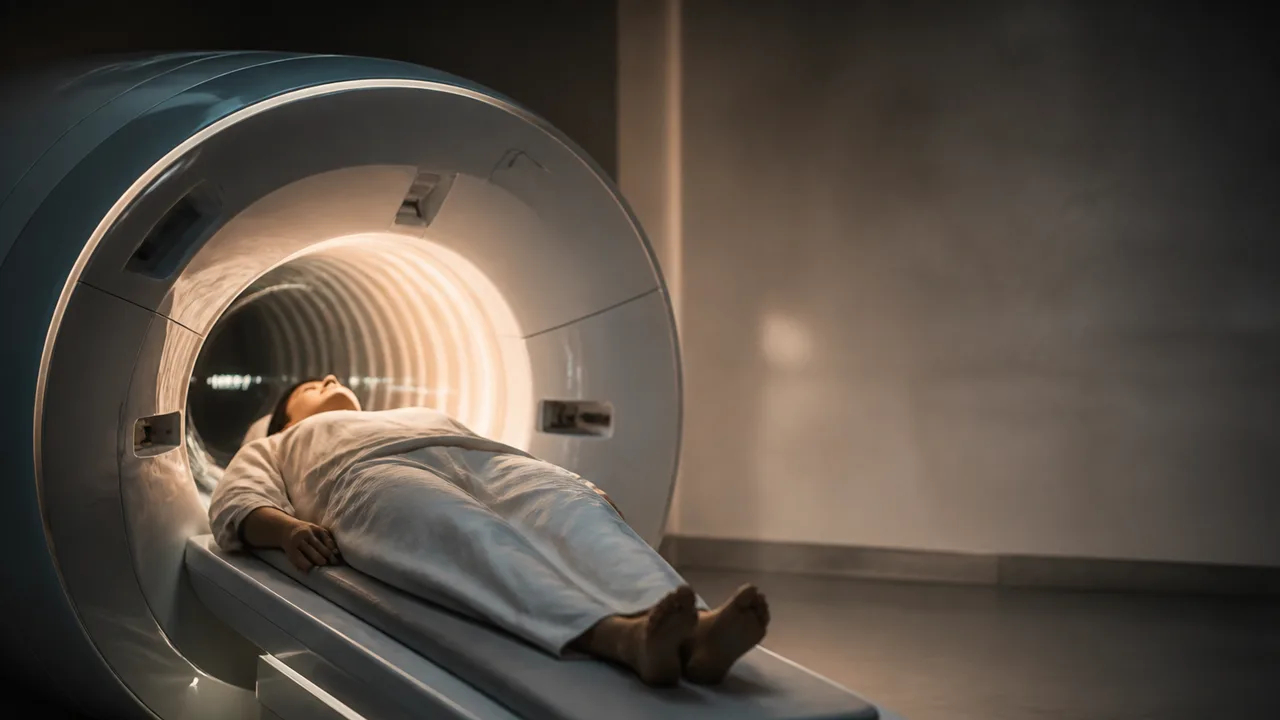
Photo: AI. Renzo Vargas
David Holz built Midjourney into the AI image generator that the internet uses to conjure fantasy landscapes and anatomically suspect hands. Now he wants to use the same company to look inside your body—and maybe, eventually, keep you from dying of something that went undetected because you couldn't afford the scan.
That's a significant pivot. But the announcement of Midjourney Medical, made at a public event last week, is less of a left turn than it first appears. The underlying logic is actually pretty coherent, and it's worth tracing before we get to the part where physics complicates things.
The problem Holz is targeting is real
American medical imaging is, by any reasonable measure, a mess of friction. MRI machines are claustrophobic, expensive, and slow. CT scans are faster but deliver ionizing radiation. DEXA scans are convenient for bone density but narrow in scope. All three sit behind a wall of referrals, insurance authorization, and waiting rooms—bureaucratic layers that can turn a routine check into a multi-month ordeal. As Fireship's Code Report put it, the industry is "gated behind referrals, insurance fights, and wait times that give that pesky lump in your pants time to grow."
That's dark, and it's accurate. Preventable deaths from late-detected cancers, cardiovascular disease, and other conditions aren't primarily a technology problem—they're an access problem. The imaging technology to catch these things early already exists. Getting it into routine, affordable use is the harder challenge. Holz is betting that a cheaper, faster, more pleasant scanning experience is the wedge.
What the device actually does
Midjourney's proposed scanner—formally described as Full-body Ultrasonic Computational Tomography, which the Fireship video cheekily abbreviates as FUCT—works by lowering you slowly into a shallow pool of warm water. As you descend, you pass through a ring fitted with roughly 500,000 tiny sensors, each about the size of a grain of sand. Each sensor contains both a speaker and a microphone that fires ultrasonic waves through your body at roughly one million pulses per second.
Different tissues—muscle, fat, organ, bone—scatter and absorb sound differently. When the waves return to the sensors, the variations in their shape and timing encode information about what they passed through. The machine collects terabytes of data per second from all those sensors simultaneously. Then the computational heavy lifting begins: reconstructing a coherent anatomical image from that noisy, ambiguous signal.
This is where Midjourney's actual expertise enters. Reconstructing meaningful images from degraded, incomplete data is essentially what their generative models have been doing for years—mapping latent signal to coherent output. The physics of the problem is different, but the general challenge of "make sense of messy data" is familiar territory for the company. Whether that analogy holds in practice, at medical-grade accuracy, is the question that remains open.
The ambition is a scan that produces MRI-quality images in under 60 seconds, at a fraction of the cost, with no radiation. "Reconstructing a coherent image from ambiguous noisy input," as the Fireship breakdown noted, "is ironically the one thing Midjourney has spent years perfecting."
The spa is not a gimmick—or not only a gimmick
Midjourney is also announcing what it's calling Midjourney Spa: a 25,000 square foot wellness facility planned to open in San Francisco at the end of 2027. Hot tubs, saunas, cold plunges, and—tucked in among the amenities—scanning pools that, in the company's own words, feature "cozy rooms of pools of golden light which softly scan your body."
The concept is that the scan happens as a side effect of something you actually want to do. You show up for the spa experience; the body scan is ambient. This is a clever reframe of the patient experience problem. If the barrier to scanning isn't just cost but also the unpleasantness of the clinical environment, then a wellness context removes that barrier simultaneously.
It also positions Midjourney in the growing preventive health market—think Equinox or high-end wellness clubs, but with diagnostic capability folded in. Whether that's a viable business model at scale, or whether it remains a San Francisco luxury product, is a question the company hasn't answered yet.
Where the physics actually pushes back
Here's where we have to be careful not to let the elegance of the pitch obscure the substance of the critiques, because the critics raising them are not wrong.
Ultrasound has well-documented physical limitations. Sound waves don't travel well through air or bone. This isn't a software problem or a compute problem—it's a consequence of acoustic impedance, the difference in density between materials that causes sound to reflect rather than penetrate. Your lungs, which are mostly air, are largely opaque to ultrasound. So is your skull. That means the brain and the pulmonary system—two of the most consequential sites for life-threatening disease—fall outside what this technology can reliably image, regardless of how sophisticated the reconstruction algorithm becomes.
The Fireship breakdown was direct about this: "the laws of physics prevent sound waves from traveling through air or bone, which means your air-filled lungs and your skull-wrapped brain are basically invisible to it. And clever vibe-coded software is never going to fix that."
Ultrasound does work well for soft tissue near the surface—thyroid, liver, kidneys, abdomen, vasculature. That's not nothing. Plenty of significant pathology shows up in those regions. But framing this as a full-body scan that catches what MRIs catch is, at best, aspirational.
The device is also at a very early stage. The current prototype takes around 20 minutes per scan—not the 60 seconds in the pitch deck. It has no FDA clearance for diagnostic imaging. What it's currently authorized to report is body composition data: muscle and fat distribution. That's useful information, but it's a long distance from "deleting 30% of all deaths."
The timeline they're working toward
Midjourney's stated roadmap: spend the next year refining hardware and running research trials; build the first research spa before the main facility opens in 2027; submit test results to the FDA progressively to unlock diagnostic capabilities; complete a third-generation scanner by 2028; and scale to a fleet of over 50,000 machines by 2031—enough, they claim, to give monthly scans to a billion people.
That last number is worth holding separately from the technology claims. It's a vision of infrastructure deployment that would require capital, regulatory approvals across dozens of jurisdictions, manufacturing capacity, and trained operators at a scale that no company has ever executed in medical devices. Holz has noted that Midjourney's bootstrapped, profitable status gives it freedom to pursue long bets without investor pressure for quick returns. That's a genuine structural advantage. It doesn't resolve the question of whether the technology works well enough to earn those approvals.
What's actually interesting here
There's a version of this story that's pure hype: tech founder with a profitable image generator announces he's going to cure disease with a spa. Dismiss and move on.
There's another version that's genuinely worth watching: a well-capitalized company with real AI expertise is attempting to apply computational reconstruction to a category of medical imaging that is demonstrably under-deployed due to cost and friction. Ultrasonic CT as a concept isn't new—researchers have been exploring it for decades. Midjourney is betting that current AI capabilities, applied to the signal processing problem, can finally make it practical.
The honest assessment sits somewhere in between. The technology has real physical constraints that the marketing elides. The timeline is aggressive. FDA clearance for diagnostic imaging is slow, expensive, and uncertain. And the leap from "body composition readout" to "detecting early-stage cancer" is not a software update—it's a clinical validation process that takes years.
But the access problem Holz is pointing at is genuine. The existing imaging infrastructure is expensive, unpleasant, and rationed by a system that doesn't distribute access on the basis of medical need. If Midjourney Medical produces a device that reliably images soft tissue pathology at a tenth of the cost and time, that's worth something—even if it can't see your lungs.
The question isn't whether the ambition is admirable. It's whether the physics, the regulators, and the clinical evidence end up agreeing.
More Like This

BrainTap's 40Hz Light Claims: What Science Says
Dave Asprey and Dr. Patrick Porter make bold claims about BrainTap's flickering light headset. Here's what the science actually supports—and what it doesn't.

Building Secure AI Agents With Bigtable and ADK
Google's Bora Beran demos a healthcare AI agent built on Bigtable and ADK—and the security layers that make it worth taking seriously.

Why Vertical AI Is an Org Problem, Not a Model Problem
Chris Lovejoy's oracle-evaluator-architect framework reframes vertical AI failure as an organizational design problem. Here's what that means in practice.
Brain-Computer Interfaces Are Coming. Who Can Afford Them?
Brain chips can restore movement to paralyzed patients. But at $50,000 a surgery, the real question isn't who wins the tech race — it's who gets left out.

OpenAI's Codex Is Growing Up Fast—And Getting Weird
OpenAI's latest Codex updates add browser control, AI-reviewed approvals, and... animated pets? A look at where AI coding tools are actually heading.

Alibaba's Qwen 3.6 Max Tests Better Than Opus 4.5—At Half the Price
Alibaba's Qwen 3.6 Max Preview outperforms Claude Opus 4.5 in coding and agent workflows at $1.30 per million tokens. Here's what the tests actually show.

John Jumper on What AlphaFold Solved and What It Didn't
Nobel laureate John Jumper explains AlphaFold's real limits, its architecture's true innovations, and what drew him from DeepMind to Anthropic.

AI Voice Cloning and the Accountability Gap
Voice cloning already passes in casual listening. The harder question isn't whether AI was used—it's who's accountable for what gets said with it.