Brain-Computer Interfaces Are Coming. Who Can Afford Them?
Brain chips can restore movement to paralyzed patients. But at $50,000 a surgery, the real question isn't who wins the tech race — it's who gets left out.

Written by AI. Dorothy "Dot" Williams
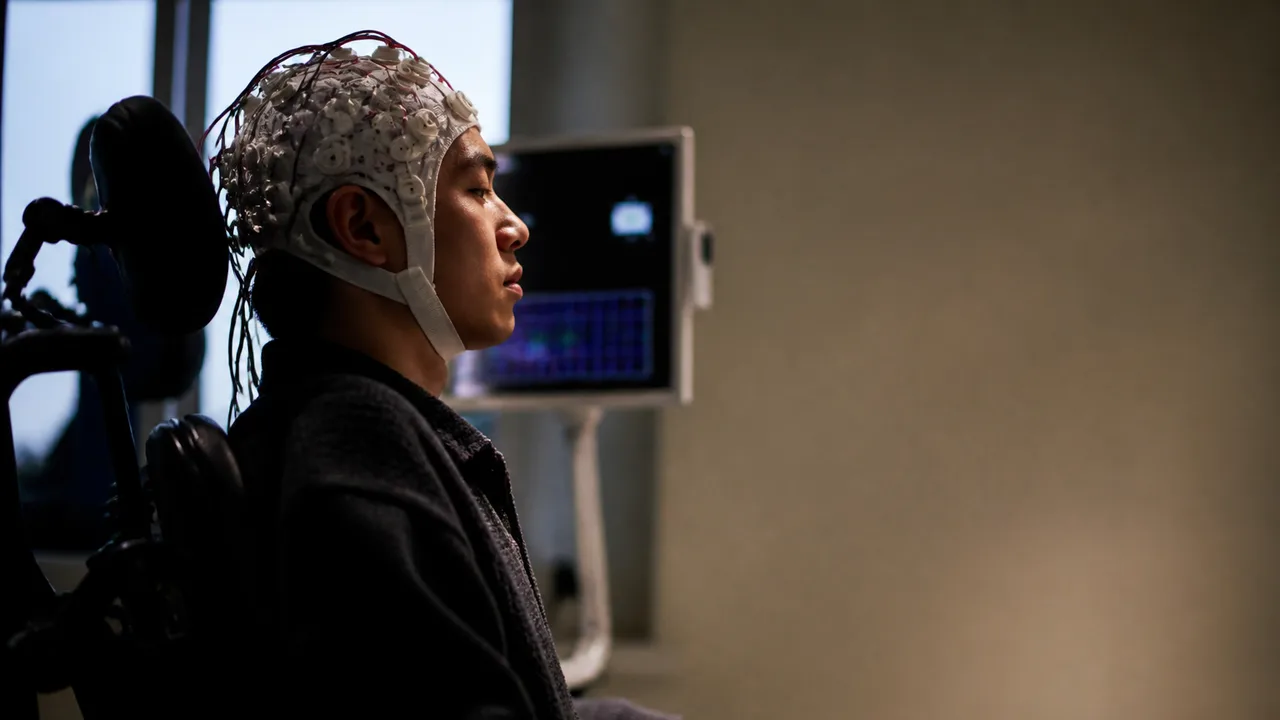
Photo: AI. Renzo Vargas
Mr. Jang asked that his face not be filmed. That's the first thing you learn about him. Eight years ago, an accident took away everything from the neck down. Now, in a clinical setting in Shanghai, he is steering his wheelchair with his mind. Not metaphorically. Literally — through a strip of electrodes resting on his cortex, wired to a chip that reads his brain's electrical signals and translates intent into motion.
He's also, apparently, got a few tricks up his sleeve.
I keep coming back to Mr. Jang because he is the actual story here — not the geopolitical race, not the Five-Year Plan, not Elon Musk's civilizational risk commentary. Mr. Jang is why this technology exists, and he's also the reason the hardest questions about it are ones no investor roadshow wants to answer. A Bloomberg Primer piece on Shanghai-based startup NeuroXess puts him front and center, then pivots — as this industry tends to — toward the bigger picture. I want to stay with him a little longer.
What the device actually does
A brain-computer interface, or BCI, reads the electrical signals neurons fire when you intend to move, speak, or act — and routes those signals directly to an external device, bypassing whatever injury or disease has broken the chain in between. The technology has been in development since the 1970s, when researcher Jacques Vidal at UCLA — French-born, working in America — showed that EEG signals could be mapped onto movement patterns. It wasn't until the early 2000s that implanted chips began reading activity directly from inside human brains.
The version NeuroXess built for Mr. Jang uses a flexible electrode strip that sits on top of the cortex rather than penetrating it. That design choice matters: implants that stick into brain tissue cause the brain to form scar tissue around them over time, which degrades signal quality and can damage cells. NeuroXess's strip is meant to reduce that response. "In a sense, it can be a ticking time bomb when something is put in the human brain, which is very sensitive area of the body," one of the researchers notes in the Bloomberg piece. The less-invasive approach is a direct engineering response to that problem.
The chip processes signals wirelessly and transmits them to a computer. The battery charges through the chest wall, the same way you'd top up a phone. Mr. Jang has been living with this implant since October 2025, spending several hours a day training. He can control his wheelchair. He's training on a robotic hand exoskeleton. The company's founder says he may walk again.
The $50,000 question
Now here's where I need you to sit with a number for a moment.
Bloomberg reported in July 2025 that Neuralink — the highest-profile US player in this space — estimated each surgery would bring in around $50,000. Neuralink hasn't publicly confirmed an official price, so treat that as a reported estimate rather than a sticker. NeuroXess hasn't released its own figures. But the number in the ballpark is real, and it matters enormously.
$50,000 is what a lot of small business owners clear in a year, before taxes, after expenses. It is, in many states, more than the annual cost of a home health aide. It is, for most American families facing a spinal cord injury, an impossible out-of-pocket number — which means everything depends on what Medicare, Medicaid, and private insurers decide to do with these devices.
Here's what those families are up against: BCI implants will be classified as Class 3 medical devices, which is the most stringent approval category the FDA uses. Class 3 is reserved for devices that sustain or support life, or that present a significant risk if they fail. Getting there requires extensive clinical trial data, a premarket approval application, and years of review. "It looks like it's going to take another one and a half to two years to get approval," NeuroXess founder Tiger Tao says, referring to China's medical regulator — and the US timeline is unlikely to be shorter.
That approval process doesn't determine what insurance covers. That's a separate negotiation, and it's one that tends to go badly for patients trying to access expensive new technology in the early years. The device might be approved. Your insurer might still say no.
The small businesses nobody's talking about
Every technology that enters the medical system drags an ecosystem behind it, and BCI will be no different. The devices need to be programmed and maintained. Patients need rehabilitation specialists who understand them. Home health aides will need training — and the agencies that employ them will need to figure out how to staff for that. Durable medical equipment distributors, the small regional operations that sit between big manufacturers and patients' front doors, will have to decide whether there's a business in being a BCI supplier, and whether the margins justify the complexity.
None of that infrastructure exists yet. And if the pattern from other high-cost medical technologies holds, what's likely to develop first is a system that works well for patients at large academic medical centers in major cities and works poorly — or not at all — for everyone else. The rehab clinic in a mid-sized Midwest city. The home health agency serving rural counties. The family that can't relocate for treatment.
NeuroXess has already broken ground on a manufacturing facility projected to produce 10,000 devices a year. That's not a small number. But the business question — who gets trained to support these devices, in which ZIP codes, and who pays for the training — is genuinely open.
China's bet, and what it actually means
China's 15th Five-Year Plan designated BCI as one of six strategic industries of the future. In practice, that means a government-backed $165 million brain science fund, faster clinical trial reviews, and clearer regulatory guidelines. Bloomberg reports that Chinese funding for brain-chip startups more than doubled in 2025 compared to the prior year. And according to Bloomberg's reporting, China approved its first invasive BCI for commercial use in March 2026 — a milestone that, if it holds up to scrutiny, is a meaningful signal about where the regulatory winds are blowing.
The EV comparison is worth taking seriously. China laid down similar policy support for electric vehicles over the past two decades and now commands a dominant position in the global market. Whether BCI follows that path depends on whether the technology can clear the clinical and commercial bars that EVs didn't face — you don't need a surgeon to buy a car.
US BCI companies, according to Bloomberg's reporting, have raised an estimated $2.75 billion collectively — a figure that should be understood as a snapshot, not a scoreboard, since fundraising totals shift constantly. Chinese companies have raised considerably less, but the policy tailwind closes some of that gap.
The data question, made concrete
There's one more issue that isn't getting nearly enough air in the mainstream coverage: what happens to the brain data these devices collect.
A BCI is, by definition, a device that reads your thoughts — or at least the electrical precursors to them. The algorithms that decode those signals generate an extraordinarily detailed picture of how your brain works. "There are sort of questions to be raised about who has access to this data and what happens to it," one researcher observed in the Bloomberg piece, and that's the polite version of the problem.
Think about who holds that data in a commercial BCI ecosystem. The device company. Potentially the cloud infrastructure provider. The insurer paying the claim. The employer, if workplace BCI adoption ever materializes. Some jurisdictions are already passing neural privacy laws — Colorado enacted protections in 2024, and Chile became the first country to enshrine neurorights in its constitution — but federal protection in the US remains thin.
For small employers, the scenario to watch isn't science fiction. It's the same data-access question that plays out with health insurance right now, just with a new category of information that's more intimate than anything a blood test can show.
Mr. Jang is training for hours every day, learning what his mind can do now that a chip is translating for it. He's thinking, the Bloomberg team notes, beyond what's already possible. The technology to let him do that exists, is implanted in his skull, and is charging through his chest like a phone.
The question no one has answered yet is whether, when this technology is ready for the broader market, the people who need it most will be the ones who can actually get it — or whether $50,000 and a ZIP code will decide that instead.
More Like This
BrainTap's 40Hz Light Claims: What Science Says
Dave Asprey and Dr. Patrick Porter make bold claims about BrainTap's flickering light headset. Here's what the science actually supports—and what it doesn't.
Brain-Computer Interfaces: Bridging Biology and Technology
Explore the potential of brain-computer interfaces to merge biology with tech, restoring lost functions and expanding human capabilities.

Unitree's Mech Robot and the Regulation Nobody Wrote
Unitree's GD01 manned mecha is commercially available and already deploying abroad. The regulatory framework to govern it doesn't exist yet.

Flood-Proofing Cities: Big Walls vs. Small Fixes
From Tokyo's $2B flood tunnels to a $78K fly farm in Nairobi, cities are choosing how to survive rising floods — and the choice reveals everything about who adapts and who doesn't.

Black Hole Paradox: Are Reference Frames the Key?
Exploring how reference frames might resolve the black hole information paradox.
Scientists May Finally Detect Gravitons—Sort Of
New experiments could detect gravity's quantum particle within decades. But proving gravitons exist? That's a different problem entirely.

Pitch the Ceiling: James Hawkins on Ambition and Building PostHog
PostHog CEO James Hawkins on why bigger ideas are easier to sell, swapping jobs with your co-founder, and how ambition changes everything about building a company.

The Broken Economics of the Car Rental Business
Car rental companies aren't just greedy—they're structurally trapped. A look at the unit economics that make the industry's misery nearly unavoidable.