Wildfires Are Reshaping Europe's Summer Holiday Map
Wildfires in Spain and France are pushing travelers toward shoulder seasons and cooler destinations. Here's what the data and experts say about Europe's shifting tourism.

Written by AI. Tomas Reyes-Kim
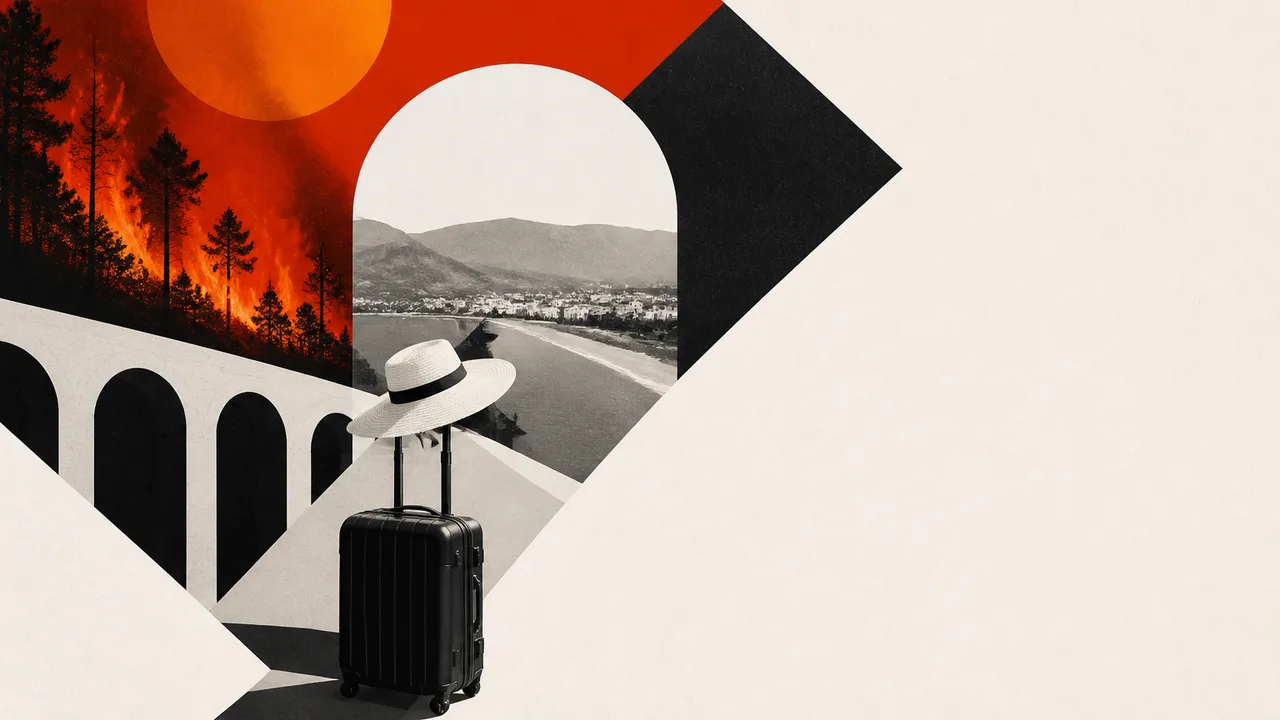
Photo: AI. Ondine Ferretti
For a long time, "European summer holiday" meant one thing: southern Europe, July or August, sunburnt and slightly dehydrated somewhere on the Mediterranean. That image is running into something harder to ignore — fires near Bordeaux described as "fires of the century," Spain declaring a national emergency as wildfires swept near Madrid, and temperatures that have made peak-summer travel feel less like a vacation and more like a stress test.
The question BBC News posed recently — have wildfires and heatwaves changed European holidays for good? — isn't really a question anymore. The data suggests the shift is already underway. What's less clear is how far it goes, who it actually affects, and whether the places scrambling to adapt can do so fast enough.
The Numbers That Are Moving
Dr. Suzanne Eti of Intrepid Travel told BBC News that her company is seeing real, measurable behavioral change among travelers. The headline figure: around a 17% increase in customers choosing shoulder season travel — May or September — over traditional peak summer. That's not a rounding error. That's a structural shift in demand.
"We have seen really a move away from southern Europe in the peak season," Dr. Eti said, "but also really kind of seeing more customers selecting to travel during the shoulder season."
Alongside that, interest in cooler Northern European destinations and Iceland has been climbing. The "Mediterranean but further north" framing might sound glib, but there's something real behind it — if your primary motivation for going to Greece or Spain in August was warm weather and outdoor time, then Scandinavia in June starts looking like a functional substitute. Especially if the alternative involves wildfire smoke and red-alert heat warnings.
What Dr. Eti didn't say, and what's worth sitting with, is what this means for the travelers who can't easily rebook for May or push their trip to September. Shoulder season travel is largely a flexibility luxury. Most people with kids are locked into school calendar windows. Workers without generous leave policies don't have the option to just drift into a less-crowded month. The behavioral shift being tracked by Intrepid Travel's data is real, but it skews toward travelers who already had options.
The Problem for Tourism-Dependent Economies
Here's the tension that doesn't resolve neatly: entire economies — Spain is the obvious example — are structurally organized around the peak summer tourist season. Hotels, restaurants, beach clubs, seasonal workers, local vendors — the whole architecture of coastal tourism assumes a concentrated July-August rush. If demand disperses across a longer season, that's arguably better for residents who've been dealing with overtourism. But it's also a genuine disruption for businesses built around a predictable, dense revenue window.
Dr. Eti put it plainly: "Climate change is no longer a future business risk — it's actually an operational reality."
That framing matters. "Future risk" is something you model and hedge against. "Operational reality" is something you deal with today, with the resources you currently have. A small family-run beach bar in a coastal Spanish town doesn't have a climate adaptation budget. A hotel that only opens in June because that's when the season starts doesn't have a playbook for pivoting to April.
The adaptation pressure is real, and it's landing unevenly.
Travel Insurance Is About to Get More Expensive
If you're planning a summer trip to southern Europe and you don't have travel insurance, Dr. Eti's advice was pretty direct: get some, and expect it to cost more going forward. The logic is straightforward — more frequent climate disruptions mean more cancellations, more emergency evacuations, more claims. Insurers price accordingly.
Her practical framework for travelers heading to fire-prone or heat-affected regions: stay informed about conditions on the ground, build flexibility into your plans, and reassess day by day rather than locking into an itinerary and hoping for the best. That last part is genuinely hard if you've pre-booked everything to save money (which, for budget travelers, is almost always the move). Pre-booking is how you get cheap flights and the hotel you actually want. It's also how you end up stuck when conditions change.
The honest answer here is that climate volatility is adding a real cost to budget travel in Europe — whether it shows up as higher insurance premiums, lost deposits on non-refundable bookings, or the price premium of staying flexible.
The Sunbed Economy Is Its Own Thing Entirely
Woven into this BBC segment was a genuinely fascinating detour into the economics of beach club pricing — and it functions almost as a counterargument to the idea that luxury Mediterranean tourism is about to price-correct for climate risk.
David Shisra, founder of a hospitality consultancy, described the current state of premium beach destinations: in some spots, a large beachfront setup with multiple sunbeds, a private jacuzzi, and direct beach access can run over €3,000 during peak season. Even at the more accessible end of that market, €400 for two sunbeds and an umbrella in a popular beach town isn't unusual — and at many venues, that comes with mandatory food and beverage minimums on top.
When asked whether climate pressures might force these venues to reconsider their pricing to attract tourists, Shisra was candid: not really, at least not right now. "The demand for both sunbeds but also just for hotel stays is just very very high at this moment," he said.
That's an important data point to hold alongside the shoulder-season shift. The premium end of Mediterranean beach tourism appears largely insulated from climate-driven demand erosion — at least for now. The travelers moving to May or heading to Iceland are, by definition, not the clientele dropping €3,000 on a beach tent in Mykonos. Those two markets may be responding to climate change in entirely different ways.
What Shisra did flag as a likely adaptation: destinations that currently open only in June or July may start extending their season earlier — into April or May — to capture the travelers who've shifted their timing. That's a structural change worth watching, because it affects staffing, supplier chains, and the rhythm of life in tourist-heavy towns.
The Bigger Frame
Ivonne Akiya, the mayor of Freetown in Sierra Leone, offered something that cut through the tourism economics entirely. Speaking from London — noting that the city had hit 40°C during her previous visit — she pushed back against the idea that extreme heat and climate disruption is a distant problem.
"This is no longer an isolated crisis," she said. "Fires raging in Spain, in France — this is a global crisis, but it needs global and local solutions."
That's the context that tends to get lost when the story gets framed purely as a consumer travel question — where should I book, what insurance do I need, is Iceland nice in July. Those are legitimate questions for people trying to plan a trip. But the infrastructure underneath all of it — the forests burning, the temperatures rising, the seasonal economies straining — those aren't travel trend stories. They're the backdrop against which every booking decision is now being made.
The shift toward shoulder seasons and cooler destinations is a real, data-backed behavioral change. Whether it's a temporary recalibration or the beginning of a permanent restructuring of European summer tourism is something no one can answer cleanly right now. But the fact that a 17% swing in travel timing is already showing up in booking data — that's not noise. That's signal.
Tomas Reyes-Kim covers budget travel and digital nomad infrastructure for BuzzRAG.
More Like This
Airport Perks Travelers 50+ Are Legally Entitled To
From wheelchair escorts to seat accommodations, here are the federally protected airport perks seniors are entitled to — and airlines won't volunteer.

Uber Wants to Book Your Hotel Now, Too
Uber is teaming up with Expedia to add hotel booking inside its app. Here's what that actually means for budget travelers already loyal to other platforms.
California's Heat Waves Are Getting Deadlier at Night
Scripps scientist Sasha Gershunov explains why California's heat waves are shifting—more humid, more nocturnal, and more deadly than ever before.

What Smart Travelers Do Right After Boarding a Plane
From seat checks to jet lag tricks, here's what experienced flyers actually do in the first few minutes after boarding—and why it matters.
Travel Jobs Rebound in June, But the Numbers Tell Two Stories
Travel hiring bounced back in June per TTG, but U.S. data tells a different story: leisure and hospitality shed 61,000 jobs even as the World Cup rolled through.

Home Swapping Saves Families Thousands on Holidays
Home swapping is helping families save thousands on holidays by cutting accommodation costs. Here's how the model works, what it costs, and what the risks are.

Mass Media Doesn't Change Your Accent. Your Friends Do.
A linguist breaks down why Netflix won't flatten your vowels, what the Peppa Pig effect actually proves, and why teenage girls lead every major sound change.

Travel Spending Is Rebounding—But Read the Fine Print
Travel spending rebounded in June and agents are booking again—but the data tells a messier, more interesting story than the headlines suggest.