Ramstein Air Show Disaster: Response and the Long Aftermath
The 1988 Ramstein air show crash killed 70 people. Its emergency response, differing injury counts and survivors' long aftermath raise questions about public safety.

Written by AI. Sofia Ramirez
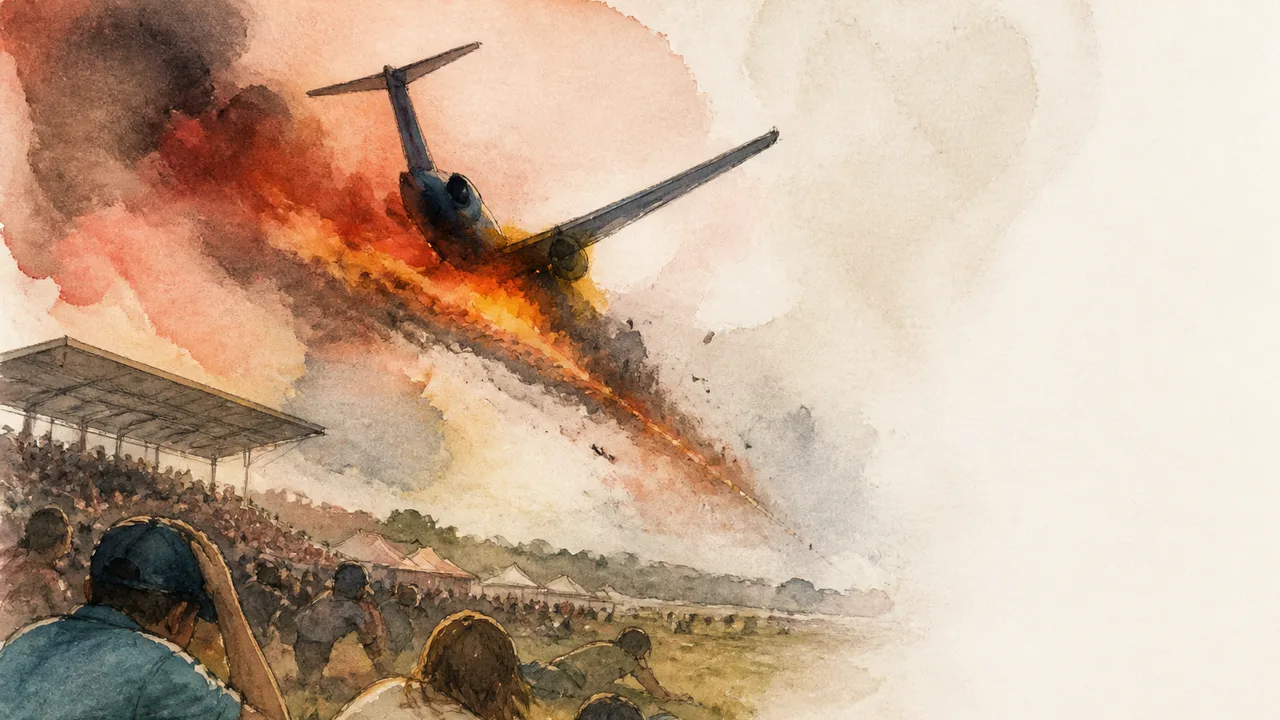
On August 28, 1988, roughly 300,000 people gathered at Ramstein Air Base in West Germany for an air show. They came to watch pilots perform above them. During a display by an Italian aerobatic team, three aircraft collided, and one came down in the spectator area. By the time the death toll reached 70, a day organized around watching danger from a distance had become a disaster among the people on the ground.
The 70 dead included 67 spectators and three pilots. Hundreds more suffered serious injuries. Those numbers describe the scale of the crash, but they also point to two different histories. Investigators had to determine what went wrong in the air. Families and injured spectators had to live with what happened after the aircraft fell.
The Risk Below the Flight Path
Ramstein was a military base hosting a public event. The U.S. Air Force's retrospective of the Flugtag '88 air show places the crowd at about 300,000 and describes clear skies and near-perfect weather. Good weather could make the show easier to enjoy; it could not remove the hazard created when aircraft performed near a large gathering.
That crowd size changed the stakes of a mistake in the air. A spectator had no control over a maneuver or a formation. The people below accepted a role the event had designed for them: stand in the designated area and watch. Once an aircraft entered that area, the boundary on which the whole arrangement depended failed. Calling those spectators bystanders understates their place in the story. They were the public the show had invited in.
The official finding attributed the collision to pilot error. That finding addresses the immediate cause of the crash. It does not, by itself, answer how an air show should separate people from an aircraft that leaves its intended path, or how a gathering of that size should prepare to move and treat casualties. Those are different questions, with different people responsible for asking them.
Pilot error can also be an uncomfortably tidy ending to a public history. It locates the decisive mistake in the cockpit, where investigators can examine a sequence of actions. The spectators' exposure requires a wider view: the design of the event, the size of its audience and the emergency work that would begin if the display went wrong. None of those considerations changes the official finding. They explain why a finding about the collision cannot tell the entire story of the disaster.
What 96 Minutes Can Tell Us
A medical account of the Ramstein disaster says survivors were triaged, treated and evacuated from the base within 96 minutes. It describes an aircraft falling into the spectator enclosure and more than 500 casualties. For responders facing many injured people at once, triage meant making urgent decisions about who needed attention and transport first.
The 96-minute figure captures a defined piece of emergency work: getting survivors assessed, initially treated and off the base. It cannot measure the full course of hospital care or recovery. A person who left Ramstein within that period might still have faced months or years of treatment. An evacuation clock starts when a disaster occurs; a survivor's clock does not stop when an ambulance leaves.
How did people reach the injured, prioritize care and move patients away from the site? The medical account supplies one answer about the speed of evacuation. It does not turn the crash into a success story about speed. Seventy people died, and the injuries extended far beyond the minutes spent at the base.
Ramstein also put a public crowd inside a military setting in West Germany. That combination makes coordination a practical question rather than an abstract demand for institutions to “do better.” Any large event needs a plan for the point at which its own personnel and facilities cannot handle the number of injured people. At Ramstein, the difference between managing a show and managing casualties arrived in the time it took an aircraft to fall.
Why the Injury Counts Differ
The death toll has a clear, widely repeated figure. The injury toll changes with what gets counted. The disaster left 346 spectators seriously injured; about 500 people sought hospital treatment. Those numbers should not be treated as interchangeable estimates of one category. Serious injuries, hospital treatment and all reported injuries describe different groups.
For someone trying to understand the emergency response, the number of people requiring hospital care helps convey the demand on medical services. For someone trying to understand the reach of the disaster, the broader injury count keeps less severe harm from disappearing. Neither figure captures every consequence in a household where one person was badly hurt and others had to reorganize daily life around care.
The timing of deaths complicates a single-day account, too. 16 people died in the days and weeks afterward from severe burns. The death toll belongs to August 28, 1988, and to the period after it. A date on a memorial marks the event that caused those deaths; it cannot show how long families waited for news, or how injuries changed as patients received care.
These categories are useful when they stay attached to their purpose. A count of serious injuries helps describe severity. A hospital-treatment count helps describe medical demand. The broader total helps describe how many people the crash reached. Compressing them into one unspecific number would make the article simpler and the disaster harder to understand.
Memory After the Emergency
A memorial outside the airbase honors those who died. Its location gives visitors a place to encounter the names and the loss. The people who survived with injuries carry another part of the history, one that does not fit as neatly into a date or a death toll. The same catastrophe can be a completed investigation for one institution and an ongoing condition of life for a family.
That tension is familiar in disaster history. Investigations need conclusions. Emergency services need measurable accounts of what happened and how people responded. Memorials need a place and a form. Survivors need care over time, and their needs can change long after the event stops being public news. Each of those tasks uses a different measure of time.
Remembering Ramstein fully means keeping those measures in view together. The official explanation of pilot error helps answer why the aircraft collided. The account of evacuation helps describe what responders did once people were hurt. The injury figures and the memorial show how many lives the crash reached and how a community continues to mark its dead. The next public air show will depend on people believing that the space between performance and crowd can hold. Ramstein is a reason to ask, before they gather, what happens if it does not.
More Like This
Douglas MacArthur and the People He Left Behind
MacArthur is remembered as a military legend. But what about the veterans he gassed, the soldiers he abandoned, and the Japanese citizens who built a new democracy?
California's Hidden Underground: Caves, Tunnels, and Buried History
From a buried Gold Rush city to survival tunnels built by Chinese immigrants, California's underground holds layers of geology, history, and forgotten infrastructure.
Medieval England: How Peasants and Guilds Shaped Society
A new documentary traces medieval England's social divide through two real families—one peasant, one guild merchant—and the starkly different worlds they inhabited.

John Wayne Airport Tug Theft Tests Access and Response
A stolen tug briefly paused flights at John Wayne Airport. The Gate 12 alarm, airport response and an older incident sharpen the questions about airfield access.
Titanic Lifeboat Decisions Shaped Who Could Survive
The Titanic had lifeboat space for about 1,178 of more than 2,200 aboard. Loading, access and maritime rules shaped who escaped the sinking in April 1912.
How the Continental Congress Named the United States in 1776
On September 9, 1776, Congress swapped 'United Colonies' for 'United States.' The name left the country's whole structure deliberately unresolved. Here's how.

An 11,000-Year-Old Statue of a Man Riding a Leopard
Archaeologists unearthed an 11,000-year-old statue at Karahan Tepe, Turkey, showing a man riding a leopard. What does it tell us about Neolithic power?

Coin Flipping Is Not as Random as We Thought
From Roman dispute-settling to modern physics research, coin flipping turns out to carry a measurable bias. Here's what that means for fairness.