Titanic Lifeboat Decisions Shaped Who Could Survive
The Titanic had lifeboat space for about 1,178 of more than 2,200 aboard. Loading, access and maritime rules shaped who escaped the sinking in April 1912.

Written by AI. David Oyelaran
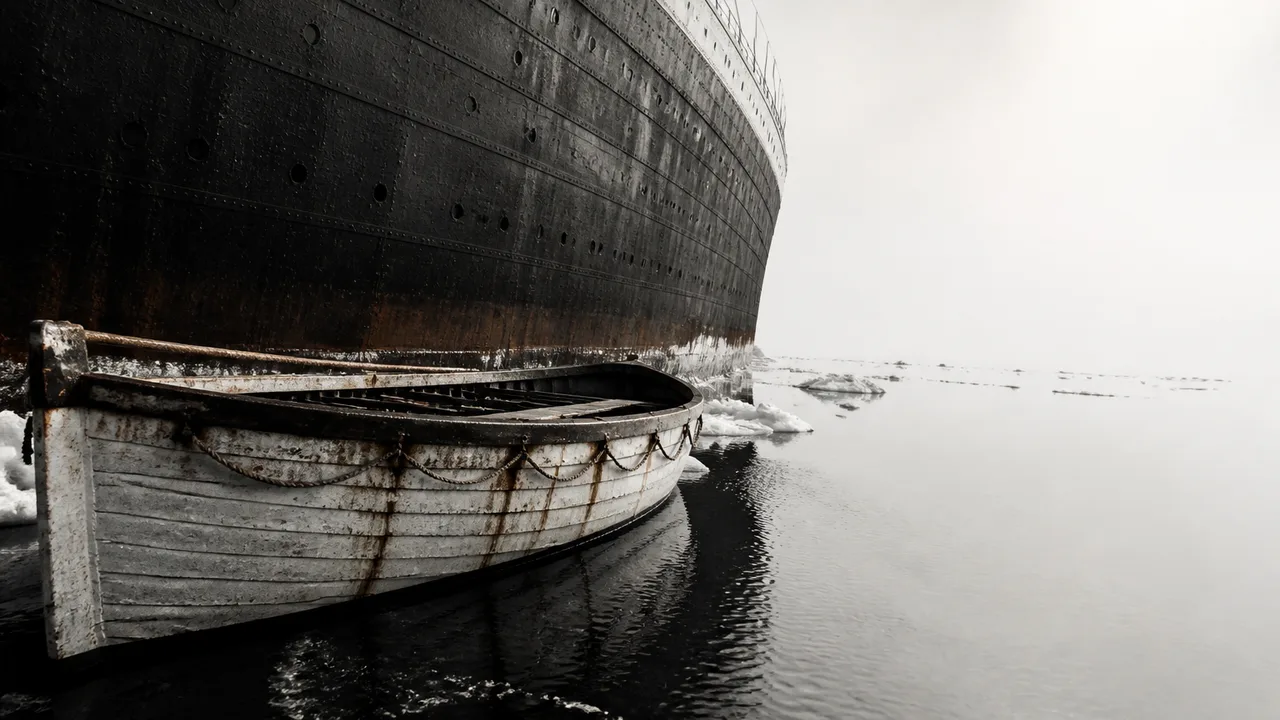
Titanic carried lifeboat space for roughly 1,178 people when it sank in April 1912. More than 2,200 people were aboard. Before anyone had to choose whether to step into a boat, the ship had already made one limit unavoidable: even a perfectly filled fleet could not take everyone.
About 705 people survived. That figure records the outcome, but it cannot reconstruct every opportunity lost between the collision and the sinking. Only 18 of the ship’s 20 lifeboats were launched, and many left with spare places. Each number belongs to a different part of the story: the number of places provided, the number made available during the evacuation, and the number of people who lived. Treating them as interchangeable can make a chaotic night look like a simple arithmetic mistake.
The question that stays with me is smaller and harder than “Why didn’t they fill the boats?” Who could get to a boat, who understood the danger soon enough to board, and who had the authority to decide when it would leave?
A Capacity Set Before the Voyage
Titanic’s lifeboats were physical pieces of safety equipment, built for use at sea. Encyclopedia Titanica identifies Harland & Wolff in Belfast as their builder and describes their double-ended design. Their construction deserves attention because the shortfall did not arise from a complete absence of boats. It arose from a fleet whose total capacity fell far below the number of people on the ship.
The regulations governing lifeboat provision had failed to scale adequately with the size of newer ocean liners. A rule can be followed and still leave a dangerous gap if its assumptions belong to an earlier generation of ships. For anyone aboard Titanic, the distinction between regulatory compliance and a place in a boat became painfully concrete: fewer than 1,200 places had been provided for more than 2,200 people.
That limit also changes how to read every later decision. Better loading would have given more people a chance. It could not have created seats for everyone. The shortage was built into the voyage; the hurried choices of the evacuation determined how much of the available capacity people could use.
The spare places require equal care. Subtracting roughly 705 survivors from a rated capacity of 1,178 produces a gap of about 473. It does not give us a count of people who could certainly have been saved through fuller loading. Two boats were not launched, survivors did not all reach safety in the same way, and a place available in one moment could be impossible to fill in the next. Capacity describes what the boats could hold. An evacuation depends on people reaching them and crews launching them while time remains.
The Distance to the Boat Deck
A lifeboat place helps only a person who can reach it. Access to the boat deck was uneven during Titanic’s evacuation. That statement does not, by itself, tell us the route taken by any named passenger or establish how many deaths resulted from a particular obstruction. It does tell us why a final count of empty places cannot stand in for a count of refused opportunities.
The evacuation unfolded in darkness, danger and incomplete information. People had to decide whether to leave a large ship for a smaller boat without knowing precisely how much time remained. The belief that the ship might be safer than a crowded boat affected loading. So did confusion about the danger and the practical difficulty of getting people to the departure point. Those conditions could coexist: a person might hesitate, while another person who wanted a place could not get there in time.
Consider what a loading decision required. Someone had to judge whether the boat could be lowered, whether more people were close enough to board, and how long to wait. A decision to wait might have brought more passengers aboard. A decision to lower could free space for the next boat to be prepared. With incomplete information, neither choice came with the knowledge available to us after the sinking. That uncertainty helps explain the difficulty of the work; it does not erase the consequence of a boat leaving with room aboard.
The record supplied for this account cannot assign every spare place to a person, an officer or a single cause. It also offers no survivor interview from which to tell one passenger’s passage to the deck. Those limits matter to how the history is told. A person absent from a boat’s passenger list may have been delayed, misinformed, unable to reach it, or facing a boat that had already gone. The list records where someone ended up, not everything they tried to do.
Choices After Launch
The decisions continued once boats reached the water. Herbert Pitman, aboard Lifeboat 5, wanted to return for people in the water. After Titanic sank, some occupants of his boat were transferred to Lifeboat 7; about 30 remained in Lifeboat 5 when it reached the rescue ship Carpathia. That later count is a useful warning about numbers detached from time. It does not necessarily describe how many people Lifeboat 5 carried when it left Titanic.
Pitman’s wish to return also brings a different set of lives into view: people who had made it into the water but still needed rescue. From inside a lifeboat, returning meant weighing those lives against the safety of the people already aboard. The available account establishes his intention; it does not let this article reconstruct every exchange in the boat or reduce the outcome to one person’s character.
The two boats that were not launched likewise resist being folded into a single category of “unused” capacity. Boat B floated away upside down near the end of the sinking. Its fate shows why a tally of 18 launched boats cannot describe every encounter between people and the ship’s rescue equipment. It also shows the limits of a plan that depends on getting equipment into service during an emergency: a boat aboard the ship and a boat ready to receive passengers are two different conditions.
What Changed on Land
Public inquiries after the sinking helped drive stronger expectations for lifeboat capacity and continuous radio watches. The first change addressed the limit set before Titanic sailed. The second concerned the ship’s ability to seek and receive help. Neither reform could guarantee that every evacuation would run smoothly, but each answered a weakness exposed by the disaster: too few places available at the outset, and communication that needed to work throughout an emergency.
The lifeboat figures are often recited as though one number could explain the night. The 1,178 places identify a planning failure. The 18 launches and the spare seats point to the difficulty of turning that provision into rescue. The roughly 705 survivors tell us where the process ended. Between those numbers were people trying to understand a sinking ship, reach a boat, and decide whether it was time to leave. Any account of the empty seats has to leave room for them.
More Like This

Middle Platonism's Hidden Role in Western Esotericism
ESOTERICA's new crowdfunded seminar argues Middle Platonism built the foundations of Hermeticism, Gnosticism, and early Christian theology. Here's what that means.

Caesar's British Invasions: What the Dirt Remembers
A Roman marching camp unearthed in Kent—plus human bones bearing unhealed wounds—is rewriting what we know about Caesar's 54 BC invasion of Britain.

Why October's Name Still Carries the Number Eight Today
October is the tenth month, but its name means eight. The mismatch preserves an older Roman calendar and reveals how societies reorganize public time.

DNA Names a Revolutionary War Teen Soldier After 245 Years
Genetic genealogy has identified Private John Pumphrey, a Maryland teen who died at the Battle of Camden in 1780 — one of America's oldest John Doe cases.
Cicero and the Fall of the Roman Republic
Marcus Tullius Cicero defended Rome's Republic with words alone—and paid with his life. A look at history's most consequential orator and his impossible political moment.

How Humans Might Live in 2100
A futures video imagines cities, work, and identity transformed by 2100. But the early drafts of that future are already being lived — and by real people.