John Wayne Airport Tug Theft Tests Access and Response
A stolen tug briefly paused flights at John Wayne Airport. The Gate 12 alarm, airport response and an older incident sharpen the questions about airfield access.

Written by AI. Tomas Reyes-Kim
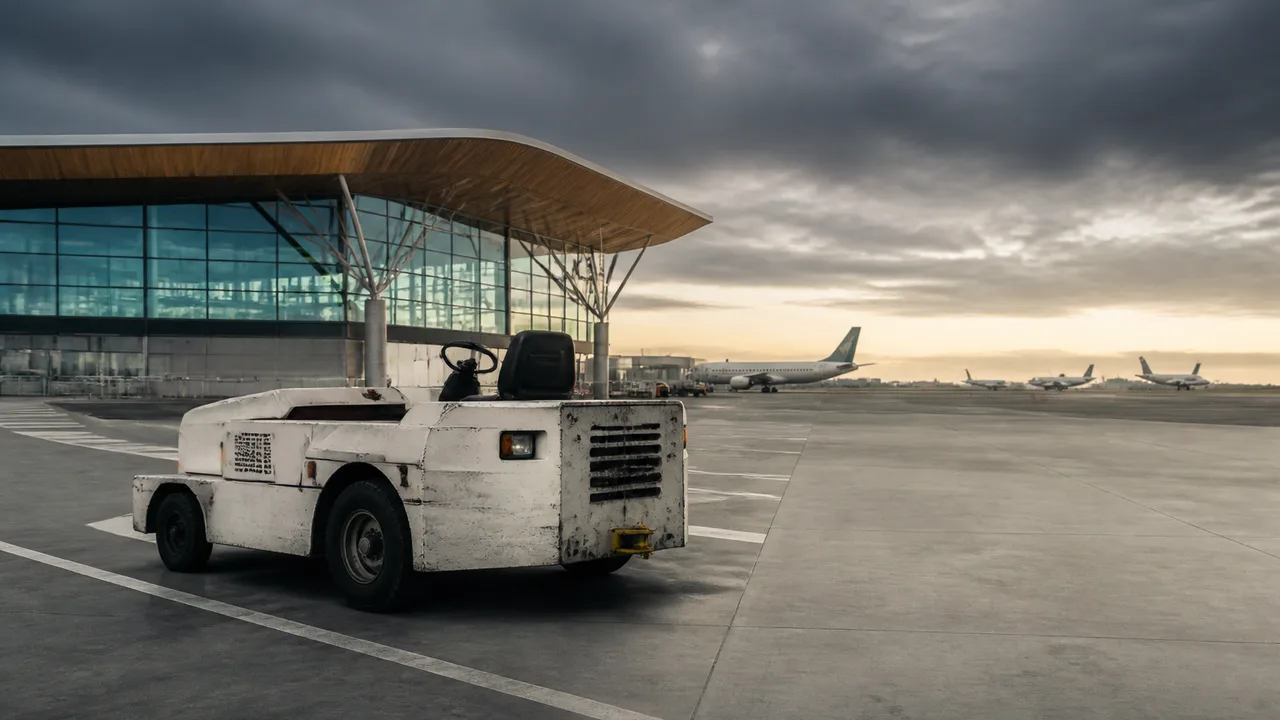
John Wayne Airport briefly halted flights on October 6 after a passenger allegedly took an airport tug onto the airfield, crashed it and tried to take a second vehicle. For anyone waiting to fly, the immediate question was how long the pause would last. For the airport, a harder question starts earlier: what happened between the Gate 12 door alarm and the drive to Gate 7?
The passenger, who was booked on a Delta flight to Seattle, went through an emergency access door at Gate 12 in Terminal B at about 5:30 p.m., setting off an alarm. Airport officials said he took a tug assigned to Alaska Airlines, drove it toward Gate 7 and crashed into a utility cart. He then allegedly tried to take an American Airlines lavatory truck before airport police arrested him. The Orange County Sheriff’s Department identified him as Skyler Jay Barr, 26. He faced vehicle-theft, trespassing and vandalism charges and remained in custody as of October 7.
That is an improbable itinerary for a Seattle-bound traveler, even before the lavatory truck enters the story. It is also a sequence with two separate questions tucked inside it. The first is how a passenger reached an airfield through a terminal door. The second is how he gained use of a vehicle once there. An alarm sounding answers neither question by itself: it marks a door event, while police stopping someone later marks the end of a response. The time and decisions between those points determine whether the alarm prompted an effective intervention or arrived too late to prevent the drive.
A Short Pause, with Precise Boundaries
Authorities closed the Gate 7 area for about 10 minutes during the response. Flights briefly halted, too, but that 10-minute figure describes the gate-area closure, not the length of the flight pause. Crews checked the taxiway route between Gates 12 and 7 for debris or other hazards before aircraft movements resumed.
No official ground stop was issued; flights were briefly halted, and airport officials said the incident had no impact on overall operations. A traveler hearing the radio phrase could reasonably expect a larger disruption. The narrower account describes a temporary interruption while responders dealt with the vehicle and checked its route. It does not turn a closed gate area into a 10-minute airport-wide shutdown.
The inspection had a practical purpose. After a tug strikes another vehicle, aircraft should not resume moving along its route before crews check for anything the collision or drive left behind. Police dealt with the person; airport crews dealt with the path aircraft would use. Those are different jobs, and the short operational pause reflects the second one as well as the first.
A quick return to movement is welcome if you have a connection to make. It cannot, on its own, grade the earlier access controls. Response speed after a crash and prevention before a crash measure different parts of an incident. Conversely, the fact that someone reached a tug does not tell us which control or decision, if any, failed. The reported alarm establishes that a signal occurred; the account does not establish who received it, when they acted or what access rules applied to the vehicle.
The Door Belongs to a Larger System
Airport access has been a shared-responsibility problem for years. In a congressional hearing on access-control breaches, TSA official John P. Sammon explained the general division: TSA sets standards, approves airport and airline security plans and inspects airport compliance; airport authorities and airlines carry out their plans. In the same hearing, lawmakers discussed the risk that screening passengers could be undermined by weaknesses at other routes into secure areas.
That older debate helps locate the John Wayne questions. The familiar checkpoint is only one place where an airport controls movement. This passenger’s reported path began at a terminal access door, continued onto the airfield and reached equipment assigned to an airline. Asking whether a checkpoint screener should have caught him skips the route he reportedly took. Asking how the door alarm was handled, who controlled access beyond it and how the tug was secured gets closer to the actual sequence.
Sammon’s testimony describes a general framework, not John Wayne Airport’s current security plan. The airline named on a tug also need not be the party responsible for that door or every step of an airfield response. Shared responsibility is a reason to ask more precise questions, rather than to assign blame by reading the logos on the vehicles. It leaves room for airport police, airport operators, airlines and ground handlers to have different roles as events unfold.
There is a strong, straightforward concern here: a passenger reportedly crossed into an airfield, took a working vehicle and drove far enough to crash it near another gate. Even a short interruption cannot erase that exposure. The alarm sounded and police made an arrest. Both observations can stand without treating an unusual arrest as proof of an airport-wide pattern.
A narrower precedent makes the same point. In a retrospective account of a December 2016 Orlando incident, View from the Wing described a United passenger who was refused boarding, went through a jet bridge and emergency exit, took a baggage tug and drove to an airport fire station, where a firefighter apprehended him. Like the John Wayne episode, the account describes a passenger reaching restricted space and taking a tug. The routes and endings differ: at John Wayne, the reported path started at Gate 12, ended in a collision near Gate 7 and prompted a taxiway check and brief flight pause. The Orlando account supplies no comparable operational timeline, so the two events cannot establish that the airports had the same access weakness or responded at the same speed.
For travelers, the operational lesson is modest but useful. A controller’s phrase on the radio, a temporary halt to flights and a formal ground stop are different pieces of information; only the first two featured in this incident. For the airport, the questions remain more exacting. The Gate 12 alarm is a known starting point. What happened after it sounded will say more about the access-control chain than the speed with which flights resumed.
More Like This
Delta's 2026 Profit Bet Rides on High Airfares Holding
Delta reaffirmed its 2026 earnings forecast despite fuel volatility—but the plan depends on keeping fares high for customers it says can afford it.

Accor and H World Link 19,000 Hotels in Loyalty Deal
Accor and H World are linking loyalty programs across 19,000 hotels and 430 million members. Here's what it means for travelers—and why execution is everything.