A Traveler's Guide to European Fast Food Chains
From Belgian Quick to Finnish Hesburger, Europe's regional fast food chains offer something the golden arches simply don't: genuine local character on a budget.

Written by AI. Mariel Fontaine
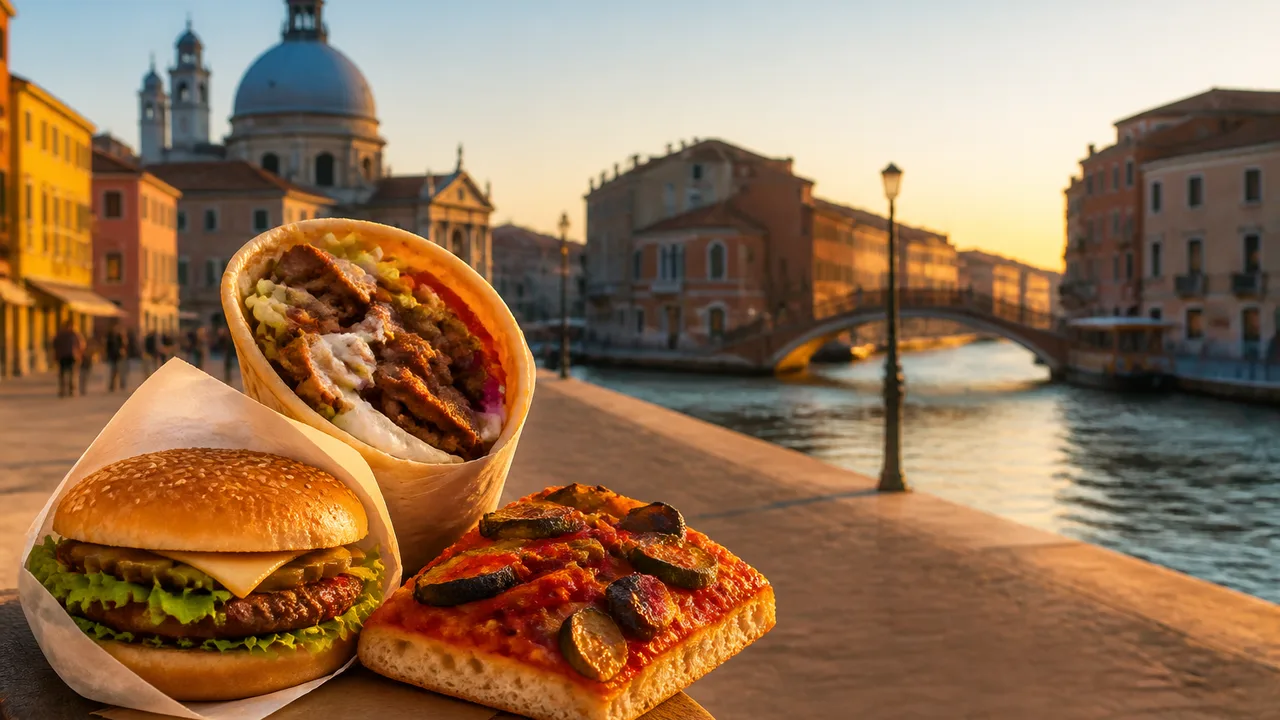
Photo: AI. Asha Kingsley
There is a particular kind of traveler's guilt that descends the moment you step into a McDonald's abroad. You know it, the locals know it, and yet sometimes it's 2 p.m., you've been walking for six hours, the children are becoming feral, and the €28 bistro around the corner requires a reservation and a disposition you do not currently possess.
Mark Wolters of Wolters World has spent considerable time living across Europe — Finland, Germany, Portugal among them — and his recent video on European fast food chains makes a case that is worth taking seriously: the alternative to a global chain isn't necessarily a sit-down meal. It might be a regional chain with its own culinary logic, loyal local following, and, crucially, a price point that won't wreck your afternoon budget.
The chains he covers are genuinely regional in character, which matters editorially. This isn't a list padded with brands that happen to have a European headquarters on paper. Most of what's here you will not find in an American strip mall.
The Burger Landscape
Wolters opens in France with Quick, the Belgian burger chain that operates across France, Belgium, and Luxembourg. The framing is instructive: he doesn't describe it as a McDonald's knockoff but as the chain his own family gravitates toward when the kids want a burger fix. "That's actually where we take the kids when they want a burger fix when we're in France and Belgium instead of going to McDonald's or Burger King." The distinction he draws — that European fast food burger culture is defined by sauce rather than size — is a useful lens. Quick's giant and mega giant burgers are the draw, but it's the proprietary sauces that separate the experience from its American-style competitors.
His genuine enthusiasm, however, is reserved for Hesburger, the Finnish chain also present in the Baltic states. "Number two, which is actually number one in my heart, is Hesburger." The emphasis here lands on mayonnaise — paprika and cucumber varieties, served in substantial packets alongside fries — and on the original Hesburger, which he positions as a Big Mac analogue that outperforms the original by virtue of those same condiments. The detail that ordering milk alongside your burger is entirely normal in Finland is the kind of cultural note that earns its place in a travel piece; it's specific, it's verifiable, and it reframes the meal in a way that a standard menu description never would.
Max, from Sweden, rounds out the burger section. Wolters is direct about the economic context: Sweden is expensive, and Max represents meaningful savings without the compromise of a global chain. The suggestion that you can legitimately tell people you "ate Swedish" at Max has a dry self-awareness to it that the video doesn't fully capitalize on, but the underlying point is sound.
Beyond the Burger
Nordsee, the German seafood chain, is the entry on this list most likely to surprise. Wolters compares it favorably to Long John Silver's and Captain D's while acknowledging that "elevated fast food fish" is a phrase that requires some trust. The Brötchen — bread rolls stuffed with shrimp salad and other seafood — are the practical recommendation here, and for travelers who find that European coastal cities offer seafood they can't afford to order properly, Nordsee is a legitimate middle path.
Italy's contribution isn't a chain at all. Pizza al taglio — pizza sold by the cut, priced by weight — is a format rather than a brand, and Wolters is right to include it. Walking into a Roman pizzeria al taglio and pointing at whatever combination of toppings looks right, then watching someone slice, weigh, and wrap your lunch in paper, is one of those eating experiences that is genuinely democratic. It's affordable, it's fast, it requires almost no Italian, and the quality ceiling is considerably higher than anything a chain could offer. Wolters discovered pear and gorgonzola pizza through this format, which he notes made it to his wedding menu — the kind of specific detail that earns credibility.
Telepizza, operating across Spain, Portugal, and parts of Latin America, occupies an interesting niche: it's a delivery chain that actually adapts to local taste. Wolters recalls a bacalhau com natas (codfish and cream sauce) pizza available in Portugal at Christmas — which sounds improbable until you consider that bacalhau is as central to Portuguese food culture as the potato is to Irish. A pizza chain that reflects where it operates is a different proposition from one that doesn't.
Wienerwald in Austria offers grilled and roasted chicken alongside chicken schnitzel, and Wolters notes the broader point that Austria's street food culture — schnitzel houses, sausage stands — gives budget travelers options that don't require sitting down at all. A Bratwurst or Käsekrainer from a German or Austrian street stand is fast food in every functional sense, and Wolters treats it as such without apology.
SuperMac's in Ireland rounds out the chain options. The snack box — chicken tenders and fries — is the recommendation, and Wolters is honest that the menu is essentially an Irish variation on familiar formats. That's not a criticism; it's an accurate description of what regional fast food often is.
On Pret A Manger
Wolters mentions Pret A Manger in passing — the sandwich chain visible at UK train stations, business centers, and "along the high street as they say in England." It's worth flagging what Pret actually is before you file it alongside Quick and Hesburger. Pret was founded in London in 1983 and has significant presence across the UK and France, but it is now majority-owned by JAB Holding, a Luxembourg-based investment group, and operates extensively in the United States and globally. (This ownership context is detailed by Capital.com in their coverage of the Pret a Manger IPO prospects.) The sandwiches are consistent and reasonably good for a grab-and-go, but positioning Pret as a local European alternative to American chains requires the same caveat that applies to any internationally scaled brand: the "local" quality is relative. Include it in your planning if you're hungry at St. Pancras, but don't mistake it for a regional institution.
The Döner
No European fast food overview is complete without the döner kebab, and Wolters gives it appropriate weight. Shaved meat, garlic sauce, lettuce, tomato, onion, folded into flatbread — available from street stands across the continent at most hours of the day or night. He particularly endorses the French variation, which adds fries inside the wrap. Its cultural footprint in Europe is enormous, and its presence spans well beyond Germany, where it is especially embedded in urban food culture.
The döner's origins are a point of genuine historical debate. Wolters mentions Germany in passing, which is where the sandwich format is most strongly associated in European popular culture, but the full origin story involves contested claims and multiple countries, and this isn't the place to adjudicate it. What matters practically is that you will find döner stands in most European cities, quality varies considerably, and the good ones — usually identifiable by a queue of locals rather than tourists — are among the most satisfying cheap meals the continent offers.
The Practical Frame
Wolters is upfront about what this list is for: "Sometimes you don't want to pay $30 for dinner. You want to pay 10." That's the honest version of the budget travel pitch, and it lands better than the usual aspirational framing. Fast food in Europe isn't a consolation prize. For families with young children, for travelers covering significant ground on limited funds, or simply for anyone who wants to eat well at lunch without it becoming a two-hour commitment, these regional chains offer something the global alternatives don't: a window into what a specific country considers normal, convenient food.
The most interesting items on this list aren't the burger chains. They're pizza al taglio in Rome, a Käsekrainer from a Vienna sausage stand, a döner from a Berlin street cart. None of those require a brand affiliation. They require only that you set aside the idea that fast food is a compromise, and treat it instead as the most democratic expression of what a food culture actually eats.
More Like This
American Tourists in Europe: The Etiquette Gap
From date formats to tipping culture, the everyday customs that trip up American travelers in Europe—and what they reveal about deeper cultural differences.
One Day of Cooking, One Week of Meals Done
Dollar Tree Dinners' Rebecca makes 8 freezer-friendly meal preps in a single afternoon—no rush, no perfection, just a genuinely doable system.

Grocery Tourism Is One of Travel's Fastest-Growing Trends
Travelers are flocking to foreign supermarkets as a cultural experience. Here's what the grocery tourism trend reveals about how we understand place and food.

What Poles Actually Want Tourists to Know
From geography to drinking etiquette, here's what Polish locals wish visitors understood before arriving—and why it matters more than you think.
McDonald's Rare Footprint Across Africa, Explained
McDonald's operates in just four African countries. Corruption, cold-chain failures, and the wrong potato explain more than you'd expect.

Transylvania's Wild Side Beyond the Vampire Myth
Transylvania offers far more than Dracula lore—its Carpathian peaks, bear sanctuaries, and ancient caves make it a serious destination for adventure travelers.
Bosnia Travel Tips: What to Know Before You Go
From Mostar's slick cobblestones to Balkan time, here's what seasoned travelers wish they'd known before visiting Bosnia and Herzegovina.

Lima's Neighborhoods and the Inequality Dividing Them
A street-level look at Lima, Peru's capital, where gang-controlled districts and wealthy enclaves exist just blocks apart—and government neglect connects them both.