Lima's Neighborhoods and the Inequality Dividing Them
A street-level look at Lima, Peru's capital, where gang-controlled districts and wealthy enclaves exist just blocks apart—and government neglect connects them both.

Written by AI. Mariel Fontaine
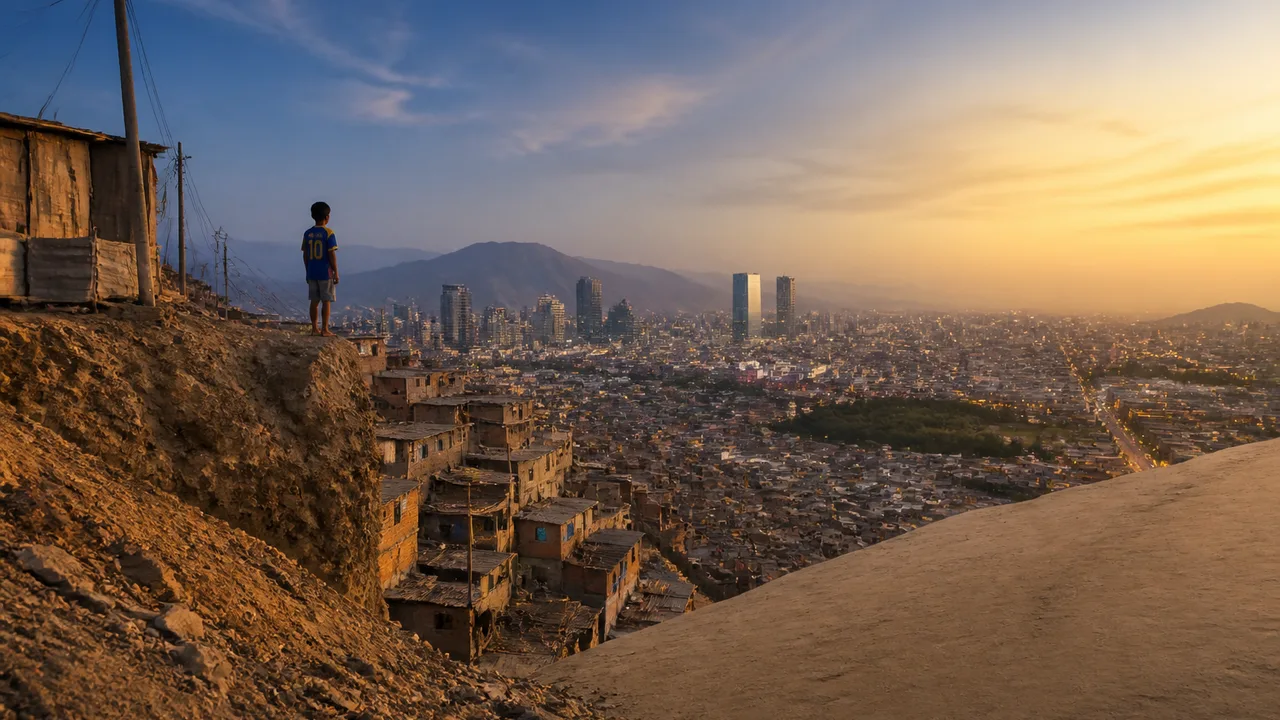
Photo: AI. Asha Kingsley
Lima is a city of 12 million people that somehow manages to contain multitudes without resolving any of its contradictions. In the same hour you can pass through a gang-controlled district where electrical cables drag along the ground and no police dare enter, then arrive at a gated enclave where security guards check your purpose at the entrance and the streets are swept clean. The distance between them, spatially, is almost nothing. The distance in every other sense is generational.
This is the terrain that travel creator Nick of Indigo Traveller navigated in a recent video documenting Lima's more notorious districts — Callao and San Pedro among them — guided by local expert Alfredo, whose unscripted commentary ends up being the most analytically useful thing in the piece.
"They protect the rich people but they don't protect the working class"
That line comes from Alfredo, and it lands with the flat precision of something said matter-of-factly rather than for effect. It describes the visible police distribution across Lima's neighborhoods: dense in Miraflores and San Isidro, the tourist and upper-income zones; sparse to nonexistent in the gang-held districts they visit. Nick observes this discrepancy himself — noting the absence of police in an area locals repeatedly warn him is dangerous — and Alfredo confirms it without ceremony.
This is not a novel observation about Latin American cities. But hearing it stated so plainly by someone who lives inside it, who navigates it daily, gives it a texture that statistics rarely do.
In Callao, the neighborhood described by one local as "dangerous but elegant," the gang presence is not incidental. It is structural. Alfredo explains that entire streets require permission from gang leaders to enter. Electrical infrastructure is so deteriorated that cables touch the ground. The state has not merely failed these areas; it has, in practical terms, withdrawn from them. What fills that vacuum is predictable.
The colonial ledger
Alfredo contextualizes the violence in terms that go beyond policy failure. He points to colonial dispossession, to Peru's Shining Path insurgency — a conflict the country's Truth and Reconciliation Commission estimates killed approximately 70,000 people between the late 1970s and the early 2000s, at the hands of the Maoist insurgents, the rival MRTA group, and state security forces combined — and to centuries of what he calls treating indigenous and working-class communities as "second or third-class citizens."
"People here have been abandoned especially indigenous peoples for many centuries since colonial times," he says. "There is racism, discrimination. So maybe they have something inside that they want to explode."
It would be easy to read this as rationalizing criminality. That reading is too simple. What Alfredo is describing is a historical accumulation — of disinvestment, of trauma, of economic exclusion — that does not excuse violence but does explain its persistence. The cycle he is describing is one that short-term policing cannot break, because policing is not what broke it.
The neighborhood of San Pedro, which Nick and Alfredo observe from a distance rather than enter, operates as a chop shop economy for stolen vehicles. Cars stolen across Lima are driven in, stripped for parts within hours, the owners sometimes called afterward and offered to buy the parts back. It is a closed, functional, and entirely illegal economy that exists because the legal one has not bothered to extend itself there.
The extraction paradox
Lima sits at the administrative center of one of the world's significant mineral exporters. Peru produces substantial quantities of copper, silver, and gold, and those exports flow through ports like the one Nick and Alfredo observe from a Callao beach — where, in the same breath, Alfredo notes that cocaine shipments move through the same infrastructure, often ignored by officials who "look the other way."
Peru is also, by Reuters reporting, in the early stages of an F-16 fighter jet procurement deal with the United States — a purchase controversial enough that it contributed to the resignation of Peru's defense minister in April 2026. Alfredo raises this directly: a country with visible, pervasive poverty, with crumbling urban infrastructure and inadequate public health and education systems, has committed public funds to advanced military hardware. "We don't need them," he says. "We need education. We need those things."
The extractive economy is the subtext of nearly everything Nick and Alfredo discuss. Peru's mineral wealth is substantial and real. Its distribution is the problem. The port that ships copper also processes cocaine. The neighborhoods that generate the labor and bear the environmental costs of extraction are the same neighborhoods the state has stopped maintaining.
What tourism can and cannot see
Nick approaches these districts as a visitor who is clearly not naive — he declines to enter gang-controlled areas despite curiosity, defers to Alfredo and local warnings, and uses a drone to observe areas from above rather than forcing access on foot. The drone footage of deserted gang-territory streets, taken from a legal distance, is one of the more honest acknowledgments in travel content that some places are not yours to enter simply because you find them interesting.
The safety texture that emerges from the street-level conversations is more nuanced than the "dangerous city" shorthand. The threat in busier areas, locals explain, is primarily opportunistic theft — snatch-and-grab, someone eyeing a camera. The threat in quieter, gang-controlled zones is categorically different: assault, or simply being in the wrong place when rival gangs settle disputes. These are not equivalent risks, and the video's interviewees draw that distinction clearly.
Lima also sits on an active seismic zone — positioned at the intersection of the Nazca and South American tectonic plates, part of the Pacific Ring of Fire — which has shaped the city's physical form. Building height restrictions exist throughout the city because of earthquake risk, which accounts for the relative absence of true high-rises in a metropolis of Lima's size and economic output.
The city as argument
What makes Lima so uncomfortable to analyze — and so instructive — is that it doesn't let you choose a frame and stay in it. The beach at Callao is genuinely pleasant. The market stalls selling coca leaves and shaman's preparations are part of an unbroken cultural tradition that predates the country's borders. The generosity that Alfredo describes — "the little they have, they can give it" — is, by all accounts, real.
And the abandoned electrical cables are real. The gang-controlled streets where no state authority operates are real. The reported F-16 procurement during a period of acute public need is real. The prison on the island in Callao's harbor, bombed by the Peruvian Navy in 1986 during the Shining Path period because the state couldn't control what was happening inside it, is real — and the island is still visible from the beach where families buy ice cream on weekends.
Alfredo ends the video with measured hope: "Things are changing very slow. They could change much faster with all the wealth and resources we have in the country. But we need basic things like education and health."
That is not a revolutionary statement. It is, in some ways, a statement of the obvious. The fact that it remains aspirational rather than descriptive tells you something about how Lima's contradictions are sustained — and by whom.
More Like This
American Tourists in Europe: The Etiquette Gap
From date formats to tipping culture, the everyday customs that trip up American travelers in Europe—and what they reveal about deeper cultural differences.

Luxury Train Journey Across Australia: Worth the Cost?
Explore a luxurious 80-hour train journey across Australia and its opulent offerings.
Dubai's Crisis Has a Worker Problem No One's Covering
Dubai's economic model was built on migrant labor with almost no rights. Now, with airstrikes and a blockaded strait, those workers face the worst of the fallout.
Egypt's New Delta Project: Green Miracle or Mirage?
Egypt is engineering a new Nile in the desert. But satellite data, groundwater depletion, and a troubling history raise urgent questions about who this is really for.
Suriname's $10.5B Oil Bet: New Dawn or Same Old Story?
Suriname is betting a $10.5B offshore oil project will end years of recession. Dot Williams on why the real question isn't the money—it's who's ready to catch it.
La Paz, Bolivia: Life in the World's Highest Capital
La Paz sits at 3,650 metres and operates by its own rules—from a self-governing prison to unfinished buildings, coca leaves, and Pachamama sacrifices.
What TSA Confiscates at Airport Security in 2025
From dead electronics to cordless hair tools, TSA confiscates over a million items a year. Here's what triggers confiscation and how to keep your gear.

What Hotel Staff Actually Tell You (And Who's Listening)
Hotel insiders speak candidly on a Travel + Leisure video — but what does "unfiltered" mean when the interviewer has advertisers? A close read of what they said and how.