La Paz, Bolivia: Life in the World's Highest Capital
La Paz sits at 3,650 metres and operates by its own rules—from a self-governing prison to unfinished buildings, coca leaves, and Pachamama sacrifices.

Written by AI. Mariel Fontaine
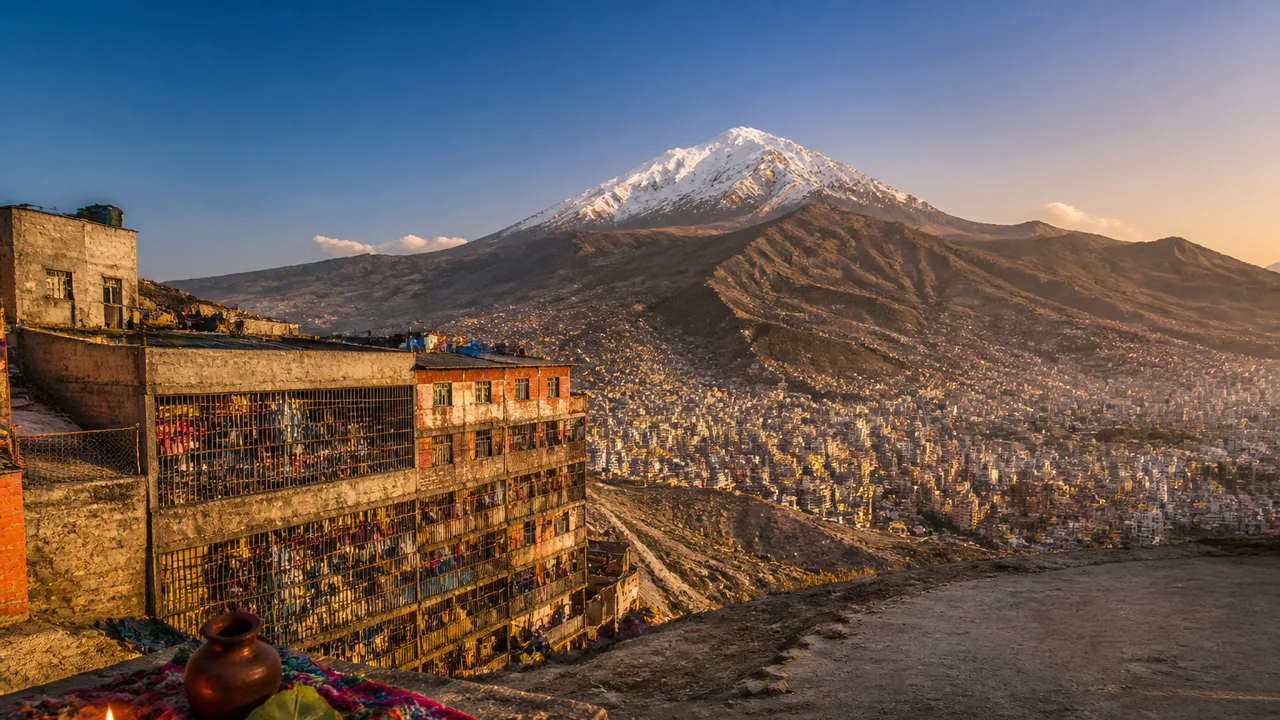
Photo: AI. Asha Kingsley
The airport in El Alto, which serves La Paz, sits at roughly 4,200 metres above sea level. Before you've collected your luggage, your body has already registered a complaint. This is the entry condition for the world's highest administrative capital — not a dramatic mountain vista or a ceremonial welcome, but an immediate, physiological negotiation between your cardiovascular system and an atmosphere that contains about 40 percent less oxygen than the air at sea level. Locals, whose bodies have adapted over generations with elevated red blood cell counts, watch tourists move slowly and breathe carefully with what one imagines is patient familiarity.
In a recent video for the Indigo Traveller channel, New Zealand-based travel creator Nick visits La Paz with local guide Willy and works through the city systematically — altitude, architecture, prison, culture, food, economy — in the way that street-level travel journalism often does better than formal reporting: by simply asking people things and filming what happens. What emerges is a portrait of a city that resists easy summarization.
A City That Operates on Its Own Logic
Start with the buildings, because the buildings tell you something important immediately. Across La Paz, the majority of structures are bare brick — unrendered, unpainted, visually incomplete. This is not an aesthetic choice or a resource constraint in the usual sense. It is, as Willy explains in the video, a rational response to a tax system that levies higher rates on finished properties. Leave the facade unplastered, skip the paint, keep a few edges rough, and your tax bill shrinks. The incentive is so consistent that it has produced a city-wide visual texture: a skyline of permanent incompletion.
Nick notes the paradox directly: "I'm unsure why the government would want to give an incentive to people to not finish their buildings, because obviously then you have unfinished buildings all over the city." It is a fair observation. Tax policy shapes urban form in every city — this particular distortion just happens to be unusually visible. The finished buildings, the ones with painted facades and helipads and replicas of the Statue of Liberty emerging from their rooflines, are the exception. They belong to a different economic tier entirely, events venues and banquet halls that generate enough revenue to absorb the higher tax burden.
San Pedro: The Prison That Isn't, Quite
In the geographic center of La Paz stands San Pedro Prison, and it warrants careful handling. Built in the 1890s to hold a few hundred people, it now holds thousands. What makes it internationally notable — and what has attracted journalists, academics, and, for a period, actual paying tourists — is its internal governance structure. Guards do not enter. Inmates administer everything themselves: cell rental markets, food stalls, restaurants, a football pitch, schools, and nurseries where prisoners' children live and are educated.
The economic hierarchy inside mirrors the one outside. Drug lords occupy what the video describes as "luxury suites with hot tubs and cable TV." Those without resources occupy rat-infested corners. Protection money flows upward. Cocaine is reportedly manufactured inside the walls and distributed beyond them. The institution functions less as a correctional facility than as a parallel economy operating under different rules, contained within a city that is itself navigating significant economic strain.
The story of Thomas McFadden — a British-Tanzanian smuggler arrested in 1996 who eventually began charging tourists for guided tours through the prison, reportedly sending them home with samples of in-house cocaine, and who ultimately bribed his way to freedom — has been widely documented, including in the book Marching Powder, co-written with journalist Rusty Young. Whether San Pedro's current internal conditions resemble its 1990s incarnation is harder to verify from street level, and Nick's video engages with its history rather than claiming direct access to its interior.
"I don't know if you could really call this a prison," Nick says. "At this stage, it's basically a huge criminal enterprise right in the center of La Paz, the capital."
That framing — accurate as far as it goes — still invites a follow-on question: what does it mean for a state to effectively outsource the management of its incarcerated population to the incarcerated population itself? Whether this represents a failure of institutional capacity, a pragmatic accommodation, or something more complicated depends on who you ask and what data you trust.
Pachamama, Catholicism, and the Space Between
Bolivia is constitutionally a secular state, but La Paz operates spiritually in a register that formal secularity doesn't quite capture. When Nick asks Willy about the city's dominant religion, the answer is instructive: "It's a mix of different religions, especially Catholic plus Aymara culture. When we talk about culture, we talk about mother earth, about Tata Inti, which is the sun. We talk about the mountains like Illimani, the most famous. So it's a combination between culture and Catholic mixing both."
This layering — Andean cosmology threaded through Catholic practice — has deep historical roots. Spanish colonization imposed Christianity across the region beginning in the sixteenth century, but indigenous spiritual systems were never fully displaced. They persisted, adapted, and in many cases fused with Catholic ritual in ways that produced something genuinely distinct. Pouring a small measure of beer onto the ground before drinking, as an offering to Pachamama, is not a tourist performance; it is, for many Bolivians, simply what you do.
More complex is the tradition Willy describes around major construction projects. The belief, as he explains it, is that significant structures — large buildings, bridges, public infrastructure — require a human sacrifice offered to Pachamama as both blessing and protection for the workers. The scale of the offering corresponds to the scale of the project: a baby llama for a modest house, something larger for a skyscraper. Construction workers have reportedly refused to work on sites where no sacrifice has been performed. "They say, 'No, no, no. Call me later. Call me when you've got a dead,'" Willy explains.
The mechanism Willy describes — illegal drinking establishments where people are plied with alcohol until they lose consciousness, then handed off to project managers for burial under foundations — is presented as reported practice rather than verified fact. Bolivia's National Institute of Statistics and formal anthropological literature would be worth consulting before treating this as documented reality rather than persistent urban narrative. What is beyond dispute is that the belief in Pachamama's requirement of sacrifice is deeply embedded in Andean cosmology, that animal sacrifices for construction projects are documented and common, and that the boundary between symbolic and literal sacrifice is one that different communities have drawn differently across history. The human sacrifice claims, specifically, deserve the same skepticism one would apply to any extraordinary claim — not dismissal, but context.
Coca Leaves and Their Complicated Position
The coca leaf sits at the precise center of several overlapping realities in La Paz simultaneously. It is an ancient Andean plant with genuine medicinal and ceremonial significance, used across the region for altitude sickness, spiritual ritual, and daily sustenance. It is also the raw material for cocaine, and Bolivia is, by multiple estimates, the world's third-largest producer of the drug. The plant is legal in Bolivia. The refined product is not, but the DEA has maintained a contentious presence in the country for decades, and Bolivia expelled the agency in 2008 under President Evo Morales, partially restoring cooperation later.
Street markets sell flavored coca leaf preparations — banana, classic, and, with some irony of packaging, "criminal" — alongside 96-percent-proof alcohol in plastic bottles retailing for the same price as a local bus fare. The market does not editorialize.
The Cable Cars and the Question They Leave Open
Above all of this — quite literally — runs the Mi Teleférico network, a Swiss-engineered cable car system that connects La Paz's dramatically vertical neighborhoods. The city's topography makes conventional transit slow and politically vulnerable; when protests block streets, the cable cars continue operating overhead. Nick is visibly impressed: "It looks like you're on another planet or something."
The system is, by most accounts, a genuine infrastructure success: affordable, efficient, expansive. It serves the poorer, higher-altitude neighborhoods of El Alto as readily as the wealthier southern zones. That a city navigating serious inflation, political instability, a prison it cannot govern, and a construction tax policy that incentivizes unfinished facades also built one of the more functional urban transit systems in South America is the kind of contradiction that makes La Paz hard to reduce to a single narrative.
A taxi driver Nick and Willy encounter works sixteen to eighteen hours a day, five in the morning until ten or eleven at night. Asked whether he is happy with the current state of Bolivia, he says yes — then qualifies it with the equanimity of someone who has made a durable peace with uncertainty: "Sometimes it's raining, sometimes not. Sometimes he's lucky, sometimes not. Sometimes he has a job, sometimes not. But in general, he's okay."
Whether that acceptance reflects resilience, resignation, or something that doesn't translate cleanly into either category is the question La Paz keeps posing, from its altitude on down.
More Like This
Air New Zealand's Business Class Dilemma
Air New Zealand's new business class faces criticism for its lack of privacy and direct aisle access, raising questions about its competitive edge.
Mapping the Invisible Paths of Knowledge Transfer
Explore the dynamics of knowledge transfer and its principles, from Silicon Valley success to forgotten technologies.
Inside Argentina's 7-Generation Working Estancia
Estancia La Tomasa near Buenos Aires has welcomed guests since 2023. Here's what a weekend on this 140-year-old working ranch actually looks like.
Driving Patagonia's Route 40: What Van Life Actually Looks Like
Kara and Nate drove 2,000 miles across Patagonia in 8 days. What they found reveals the gap between van life mythology and Patagonian reality.
California's "Don't Stop" Towns Have a Deeper Story
A viral video warns drivers not to stop in 12 California towns. The crime stats are real. So is everything the warning leaves out about the people who live there.
Ancient Amazon Civilizations Revealed by Archaeology
LiDAR mapping and new excavations are overturning the myth of a pristine, empty Amazon—revealing cities, roads, and millions of lost inhabitants.
Airport Behavior That Makes Flying Worse for Everyone
From gate lice to baggage claim crowding, Mark Wolters of Wolters World maps the airport habits that slow everyone down—and why they persist.
Basic French Phrases That Help Tourists in France
A handful of French words can shift how locals treat you in France. Here's what actually matters, and why the effort carries more weight than fluency.