One Day of Cooking, One Week of Meals Done
Dollar Tree Dinners' Rebecca makes 8 freezer-friendly meal preps in a single afternoon—no rush, no perfection, just a genuinely doable system.

Written by AI. Marcus Obi
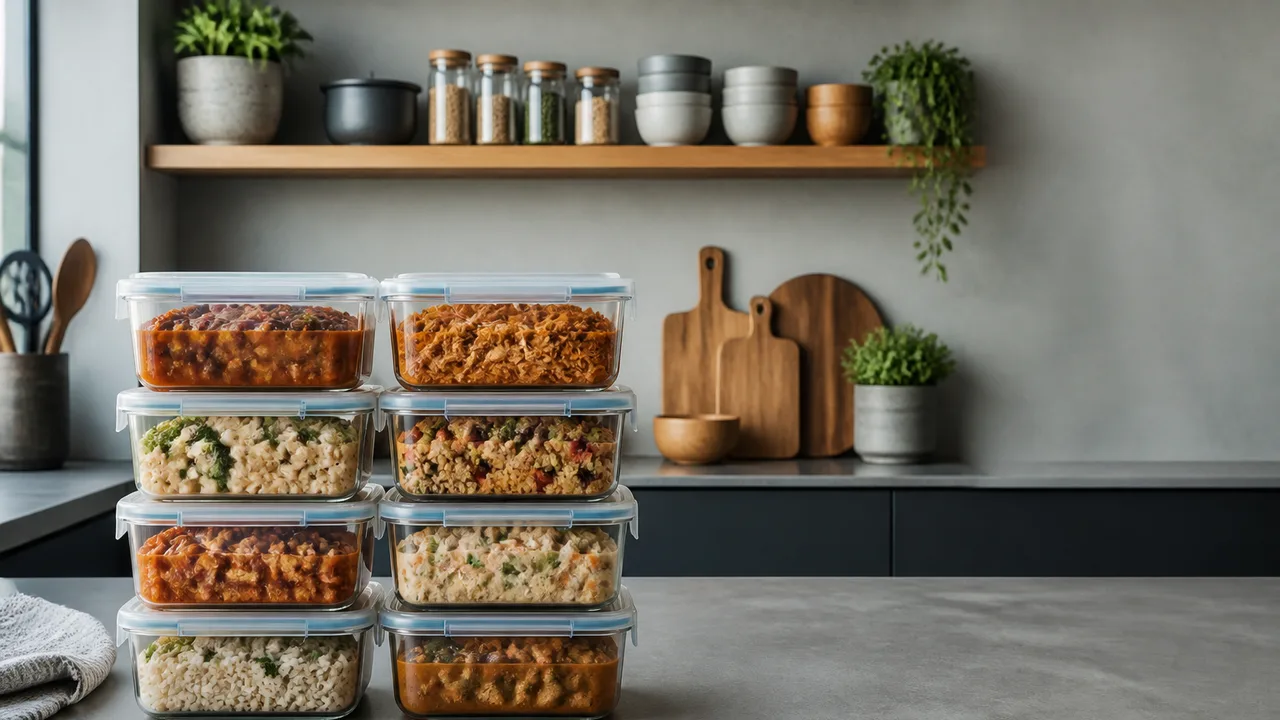
Photo: AI. Hayden Cross
There's a version of meal prep content that makes me want to lie down and never enter a kitchen again. The matching glass containers. The color-coded macros. The person who somehow looks refreshed after a six-hour cooking session. It's aspirational in the same way a triathlon is aspirational—technically possible, practically not for the parent who's already running on three hours of sleep and a cold cup of coffee.
Then there's Rebecca from Dollar Tree Dinners, whose approach to a full week of food prep feels less like a wellness ritual and more like something a real person actually did on a Saturday. Her recent video—46 minutes of unhurried, honest cooking—walks through eight meals made in a single afternoon: three breakfasts, five lunches and dinners, all designed to be reheated and eaten across a busy week.
The difference in tone is immediate. "I like to kind of relax while I do this and not rush," she says at the top. That's it. That's the whole ethos. No optimization framework. No timer ticking in the corner.
The System, Such As It Is
What Rebecca is doing isn't complicated, but it is thought-through. The session starts around 11 a.m. with a slow cooker going—chicken breasts, bell peppers, onion, salsa, and taco seasoning—because that's the thing that needs the most time and the least attention. Slow cooker chicken enchiladas will be the last thing packed up, nearly five hours later, once the chicken is pull-apart tender and ready to be rolled into flour tortillas with red enchilada sauce.
Everything else happens around that anchor. A 48-ounce bag of popcorn chicken goes into the oven early because it'll serve double duty: half for Country Chicken & Biscuits bowls (biscuits made last week and pulled from the freezer), half for "Not So Famous" bowls—her homemade riff on KFC's Famous Bowl, complete with instant mashed potatoes elevated with butter and sour cream, canned corn, and a mixed gravy made from one packet of brown gravy mix and one of chicken gravy mix.
The prep intelligence is in the cross-utilization. Peppers and onions appear in nearly every meal—sliced for the slow cooker enchiladas, diced for the omelette bowls, sautéed as fajita veggies for chipotle burrito bowls, folded into unstuffed pepper bowls with Italian sausage and leftover pizza sauce from a previous week. By buying a few bell peppers and working them across the whole session, Rebecca gets variety without waste and without a grocery list that requires a spreadsheet.
Rice gets cooked once—enough for three rice-based meals across multiple servings—in a rice cooker while the teriyaki chicken marinates in the fridge. The chicken teriyaki itself uses a doubled sauce recipe from Woks of Life (linked in the video description), seared in a screaming-hot pan until golden and glossy.
The breakfast lineup covers three different moods: the gravy-forward comfort of Country Chicken & Biscuits, a McGriddle-in-a-bowl built on frozen blueberry pancakes with sausage crumbles and scrambled eggs (syrup added at reheat time), and a meat-lover's omelette bowl with roasted potatoes, sausage, bacon, shredded cheddar, and green onions. All three lean on components made in advance or prepped in parallel—eggs scrambled in one big batch, sausage crumbled from Banquet links rather than a sausage roll, potatoes roasted alongside vegetables destined for other meals.
The Honest Parts
What makes this watchable—and, frankly, more useful than most meal prep content—is that Rebecca narrates her own imperfections in real time rather than editing them out.
She forgets to start the slow cooker first and has to double back. She acknowledges that the teriyaki came out a little salty because she used full-sodium soy sauce (and tells you exactly how to fix it). She openly admits she's exhausted by the time she gets to the last bowl: "I am for sure getting tired and tapping out, but we only have one more left to do."
She even cops to a small act of domestic independence: the "Not So Famous" bowls are explicitly for her. Her partner Michael, who appears throughout the video as a matter of household context rather than performance—the video makes clear they cook together and for each other regularly—doesn't love that one. Her response? "I think it's okay to make something that you exclusively enjoy, especially in this kind of a scenario where you're meal prepping like ready to eat meals." That's it. No guilt. No compromise bowl. Just a container labeled "Not So Famous" that's all hers.
The labeling system, by the way, is genuinely clever without being precious. Rebecca uses Cricut software to design simple text labels printed on waterproof vinyl—borrowed from her partner's small business supplies. The labels peel cleanly off the containers at the end of the week, no soaking required. It's a small logistical detail that pays off every time you open a fridge full of identical containers and can't remember which one is the enchiladas.
What Six Hours Actually Looks Like
The session wraps around 5 p.m. That's six hours, including breaks and cleanup, for eight different meals across multiple servings. Rebecca is careful to note she wasn't moving fast: "I could have definitely done this a lot faster if I had been a lot more strategic. But today I just wanted to relax and get it done, which we definitely did."
Six hours is a non-trivial chunk of a day. It's also, for a lot of families, the math that makes the rest of the week survivable. One afternoon of cooking means no decisions at 6 p.m. on a Tuesday. No "what do we have?" negotiation. No default to takeout because everything in the fridge is raw and nobody has the bandwidth to start from scratch.
There's also something quietly generous running through the video. Rebecca mentions she's been volunteering to cook lunches for a local high school robotics camp—up to twelve teenagers and adults, several days in a row, starting early in the morning. It comes up almost as an aside, framed as "cooking for community 2.0," something she clearly enjoys and plans to keep doing.
The meals themselves are built on the same logic as everything else she makes: inexpensive, adaptable, reheatable. The FAQ in the video description answers the practical questions directly—refrigerator storage up to seven days, freezer best within three to six months, most things reheat in one to two minutes with a stir halfway through. Every recipe can be doubled or tripled for larger households.
The Thing Worth Actually Thinking About
Meal prep content occupies a weird space. At its worst, it's productivity culture dressed in an apron—another arena where you're supposed to optimize, systematize, and never let a bell pepper go to waste because you didn't have a plan. At its best, it's just cooking smartly so that the week goes a little easier.
Rebecca's version sits clearly in the second category, and the distinction matters more than it might seem. The meals aren't aspirational. Country gravy from a packet. Instant mashed potatoes. Frozen popcorn chicken. These are ingredients that fit a budget and a schedule and a real refrigerator, not a content calendar.
The question her video quietly poses isn't "can you do this?" It's closer to: what would your week look like if you spent one afternoon making it easier? That's a different kind of aspiration—and a considerably more achievable one.
More Like This
Eckhart Tolle Says You're Not Who You Think You Are
Eckhart Tolle's 'historical self' vs 'deep eye' framework is either profound or a very elegant dodge. A parenting writer tries to figure out which.

Handwriting Beats Typing for Learning, Studies Find
New research shows handwritten notes improve memory and recall more than typing. Here's what the science says — and what it actually means for kids and parents.
Dr. K Walked Into Chaos and Won the Room
Dr. K's Tiger Belly appearance is a masterclass in social dynamics. Here's what the Charisma on Command breakdown gets right—and what it glosses over.

Practical Productivity Strategies That Actually Hold Up
A YouTube channel called Simple, Actually argues productivity is about wasting less, not doing more. Here's what the framework gets right—and where it gets complicated.

Five Patterns That Keep People Stuck, Examined
A recent video maps five behavioral patterns behind feeling stuck. Ellis Redmond examines the framework—what holds up, what it leaves out, and what's worth your attention.
The Sardine Fast: Metabolic Reset or Wellness Trend?
Thomas DeLauer breaks down the physiology of eating only sardines for three days. Here's what the science actually supports—and where the gaps are.

Making Studying Stick: The Psychology of Starting
A YouTube video promises you can get addicted to studying in 10 minutes. The psychology is mostly real. The missing piece is who gets to use it.

Your Childhood Coping Strategies Are Running Your Life
The marshmallow test wasn't measuring self-discipline. It was measuring trust. What that means for how we parent—and how we were parented.