The Sardine Fast: Metabolic Reset or Wellness Trend?
Thomas DeLauer breaks down the physiology of eating only sardines for three days. Here's what the science actually supports—and where the gaps are.

Written by AI. Kira Yoshida
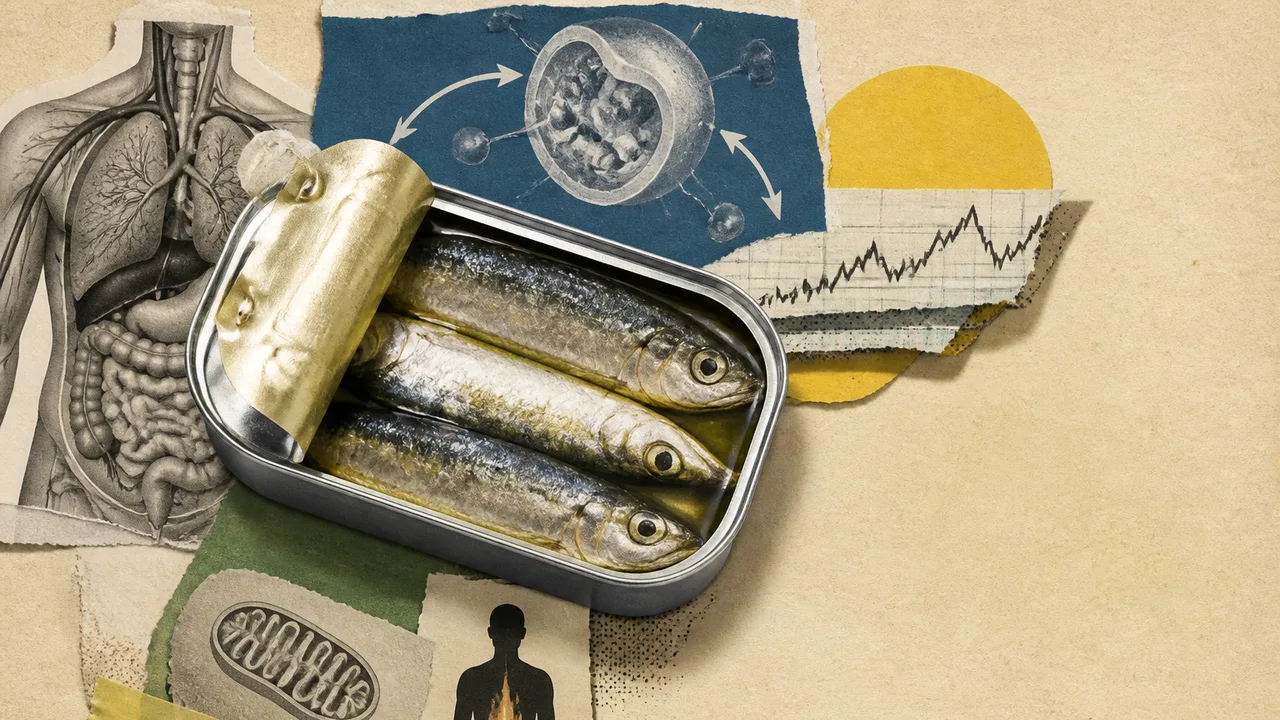
Photo: AI. Wren Sugimoto
Somewhere between "legitimate metabolic intervention" and "thing you tell your coworkers about and immediately regret," there exists the sardine fast. Three days. Nothing but tinned fish. And according to fitness creator Thomas DeLauer's recent deep-dive video, the physiology behind it is more interesting than the premise deserves.
Let's take that seriously for a minute—because the underlying science actually is interesting, even if the protocol itself lives in a neighborhood adjacent to the wellness-industrial complex.
What DeLauer is actually arguing
The pitch isn't that sardines are magic. It's that sardines are an unusually complete food that happens to be nearly carbohydrate-free. A single tin delivers roughly 20 grams of complete protein, a substantial hit of EPA and DHA omega-3s, vitamin B12 at several times the daily requirement, selenium, CoQ10, calcium (from the soft bones), and vitamin D. Calorie count for the whole day? DeLauer estimates around 600–700 if you're eating sardines and basically nothing else.
That combination—nutrient-dense, essentially zero carbs, very low total calories—is doing specific metabolic work. Drop dietary carbohydrates and your blood sugar stays flat. Flat blood sugar means low insulin. Low insulin means glucagon, its counter-regulatory hormone, starts climbing. And glucagon is the signal your body uses to start mobilizing stored fat and converting it into ketones your liver can export as fuel.
"That combination right there—nutrient-dense, carb-free, and calorie-light—is the whole magic trick," DeLauer says in the video. "You're nourished and fasting at the same time."
That framing—nourished and fasting at the same time—is actually the crux of what makes this different from a water fast, and it's worth examining on its own terms.
The fasting mimicking connection
DeLauer anchors the sardine fast to research by Dr. Valter Longo (he spells it "Walter" in the video, but the reference is to the USC longevity researcher), whose work on fasting-mimicking diets has been genuinely influential. Longo's research has shown that keeping calories low while modulating carbohydrate and protein intake can drop not just insulin, but also IGF-1—a growth factor that, when chronically elevated, is associated with accelerated cellular aging. The downstream effect is autophagy: the cellular recycling process where your cells identify and break down damaged proteins and organelles.
Here's where DeLauer is admirably honest about the limitations of his own argument. A textbook Longo-style fasting-mimicking protocol deliberately keeps protein lower to suppress that IGF-1 signal. Sardines, being protein-rich, don't fully satisfy that requirement. As DeLauer acknowledges: "A sardine-only run isn't like a perfect fasting-mimicking protocol. It's more of a fasting-mimicking adjacent, very low-carb, calorie-restricted ketogenic state."
That's a meaningful distinction. It doesn't necessarily sink the argument—you can still get autophagy benefits through caloric restriction and ketosis without perfectly mimicking Longo's exact macro ratios—but it does mean the sardine fast isn't interchangeable with the clinical protocol. They're related, not identical.
Day by day: what the physiology looks like
DeLauer walks through the three-day experience with enough physiological specificity to make it useful, whatever you think of the protocol.
Day one is mostly unremarkable. Your body is still burning through stored glycogen, insulin hasn't fully bottomed out yet, and the satiety from all that protein and fat means most people don't feel the hunger they expect at 600 calories. There's some literature suggesting that calcium from food (here, from the bones) and omega-3s both influence satiety signaling—DeLauer references research suggesting we eat partly in response to calcium needs, which is a genuinely interesting if still-debated area of appetite science. By evening, glycogen is running low and you might feel a transitional energy dip, but you're heading to bed anyway.
Day two is where things shift. Overnight, the liver finishes ramping up ketone production. The brain, which can run on ketones, now has a different fuel source than it's used to. People consistently report a distinctive subjective quality to this state—a calm, clear, low-static kind of focus rather than the jittery alertness of caffeine. Whether that subjective experience maps onto measurable cognitive improvement is an active area of research, but it's not fabricated. Researchers including Dom D'Agostino (who DeLauer references, though the transcript phonetically mangles the name) have published work on ketones as a neurological fuel, particularly in contexts of metabolic stress.
Underneath that clarity, several things are happening simultaneously: visceral fat (the metabolically active, organ-adjacent fat associated with metabolic disease) is being mobilized for fuel; liver fat is decreasing as the liver pulls from its own stores; and insulin sensitivity is beginning to recover from the chronic signaling it receives during a standard diet. Autophagy is also ramping up—though the exact magnitude relative to a true extended fast is unknown territory.
Day three is characterized by deeper ketosis, stable energy, and effectively no hunger. DeLauer notes you've been continuously nutrient-replete the whole time, which distinguishes this from extended water fasting where micronutrient and electrolyte depletion become legitimate concerns around the same timeframe.
The refeed phase and where the sponsored content lives
The video makes a reasonable physiological point about the refeed: Walter Longo's research indicates that the period after a fast, when the body shifts from cleanup to regeneration, matters as much as the fast itself. Reintroducing food carefully—DeLauer recommends starting with lean protein and keeping fats lower initially—makes sense from a basic metabolic standpoint. You want to avoid a large bolus of fat and carbohydrates crashing back into a sensitized system.
That said, this is also where the video pivots to a sponsored segment for a whey protein supplement. Worth flagging because the transition is load-bearing for the argument: you need high-quality protein to break the fast properly, the branded product is high-quality, therefore. It's a clean funnel, not a hidden one—DeLauer discloses the partnership—but it's worth reading the supplement recommendation as commercially motivated rather than independently derived.
The honest questions the video doesn't raise
The sardine fast, as presented, is a reasonable short-term metabolic intervention for generally healthy adults who are curious about extended caloric restriction and ketosis. The underlying mechanisms are real. The nutrient profile of sardines genuinely is exceptional. Three days at 600–700 calories in a state of nutritional ketosis will produce measurable changes in insulin, liver fat, and circulating ketone bodies. That's not pseudoscience.
But a few things get underdiscussed:
Who this is not for. Any kind of multi-day caloric restriction protocol carries real risks for people with a history of disordered eating, people on medications that are sensitive to blood sugar shifts, those who are pregnant or nursing, or anyone with a relevant underlying condition. DeLauer doesn't address this in the video.
The evidence gap is real. There's no direct study of a sardine-only fast. The video is, as DeLauer himself notes, a thought experiment assembled from adjacent research areas—fasting-mimicking diet literature, ketosis research, and autophagy studies. Each of those fields is legitimate. The combination, applied to sardines specifically, is extrapolated rather than tested.
Sustainability vs. novelty. Three days of metabolic stress-and-reset probably does something. Whether it does something meaningfully different from simply eating well, training consistently, and sleeping adequately over a longer period is a question the video doesn't attempt to answer. The appeal of acute interventions is partly that they're legible—you can feel them happening, you can track the days. Chronic lifestyle choices are harder to attribute and harder to sell.
The mercury question. Sardines are generally considered low in mercury compared to larger fish because of their short lifespan and low position on the food chain. But eating nothing but sardines for three days means eating quite a lot of them. This seems worth at least acknowledging.
None of this makes the sardine fast useless or dangerous for most people. But the video's framing—confident, mechanistic, enthusiastic—doesn't leave a lot of room for "we genuinely don't know the magnitude of this effect in humans doing this specific thing."
The science DeLauer is citing is real. The logic connecting sardines to fasting-adjacent metabolic benefits is coherent. The leap from "these mechanisms exist" to "here's exactly what will happen to you hour by hour" is where extrapolation starts doing a lot of the heavy lifting.
Whether that gap bothers you probably depends on your prior relationship with uncertainty—and with tinned fish at 7am.
More Like This

How to Stop Losing Time Without Realizing It
Not a time management overhaul—just a clearer look at where your hours actually go, and what's worth doing about it.

Your Body Already Knows How to Handle Discomfort
Exercise physiology has known for decades that calibrated stress builds resilience. So why does the wellness industry keep selling you comfort instead?

Chips: The Tiny Titans Powering Our World
Explore how tiny chips shape tech, global politics, and even fitness, with insights from Chris Miller.
Morning Routines: Intention, Gratitude, and a Dash of Skepticism
Explore morning routines focusing on intention and gratitude, with a critical look at wellness industry promises.

Morphic Resonance: The Science Orthodoxy Tried to Burn
Rupert Sheldrake's morphic resonance theory was publicly burned by academia—while the U.S. military quietly funded similar research. Col. Morrison investigates.
Fasting and Connective Tissue: What the Science Shows
A 2024 Nature Metabolism study tracked 3,000+ proteins during a 7-day fast. The findings on collagen remodeling and muscle preservation are harder to dismiss than you'd expect.

Eckhart Tolle Says Know Less. Your Body Already Does.
Eckhart Tolle's case for 'not knowing' as spiritual awakening has real overlap with movement science—and a $139/year subscription attached to it.

Why Proving 1+1=2 Took Mathematicians 362 Pages
Whitehead and Russell spent 362 pages proving 1+1=2. Their story is about what happens when you actually audit the axioms everyone told you were obvious.