McDonald's Rare Footprint Across Africa, Explained
McDonald's operates in just four African countries. Corruption, cold-chain failures, and the wrong potato explain more than you'd expect.

Written by AI. Raj Mehta
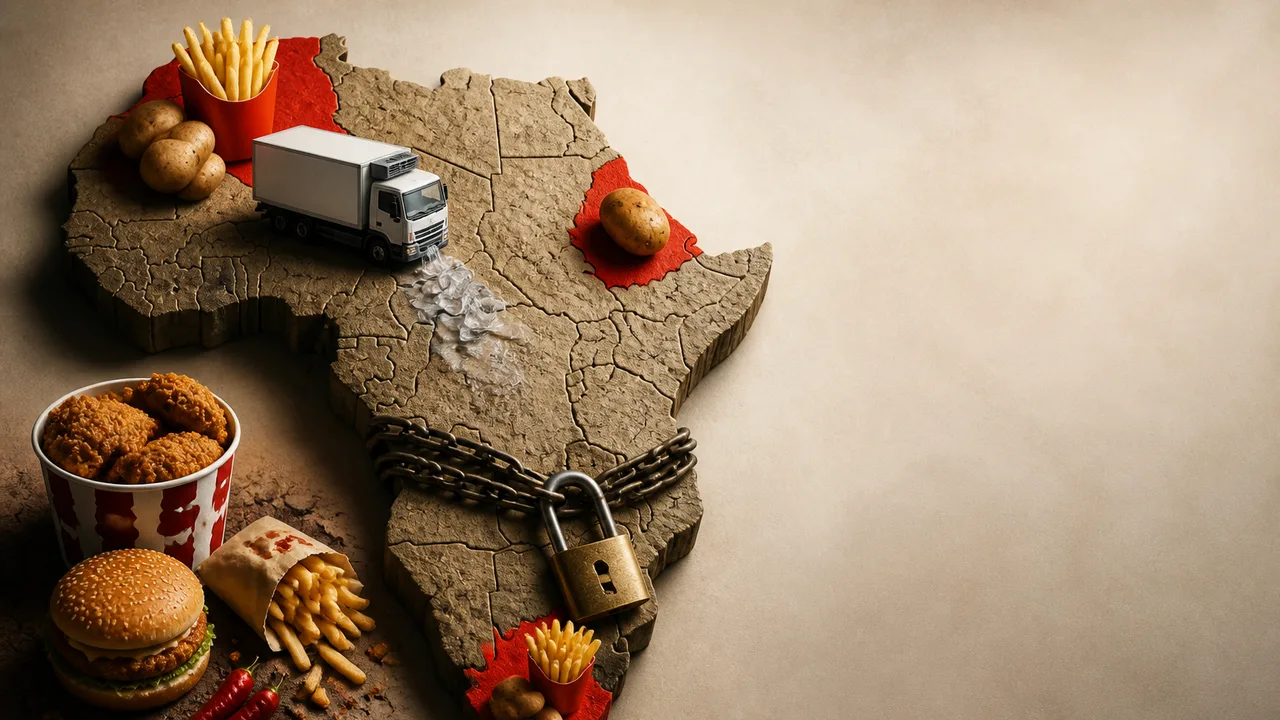
Photo: AI. Ines Cienfuegos
McDonald's has a location a few steps from the Vatican. It operates in the Negev Desert. It serves fries somewhere in the Arctic Circle. It has, by its own past accounting, opened a new restaurant somewhere on earth roughly every three hours. The company runs more than 40,000 locations across something like 100 countries.
And yet, across a continent of nearly 1.5 billion people — a continent with fast-growing cities, expanding middle classes, and populations that clearly have appetite for American fast food — McDonald's has managed to plant its golden arches in exactly four countries: Morocco, South Africa, Egypt, and Mauritius. KFC, by contrast, operates in more than 25 African countries. Burger King is there. Domino's is there. Even Pizza Hut made it.
So the question isn't whether Africa wants fast food. It clearly does. The question is what, specifically, keeps McDonald's out — and what that tells us about how global brands actually move through the world, as opposed to how they say they do.
A recent video by YouTube channel fern works through the explanation carefully, and it's worth following the logic, because each layer reveals something the previous one doesn't.
The Tunisia story, which is really a story about power
McDonald's tried to enter Tunisia in the 1990s. Not half-heartedly — the company spent seven years preparing: market research, licenses, supply chains, a local franchising partner. Then the deal collapsed. Tunisia's ruling family, the Ben Ali clan, wanted the franchise for themselves. Their reported message to McDonald's was direct: "Choose the right partner or face the consequences." McDonald's walked.
This is the corruption layer, and it's real, but it's also incomplete as an explanation for McDonald's absence across the continent. What happened next in Tunisia is more instructive. In 2009, a US ambassador attended a dinner at the home of the Tunisian president's daughter and her husband — a lavish beachfront affair, reportedly complete with a pet tiger — where some arrangement around McDonald's entry was apparently back on the table. Then, in December 2010, Mohamed Bouazizi set himself on fire in the street. The Arab Spring arrived. The Ben Ali government fell. The family fled into exile. Tunisia's economy never fully stabilized. McDonald's still has no presence there.
The lesson isn't simply "corruption bad." It's that when a company's market entry depends on proximity to a regime's inner circle, it also inherits that regime's political mortality. McDonald's, in an unusual way, made the right call by refusing the initial terms — and then found itself locked out anyway by events no spreadsheet anticipated.
The potato problem, which is really a supply chain problem
Here is where the analysis gets more interesting, and more technically specific.
McDonald's standardization is not a marketing posture. It is the actual operational spine of the company. The fry you eat in Seoul is supposed to be the same fry you eat in São Paulo — same texture, same color, same internal fluffiness. Achieving that requires approved potato varieties: the Russet Burbank, the Shepody, the Innovator, the Zorba. These are grown primarily in the US, Canada, and Europe. In most of Africa, they are not cultivated at commercial scale.
That matters because McDonald's preference is always to source locally. In Germany, most of its potatoes come from German farms. But local sourcing only works if the local crop is the right crop — and often in Africa, it isn't.
The fern video points to a 2022 episode that crystallized the problem. KFC Kenya ran out of fries after supply chain disruptions cut off its Egyptian potato imports. The chain refused to substitute locally grown Kenyan potatoes, which sparked genuine public fury. One Kenyan commentator's words capture the frustration precisely: "According to KFC, these potatoes — these beautiful African potatoes, these beautiful Kenyan potatoes — are not considered as potatoes to KFC."
Kenya is the fifth-largest potato producer in Africa. Potatoes are the country's second most consumed staple crop. The issue wasn't quality in any common-sense meaning of the word. The issue was that the dominant local variety, the Shangi, doesn't behave the way a fast-food fry is supposed to behave when dropped in a fryer. It doesn't crisp the right way. It fails the textural specification. And no global chain has yet invested seriously in developing or introducing approved varieties at scale for African growers — which is a choice, not a geographic inevitability.
The cold chain problem, which is really an infrastructure problem
Beyond the potato question lies something more fundamental: temperature.
Consider Nigeria. Population of more than 230 million. One of Africa's largest economies. Home to KFC, Burger King, and Domino's. No McDonald's.
The fern video frames Nigeria as "the ultimate end boss for a reliable cold chain." A cold chain is simply a temperature-controlled supply system — the trucks, warehouses, and monitoring infrastructure that keep perishable food at safe temperatures from origin to kitchen. For beef patties, this chain cannot be interrupted. Ever.
Lagos averages around 34 degrees Celsius. Power outages are frequent. When the grid goes down, a frozen burger patty can thaw within hours. Nigeria is also geographically enormous — nearly twice the size of Spain — with infrastructure that includes flooded roads, degraded surfaces, and terrain that complicates any tight logistics timeline.
McDonald's internal calculus, as reported in the fern video, appears to be that rather than entering the highest-difficulty markets first, the chain will work toward them incrementally — targeting smaller markets where cold chains are more manageable, building operational experience, and approaching Nigeria when the infrastructure math changes. One executive is quoted framing the goal as not "chasing the big gold" before the conditions support it.
This is, on one level, rational risk management. On another level, it raises a question the video gestures toward without quite naming: is McDonald's absence from Nigeria a reflection of Nigeria's infrastructure gaps, or is it also a reflection of McDonald's own unwillingness to invest in building the infrastructure that would allow entry? KFC, after all, is already there. So is Domino's. The cold chain challenge is real, but it is not prohibitive for every chain — only for a chain that won't adjust its product to reduce the cold chain dependency.
Why KFC is winning, and what it suggests
KFC's approach in Africa inverts McDonald's model in one crucial respect: it leads with chicken, which is locally sourced across the overwhelming majority of its African operations. Chicken has shorter production cycles, lower feed costs, and more accessible supply chains than beef. It is also, as of 2024, the most consumed meat across the continent. KFC Ghana serves jollof rice. KFC adapts its menu where it needs to.
McDonald's knows all of this. The chain has been moving toward chicken-based offerings in several markets as global beef prices rise. Whether a genuinely chicken-forward African expansion strategy is under active development isn't publicly confirmed — but the logic is available.
What's striking about the KFC comparison is what it exposes about McDonald's self-imposed constraints. The brand's power rests on standardization. But that standardization — the approved potato varieties, the beef-centric menu, the unbroken cold chain requirements — is not neutral infrastructure. It is a set of choices built around supply chains that originate in the Global North, and those choices carry real costs when the chain tries to move south.
Where this ends up is genuinely open. McDonald's has demonstrated, in Morocco and South Africa, that it can adapt: halal menus, Ramadan offerings, a franchise model that elevated a future head of state. South Africa alone had over 400 McDonald's by 2025. The mechanism for expansion exists. What doesn't exist yet is the willingness to absorb the investment and flexibility that a serious continental push would require.
The most interesting version of this story isn't about golden arches and missed opportunities. It's about what the conditions for a global brand's arrival actually reveal about a market — and what that brand's sustained absence reveals about the brand itself.
More Like This

Brand Authority Is Pricing Power—and Finance Knows It
Ryan Deiss's five brand "authority triggers" map onto real financial metrics. A global markets reporter translates what that actually means for valuations and beyond.
Uganda Vanilla Could End the Price Chaos
Madagascar's vanilla monopoly has wrecked small business budgets for decades. Uganda's emerging industry might finally offer the stable supply chain Main Street needs.
GameStop's $56B eBay Bid: What the Math Actually Says
GameStop bid $56B for eBay despite a $12B market cap. We broke down the financing—shares that don't exist, a non-binding bank letter, and a CEO incentive worth examining.

What 10 Million Cold Emails Reveal About Selling
Austin Schneider sent 10M cold emails and found 6 patterns that actually drive replies. Here's what globally-minded sellers need to know—and where the framework breaks.
Egypt's New Delta Project: Green Miracle or Mirage?
Egypt is engineering a new Nile in the desert. But satellite data, groundwater depletion, and a troubling history raise urgent questions about who this is really for.

Fast Food Price Increases and the Data Strategy Behind Them
Fast food prices have surged well past inflation—but labor costs are only part of the story. The bigger driver is a deliberate shift in business strategy and data.

Kevin Warsh's First FOMC Meeting Signals a Quieter Fed
Kevin Warsh held rates steady at his first FOMC meeting, but his communication overhaul and hawkish signals are already reshaping global markets.
Dubai and Egypt Holidays Undercut Europe on Price
Package holidays to Dubai and Egypt are cheaper this summer than European alternatives, as geopolitical jitters and rising costs reshape where British families travel.