GameStop's $56B eBay Bid: What the Math Actually Says
GameStop bid $56B for eBay despite a $12B market cap. We broke down the financing—shares that don't exist, a non-binding bank letter, and a CEO incentive worth examining.

Written by AI. Raj Mehta
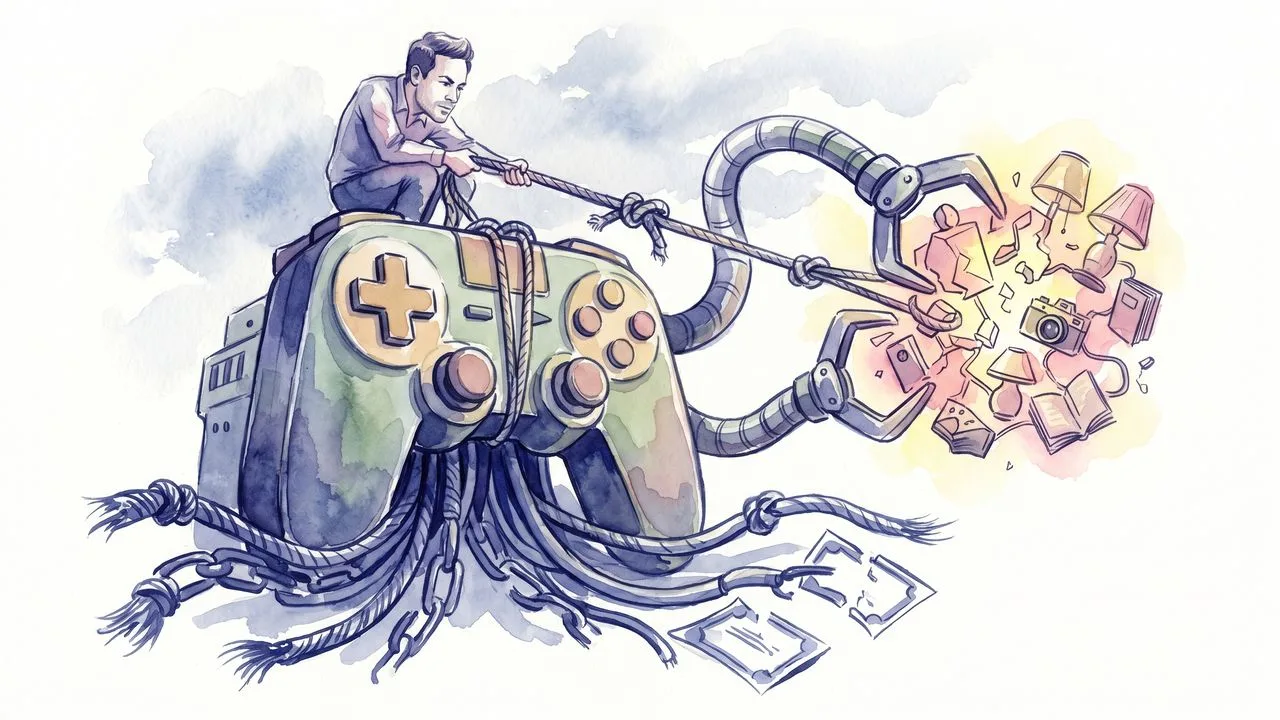
Photo: AI. Júlia Almeida
On a Sunday evening, GameStop—the retailer still in the business of selling physical video game discs to a world that has largely stopped buying them—announced a $55.5 billion unsolicited bid to acquire eBay. GameStop's own market capitalization sits at roughly $12 billion. The company is closing nearly 500 stores. It recently reported a 14% drop in quarterly revenue.
eBay, for its part, has 135 million active buyers, posted 17% sales growth in the first quarter, and has seen its stock climb over 130% since the start of 2024. So this is not a case of a predator circling weakened prey. This is the other thing.
Finance YouTuber Patrick Boyle spent 32 minutes last week working through why this deal is structured the way it is, and what that structure actually reveals. It's worth following the logic carefully, because the numbers tell a specific story.
The Financing, Piece by Piece
GameStop CEO Ryan Cohen described the deal on CNBC Monday morning as "half cash, half stock." When pressed for detail by Andrew Ross Sorkin and then Becky Quick on how a $12 billion company funds a $56 billion acquisition, Cohen repeatedly responded that the details were on the company's website. As Boyle observed, it was "like watching a man try to exit a conversation by walking into the same locked door over and over again."
So here is what is actually on the website. The funding breaks into three parts.
First, $9.4 billion in cash and liquid assets. According to reporting by the FT's Robin Wigglesworth, that figure includes $6.3 billion in actual cash, $2.7 billion in what GameStop describes as "liquid investments" (unspecified), and approximately $368 million in Bitcoin. The cash is mostly cash. That part holds up.
Second, a $20 billion loan. TD Bank has provided what the industry calls a "highly confident letter"—a document in which a bank states that it is highly confident it could arrange financing, without actually committing to do so. Boyle notes the historical significance of the instrument: in the 1980s, these letters carried real weight because they came from Drexel Burnham Lambert, backed by Michael Milken's junk bond apparatus. TD Securities is a credible institution. It is not that. More to the point, GameStop itself cannot service $20 billion in debt—its estimated EBITDA is around $469 million, and it already carries $4 billion in existing debt. The $20 billion would need to be secured against eBay's cash flows, meaning GameStop is proposing to use eBay's own balance sheet to fund its own acquisition.
Third, $28 billion in newly issued GameStop stock. This is where the structure gets genuinely interesting. At GameStop's current share price of around $24, delivering $28 billion in stock requires issuing more than one billion new shares. GameStop's corporate charter authorizes one billion shares in total, of which 448 million are already outstanding. The shares needed to complete this transaction do not currently exist and are not currently authorized to be created. Shareholder approval would be required to change that—approval that had not been sought before the announcement was made.
Who Ends Up Owning What
Bloomberg's Matt Levine, in his Money Stuff column, identified the structural consequence of this share issuance that explains a great deal about why Cohen was reluctant to work through it on live television.
If GameStop issues roughly one billion new shares to pay eBay's existing shareholders, those former eBay holders would end up owning approximately twice as much of the combined company as GameStop's current shareholders would. GameStop has 448 million shares outstanding. After the issuance, legacy GameStop investors would hold a minority position in their own company's acquisition. As Boyle frames it, "This is not really GameStop buying eBay. It's closer to eBay accidentally acquiring GameStop with Ryan Cohen volunteering to be the CEO of the new company."
This matters for a specific reason beyond optics. In January, GameStop's board granted Cohen a performance-based stock option package worth up to $35 billion if the company hits a market capitalization of $100 billion and $10 billion in cumulative EBITDA within ten years. GameStop is currently worth $12 billion. Reaching $100 billion organically—through selling used games and closing stores—is a distant prospect. Reaching $60 billion by acquiring a $46 billion company and then growing modestly is considerably more achievable.
Cohen told CNBC his compensation was "designed to align his interests with shareholders." Becky Quick suggested it might instead be designed to align his interests with a very large number. Cohen said he didn't understand the question.
In the corporate governance literature, Levine notes, this pattern—CEOs pursuing scale rather than return on invested capital—is called empire building, and it is generally considered a misalignment of incentives rather than a feature.
The Strategic Rationale
There is a business logic to the combination, and it deserves a fair hearing before being dismissed.
Cohen's argument is that GameStop's 1,600 physical US locations can serve as a national infrastructure layer for eBay—drop-off points for authentication, intake, and fulfillment for high-value collectibles. The vintage Rolex doesn't get mailed to a central hub; it walks in through the GameStop door on the high street. Boyle acknowledges this is "not a terrible idea."
The complications are practical rather than conceptual. GameStop is currently closing nearly 500 of those 1,600 locations. Building a national authentication network on a contracting footprint is structurally difficult. There are also questions about whether GameStop's retail staff are equipped to authenticate luxury goods—though, as Boyle notes, they likely do know their way around a rare Pokémon card, "and a vintage Rolex is really just a Pokémon card for people who wear suits."
The rest of the cost-cutting plan—Cohen proposes $2 billion in annual savings, primarily by cutting $1.2 billion from eBay's sales and marketing budget and $500 million from general and administrative costs—is more straightforwardly aggressive. Slashing the marketing budget of a consumer marketplace that competes with Amazon and a dozen vertical platforms is a move that can improve short-term EBITDA while creating longer-term problems. Whether those problems land in year two or year five is the open question.
The Shareholder Math and the Proxy Problem
Cohen told the Wall Street Journal that if eBay's board resists, he is prepared to run a proxy fight—taking the offer directly to shareholders. This is standard hostile takeover language. The wrinkle is that the deadline for nominating director candidates ahead of eBay's upcoming annual meeting had already passed by the time the announcement was made.
His 5% economic stake in eBay, which he cited as leverage to force board engagement, turns out to consist of 25,000 actual shares of eBay stock and a portfolio of American-style put and call options. A corporate board's fiduciary duty runs to its actual shareholders, not to parties holding derivatives on the stock price.
On Reddit's SuperStonk, the retail shareholder community received the CNBC interview enthusiastically. The prevailing theory was that Cohen was deliberately stonewalling Sorkin as payback for CNBC's years of skeptical GameStop coverage, and that substantive explanations would follow in friendlier venues—which apparently they did, in a subsequent Fox Business appearance with Charles Payne.
This dual-audience strategy is coherent if the goal is to maintain retail investor loyalty. It is less coherent if the goal is to persuade eBay's institutional shareholders—the fund managers who actually hold the votes—that this deal makes financial sense. Those investors are not on Reddit, and "it's on our website" is not typically the kind of capital allocation communication that moves them.
The Burry Exit
Michael Burry—the hedge fund manager who bet against the US housing market before 2008 and was portrayed by Christian Bale in The Big Short—sold his entire GameStop stake this week. Burry has a longer relationship with GameStop than most: he took a large position back in 2019, well before Ryan Cohen arrived, and began pushing the board for strategic changes. He was, in some sense, one of the people who put GameStop on the map for the retail investor community that later turned it into a meme.
Boyle's observation on the timing is dry: "Sometimes the smartest trade is just leaving."
What Burry's exit doesn't tell us is whether he's skeptical of this specific deal, skeptical of the stock's current valuation, or simply done with a position that has run its course. His exit is data, not argument. But the timing is notable.
The financing has holes, the proxy threat missed its deadline, the shares don't exist yet, and the business rationale rests on a store network that is currently shrinking. Whether eBay's board engages with this offer seriously, dismisses it outright, or uses it as negotiating leverage for something else entirely is now the question—and the answer will tell us something about how much Cohen's unconventional playbook can accomplish when the audience isn't retail investors, but fiduciaries.
More Like This
Your 401(k) Is About to Become AI's Exit Strategy
SpaceX, OpenAI, and Anthropic plan $170B in IPOs. New NASDAQ rules mean your retirement fund will buy them automatically—whether you want to or not.

OpenAI and Anthropic's Developer Tool Land Grab
OpenAI acquired Astral. Anthropic acquired Bun. Developers cheered one and panicked at the other. Here's what the different reactions actually reveal.
America's Economic Cycles: Reinvention or Stagnation?
Examining America's economic pivots every 80-90 years and their impact.
The Economic Cost of Singlehood
Exploring how the rise in singlehood leads to higher costs and challenges modern economies' adaptability.
OpenClaw Acquisition Raises Questions About Startup Exit Timing
Tech streamer Theo discusses OpenClaw's acquisition amid launch preparations, revealing the complex calculus behind when startups should sell versus building.
Block Just Cut Half Its Staff. Here's What That Means.
Jack Dorsey's Block laid off 4,000 employees despite growing profits. The reason reveals something fundamental about how AI is reshaping tech work.

McDonald's Rare Footprint Across Africa, Explained
McDonald's operates in just four African countries. Corruption, cold-chain failures, and the wrong potato explain more than you'd expect.
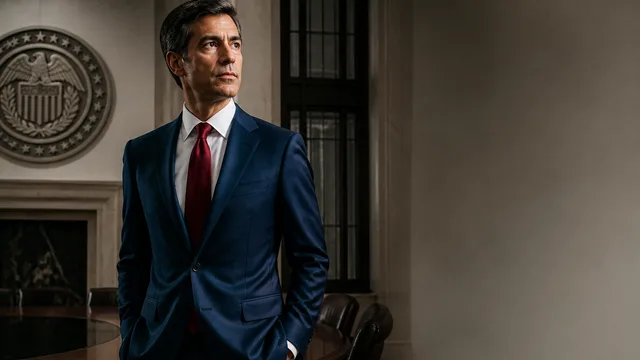
Kevin Warsh's First FOMC Meeting Signals a Quieter Fed
Kevin Warsh held rates steady at his first FOMC meeting, but his communication overhaul and hawkish signals are already reshaping global markets.