Sweet Potatoes and Potatoes Tell Different Food Histories
Sweet potatoes and potatoes share a name, but their plant families and journeys differ. Trace Indigenous cultivation, Pacific routes and colonial exchange.

Written by AI. James Morrison
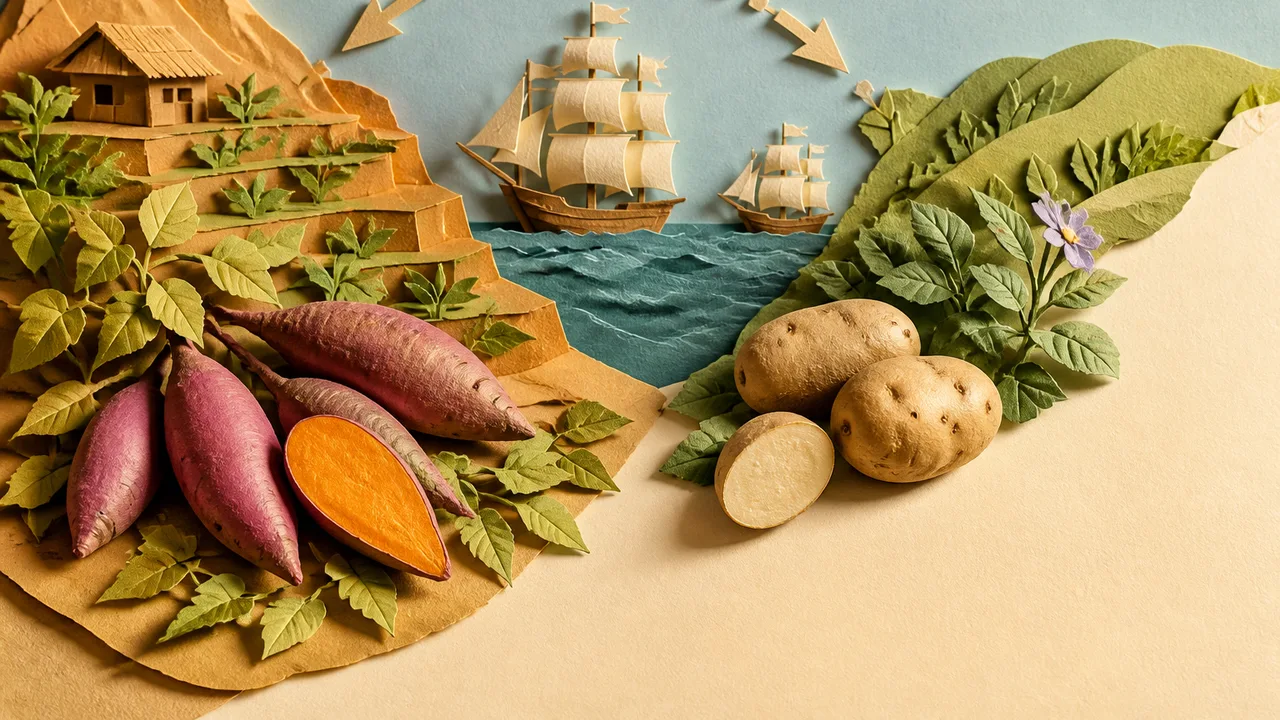
The shared English name of sweet potatoes and common potatoes reflects what cooks can do with them. It says little about how the plants evolved or how people carried them across oceans.
The sweet potato, Ipomoea batatas, belongs to the morning-glory family. The common potato, Solanum tuberosum, belongs to the nightshade family. They share a broader botanical order, Solanales, but sit in separate families. Even the parts we eat differ: a potato is a tuber formed from a stem, while a sweet potato is a swollen root. A recipe may put them in the same slot; a botanist would have considerably more paperwork to do.
Both crops originated in the Americas. Both became foods far beyond their places of origin. Those parallels make their separate paths more revealing, because the history of a crop involves more than its point of departure. People had to cultivate it, carry it, find ground where it would grow and decide what place it would take in a diet.
Two Plants, Two Starting Points
The common potato was domesticated in the Andes, where Indigenous agricultural knowledge shaped its long history before Europeans encountered it. That starting point matters when telling the later story of a European staple. The crop did not arrive from an empty landscape as a ready-made answer to hunger. Its cultivation began with people in the Americas who understood the land and worked with the plant over generations.
The sweet potato has its own American origins and a different agricultural history. Its morning-glory lineage and distinct cultivation needs complicate the shorthand of calling both crops simply “potatoes.” The Andean potato and the sweet potato could each become a valuable food without following the same route through fields or kitchens.
English names can flatten such differences. “Potato” is useful at a market stall, where buyers are concerned with what to cook for dinner. It is a poorer guide to ancestry. By the 1700s, “sweet potato” served to distinguish one crop from the other. The label records a practical distinction made by speakers of English, long after both plants had histories of their own.
Nor does botanical classification overrule the cook. A household can reasonably treat both as starchy side dishes, just as farmers and botanists can reasonably separate them. Trouble begins when a familiar food category becomes the whole explanation. Two crops can fill a similar role on a plate while making different demands on the people who grow them.
The Routes Out of the Americas
The potato’s spread into Europe belongs to the Columbian Exchange, the movement of crops, animals and people that followed European colonization of the Americas. From an Andean crop, it became a staple in parts of Europe and later traveled farther. The usual account of its success emphasizes what the plant offered new growers. The account also needs the earlier Indigenous cultivation that made that journey possible.
Europe’s reliance on the potato carried risks alongside its benefits. Ireland’s potato famine in the 1840s remains the stark example: crop failure became a human catastrophe within a political and economic order that shaped who had access to food. A staple can help sustain a population and still leave it exposed when harvests fail or institutions fail the people who depend on them. The plant alone cannot explain either outcome.
Sweet potatoes also traveled through the exchanges that followed colonization, but their Pacific history calls for a wider map. Polynesian oral traditions include accounts of the crop’s origins and movement. The precise routes by which sweet potatoes spread across the Pacific remain debated; those traditions make it difficult to tell the story as a simple shipment from the Americas to Europe and then outward again. People moved crops across that ocean within histories of exchange that deserve attention in their own right.
That distinction does not make the Columbian Exchange a minor event. European colonization remade diets on a vast scale and involved coercion and displacement as well as trade. It does mean that “the crop went global” is an ending, not an explanation. A route through Europe, a route across the Pacific and adoption by growers in a new region each involve different people making decisions under different conditions.
What a Shared Name Leaves Out
The two crops also met different receptions as they entered new agricultural settings. Sweet potatoes became popular in Mediterranean regions earlier, while the common potato followed another course through European agriculture. That contrast suggests a question more useful than which crop arrived first: what made people willing and able to grow, sell and eat each one?
Climate and cultivation needs are part of the answer. So are habits. A familiar method of cooking can help a new food find a place, while suspicion can slow its acceptance. Once a crop becomes ordinary, those decisions disappear from view. The potato in a European meal can look inevitable; the sweet potato on a holiday table can look as though it has always belonged there. Neither arrived in its later role by itself.
It is tempting to use the botanical divide as a neat correction to a common mistake. That would leave the larger history untouched. The family names tell us that these are separate plants. They cannot tell us who first cultivated them, whose knowledge traveled with them, or why one community embraced a crop while another took longer. For those answers, the field and the trade route belong beside the classification chart.
The language of a holiday meal offers one last caution. English puts both foods under “potato,” then adds “sweet” to distinguish one of them. That arrangement reflects the needs and habits of English speakers; it does not assign the common potato a greater claim on history. Each crop was already part of human life before it acquired its place in that vocabulary.
Set the two dishes side by side, and the shared name still works for dinner. Follow the plants backward, and it leads toward Andean cultivation, Pacific exchange and the colonial remaking of diets. The plate holds both histories, even when the menu has room for only one word.
More Like This

The KGB's Cyanide Newspaper Gun That Almost Worked
How a KGB poison weapon hidden in a rolled newspaper killed Ukrainian nationalist Stepan Bandera in 1957—and why one mistake unraveled the whole operation.

LIDAR Is Rewriting What We Know of Ancient Cities
Anthropologist Luke Caverns is planning the largest LIDAR scan ever done in the Amazon. What the technology finds may force a rewrite of ancient history.
Bodmin Moor's Bronze Age Village and Its Neolithic Cairn
Archaeologists confirm a Bronze Age village on Bodmin Moor—and find a 6,000-year-old cairn that may have outlasted the community that built it.

The Medici and the Borgia: Power, Banking, and Renaissance Italy
The Medici-Borgia rivalry was no simple feud. A look at how banking, papal power, marriage, and armies shaped Renaissance Italy's contested politics.
How the Continental Congress Named the United States in 1776
On September 9, 1776, Congress swapped 'United Colonies' for 'United States.' The name left the country's whole structure deliberately unresolved. Here's how.
Vodka and Pierogi: Poland's Food Identity Explained
Rick Steves and guide Tomasz Klepacki explore what Polish vodka and pierogi reveal about Polish identity, tradition, and the meaning of home-cooked food.
Genghis Khan: Rise, Conquest, and Contested Legacy
From orphaned steppe child to ruler of history's largest empire—Genghis Khan's life raises questions about violence, genius, and what conquest actually builds.
Queen Caroline's Arthurian Gambit and the Politics of Myth
In 1735, Queen Caroline built Merlin's Cave to tie the Hanoverian dynasty to Arthurian legend. The stakes were more than symbolic—they were strategic.