Sony’s Controller Payment Patent Maps a Storefront Shift
Sony’s controller payment patent could streamline PlayStation Store purchases, but its convenience, security and preservation tradeoffs remain unresolved.

Written by AI. Sarah O'Brien
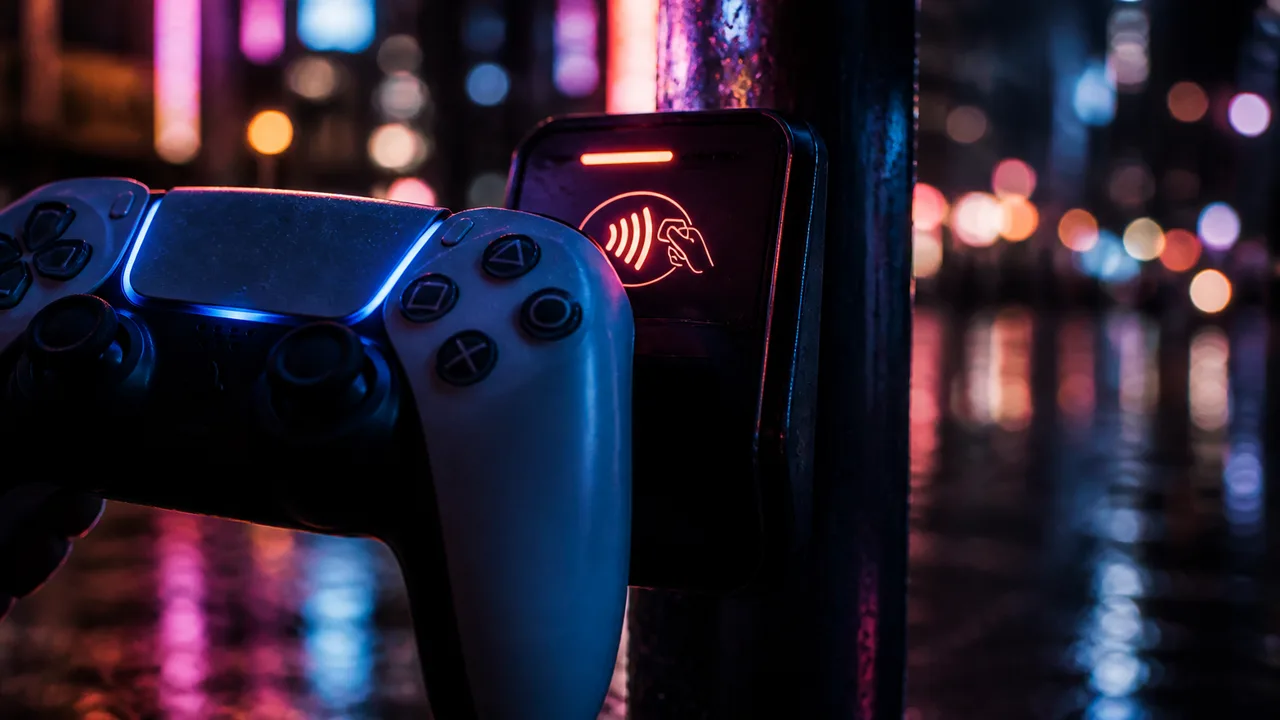
Sony filed a patent application describing a PlayStation controller that could carry payment information from a phone, credit card or gift card to a console.
The application, titled “Video Game Controller-Driven Information Transfer,” was filed in March 2025 and published on September 17, 2026. The reported document hands patent headlines a wonderfully silly prop: a DualSense moonlighting as a card terminal. That description captures the broad idea, but the application does not announce new hardware, confirm a PS5 feature or promise a commercial release.
That leaves a more useful question than whether your next controller will ask for a tip. What problem is Sony trying to solve by placing the payment handoff in the object players already hold?
What the Application Describes
The proposed process begins when a console requests payment information. In one example, the player brings a phone near the controller; the controller retrieves the information and passes it to the console. Sony identifies NFC and Bluetooth as possible communication methods, according to Dexerto’s account of the application.
Other examples cover credit cards and gift cards. One illustration reportedly shows a console recognizing a gift card and displaying its balance. The system could support purchases of games, add-ons and in-game credits. Another scenario puts the transaction after somebody tries a demo at a shop or gaming event, allowing the controller and console to carry the purchase forward.
The application reaches beyond checkout. The same connection could transfer a player ID or help a guest join a multiplayer session. That broader scope suggests Sony is considering the controller as a short-range bridge between an external object and the console, with payment as its most commercially conspicuous use.
Dexerto and Tom’s Hardware are reading the same patent application, not handling two working controllers on a laboratory bench. Tom’s Hardware reports that the drawings use a recognizable PS5 and DualSense, while stressing that patented ideas frequently remain paperwork. Neither account identifies a prototype, release schedule or Sony product announcement.
The dates supply some patent-history hygiene. Sony filed the application in March 2025, yet it became public in September 2026. The idea predates this week’s attention by a considerable margin. Publication created the news cycle; it did not establish that Sony had just begun developing a retail feature.
Two Forms of Convenience, Two Sets of Questions
A phone-mediated purchase has an intelligible consumer case. Entering card numbers with a controller is slow, and saving payment details to a shared console may be undesirable. Passing credentials from a nearby phone could remove the on-screen typing without requiring the console to retain the same information.
That last benefit remains conditional. Operation Sports argues that the phone route might let users avoid storing payment information on the console. The available descriptions do not establish how credentials would be tokenized, retained or protected in a finished implementation. A controller acting as an intermediary does not by itself prove that sensitive data becomes safer.
The direct-card scenario presents a different tradeoff. Bringing a card near the controller sounds effortless, but effortless purchasing needs deliberate authorization. Tom’s Hardware notes that it remains unclear whether a user would have to sign in before completing a transaction. Operation Sports raises the possibility of children or guests making purchases and argues that secondary checks would be needed.
Those concerns do not make short-range payment inherently reckless. A shipping system could require an account password, phone approval or another confirmation step. Each safeguard, however, restores some of the friction the patent appears designed to remove. Sony would have to decide where convenience stops and authorization begins.
Gift cards make the proposal easier to justify. Anyone who has entered a long redemption code with a directional pad knows that this corner of console design still carries the aroma of a 1990s television menu. Reading a nearby card and showing its balance could replace an error-prone transcription job, producing a concrete gain even if the final purchase still requires confirmation.
The Controller Becomes Part of the Shop Counter
The closest comparisons are already inside the application: typing information into the console, presenting a phone, tapping a card and scanning a gift card. These methods address related checkout problems while assigning different responsibilities to the controller.
Manual entry keeps the controller as an input device. The phone route turns it into a relay. A card tap asks it to participate in a payment flow. Gift-card reading makes it a redemption interface. These are small physical changes with larger software consequences because the controller would sit between the player, the account system and the PlayStation Store.
That architecture also clarifies the commercial logic. Fewer checkout steps may make purchases easier to complete. The application’s examples include games, credits, add-ons and purchases following demos, all points where a customer has already shown interest. It is reasonable to read the proposal as infrastructure for reducing storefront friction, although the reports provide no transaction data showing that it would increase spending.
Players could benefit from the same reduction. Convenience and commercial advantage can occupy one piece of plastic without cancelling each other out. The unresolved issue is whether Sony would preserve enough deliberate confirmation for a purchase to remain an informed act rather than an accidental tap.
The comparison also exposes a limit in the familiar “tap to pay” shorthand. A phone relay, a direct card read and a gift-card scan may look similar from the sofa, but they need not carry identical security requirements. Without implementation details, the patent coverage cannot establish what data the controller would receive, whether it would retain anything, or which device would authenticate the buyer.
A Patent is a Record, Not a Roadmap
Patent publications are valuable historical documents because they record what companies considered protecting. They are unreliable product catalogues. This application may describe a future controller feature, a defensive claim around an idea Sony never ships, or one component later implemented in another form.
That status also changes how the filing should be read. It documents a proposed relationship among controller, console, account and payment method. It does not demonstrate that the arrangement has passed security review, satisfied payment rules or survived the compromises required to become consumer hardware. A diagram can omit all the awkward bits that make a checkout trustworthy.
Preservation introduces another concern. If a future controller function depends on a phone application, account authentication and an operating storefront, preserving the hardware alone would not preserve the feature. The controller might survive while the service that gave its reader a purpose disappears. That outcome remains hypothetical because no implementation exists, but dependencies are easiest to document before servers close, not after the login screen becomes an epitaph.
For now, Sony’s filing records an ambition to move more identity and payment exchange through the controller. Whether that produces a better checkout, an easier route to accidental spending or another abandoned patent will depend on safeguards and software that the published descriptions cannot yet show. The filing puts the shop counter in the player’s hands; Sony has given no indication that it plans to open that counter.
More Like This
Quake Champions Turns Paid as Its Live Service Ends
Quake Champions now costs $9.99 as updates end. Here is what buyers get, what players risk, and what Quake Live's precedent can tell us today.

Lollipop Chainsaw's Movie Tests a Franchise Revival
The Lollipop Chainsaw film joins a sequel and anime, showing how a delisted cult game became a cross-media franchise without its original leads attached.

The Last of Us Part 2 Mod Cancellation: Who Owns a Finished Game?
Sony reportedly asked a fan PvP mod for The Last of Us Part 2 on PC to stay private weeks before launch. What the episode reveals about modding, control, and preservation.

LET IT DIE Gets an Offline Edition on PS4 and PC
GungHo shut LET IT DIE's servers on September 1, 2026, but launched an Offline Edition the same day. Here's what that means for the community.

Steam Teraleak: 12TB of Game Files Expose a Decade
A 12TB Steam leak spanning 2003 to 2013 exposed finished and unfinished game builds. Here's what it means for preservation, IP law, and small developers.

GTA 6's Deliberate Miss Mechanic Changes the Series
GTA 6 lets players deliberately miss shots to avoid killing cops and civilians. What this mechanic means now—and what it will mean when the servers go dark.

July 2026 Game Releases: Remakes and New IP
Halo remade again, Black Flag re-engineered, and a packed July of new releases arriving in GTA 6's shadow. What this month reveals about how the industry treats its catalog.
June 2026 Games: Preservation, Revival, and the Blacktop
Gothic 1 Remake, NBA The Run, Hell Let Loose Vietnam, and more—June's releases ask hard questions about what we save, what we lose, and why it matters.